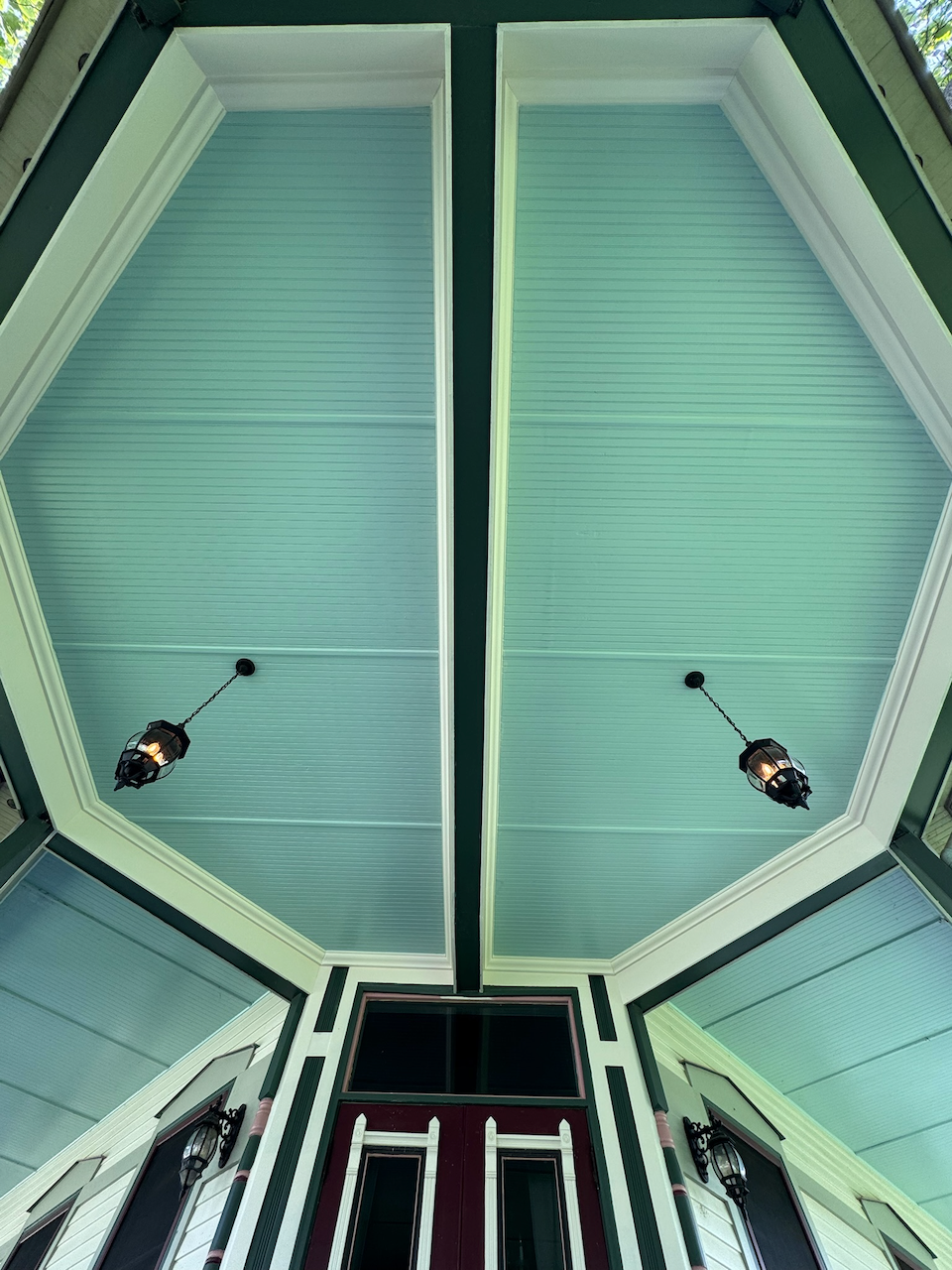
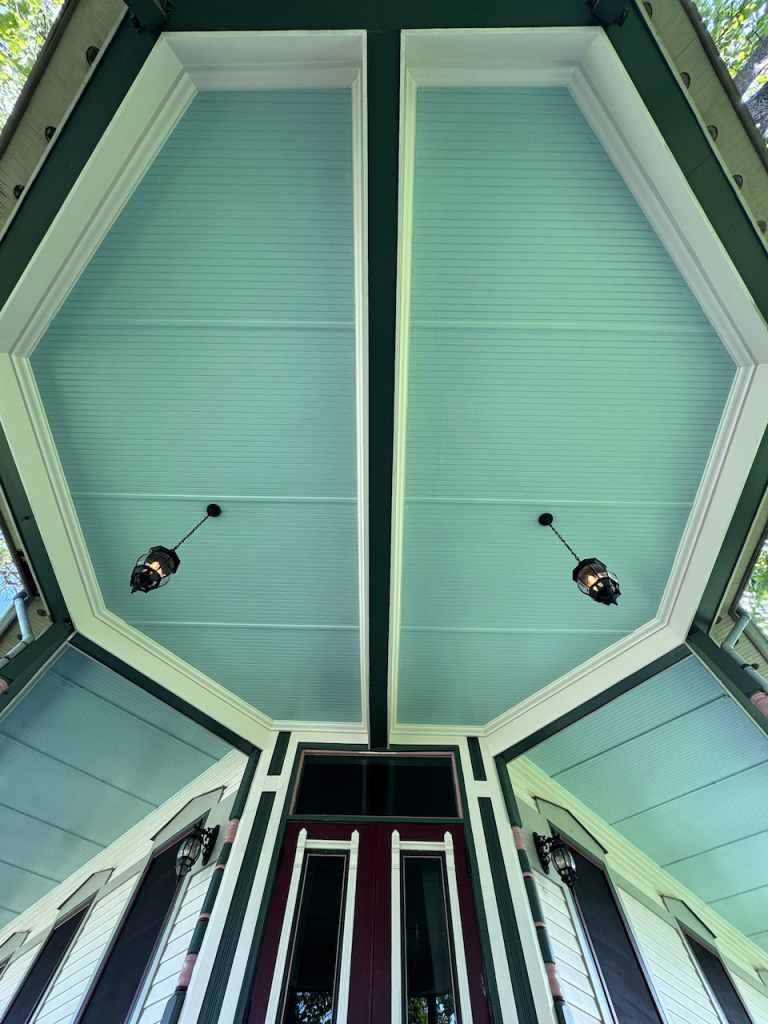
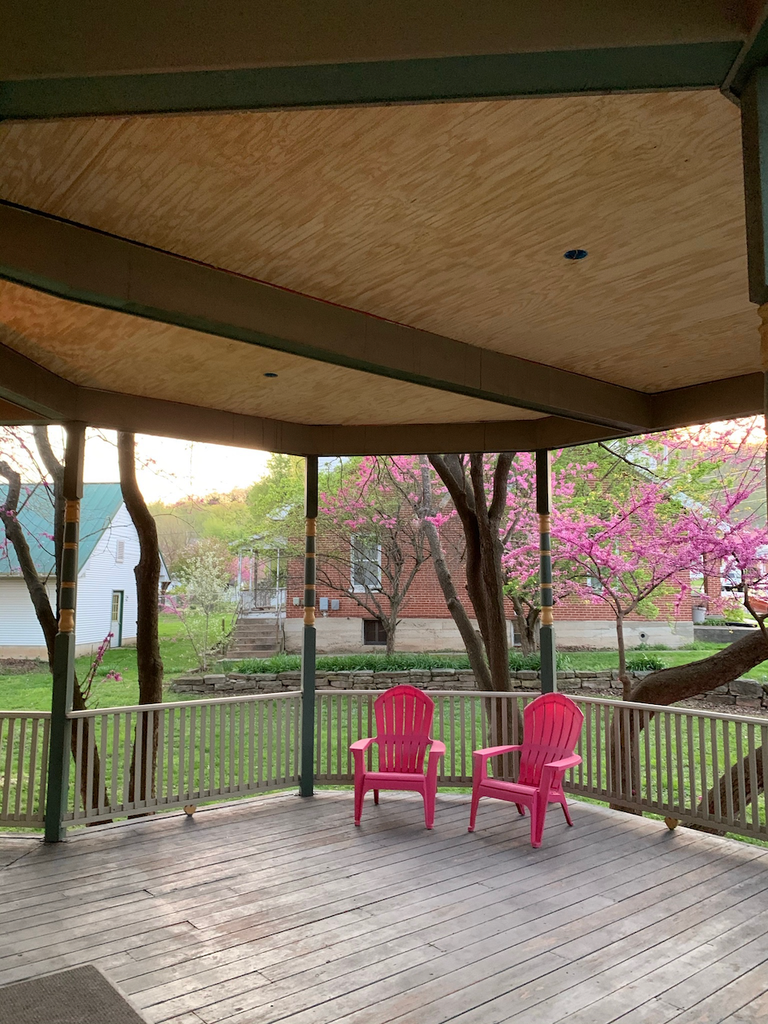
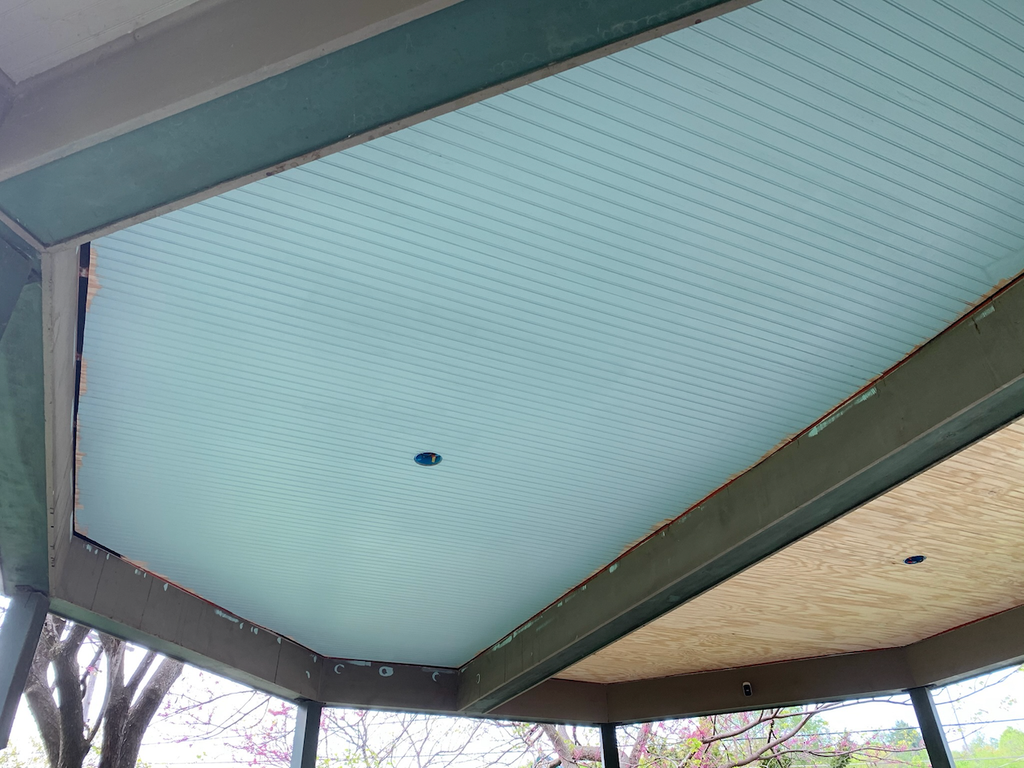
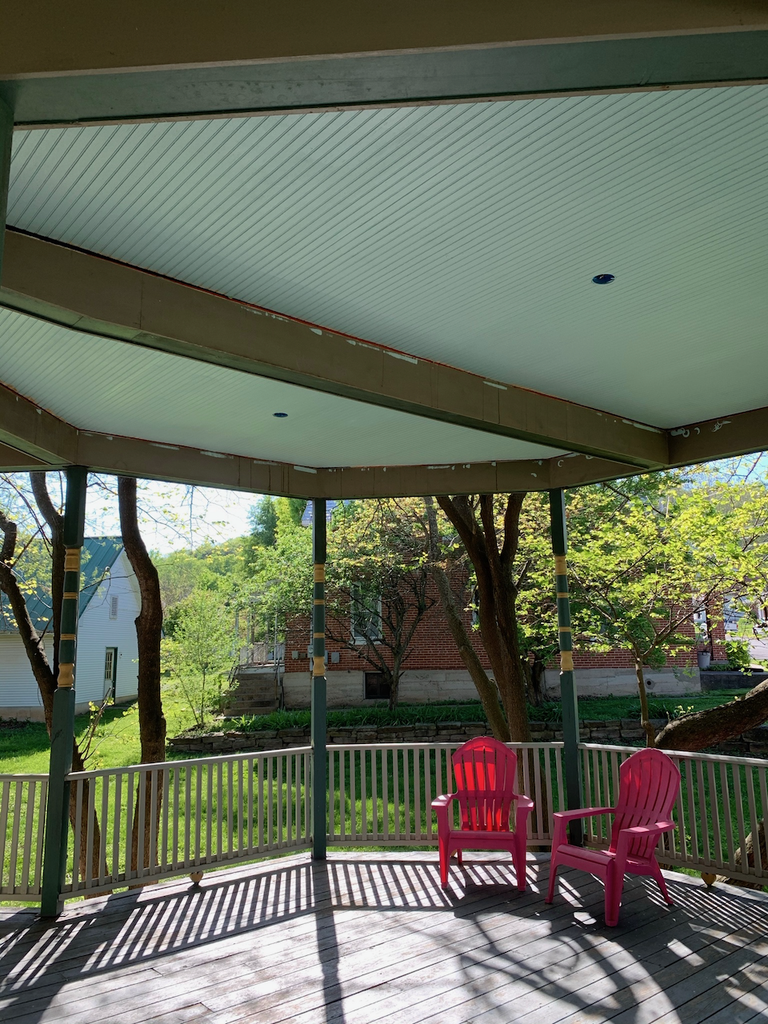
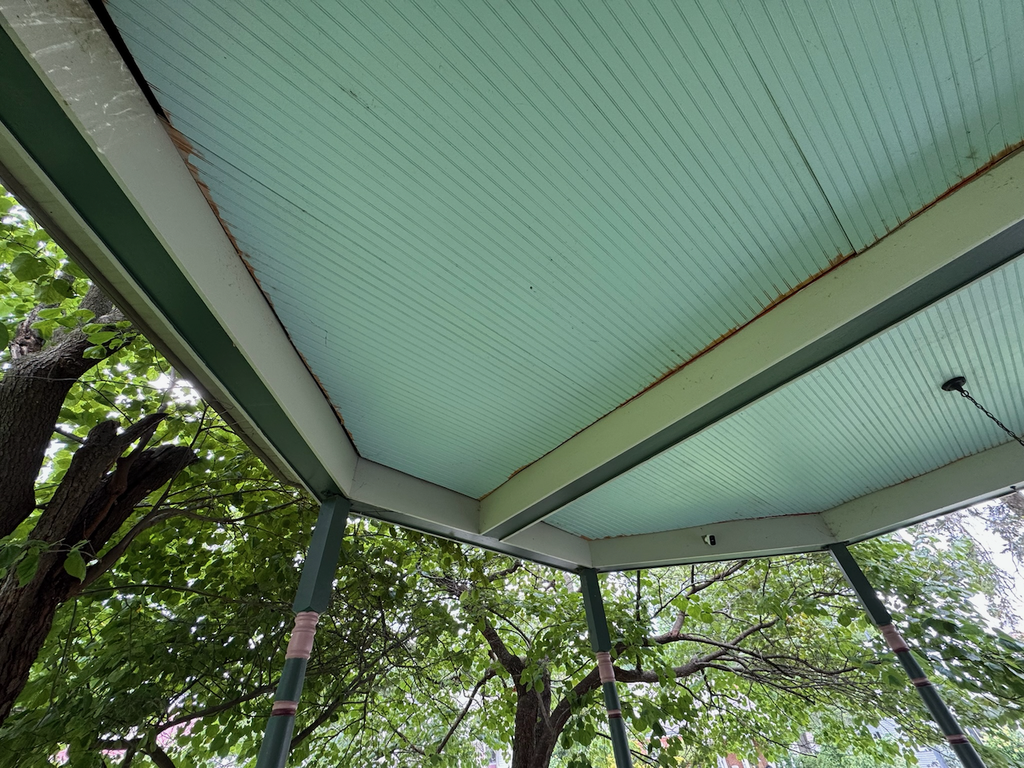
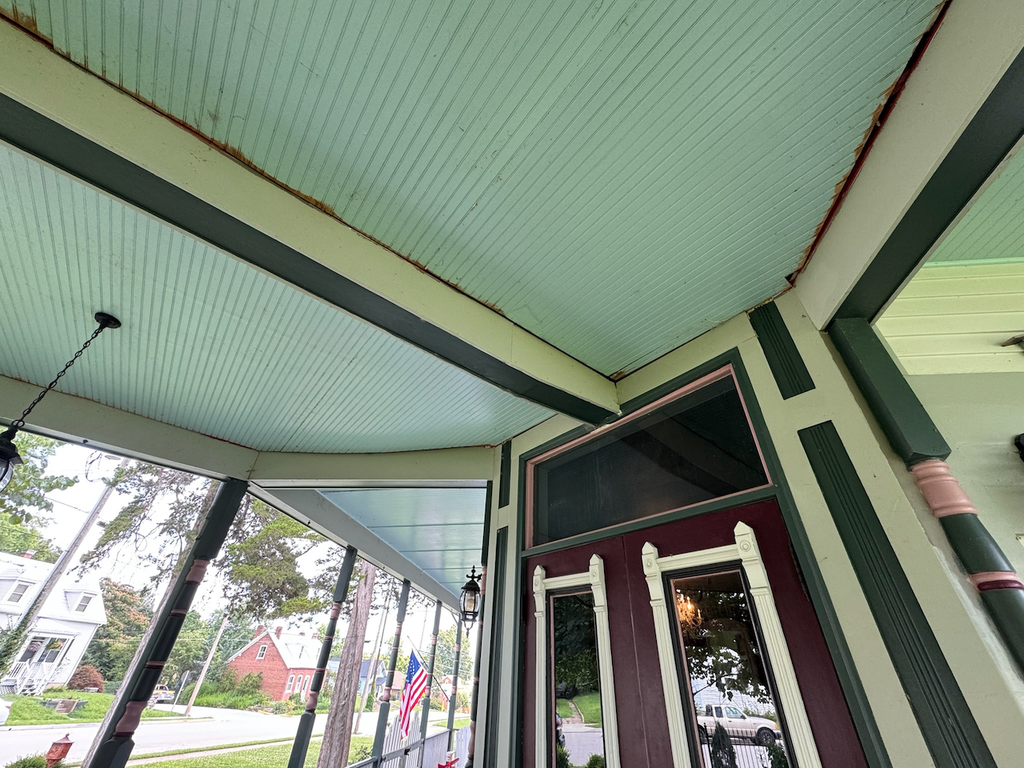
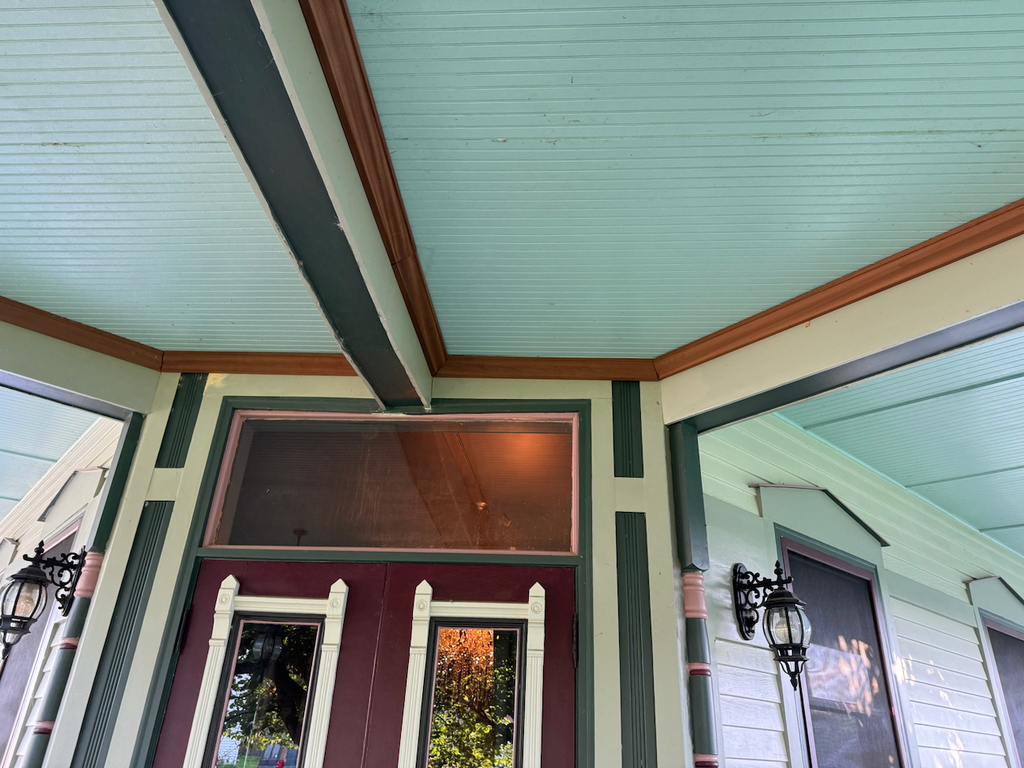
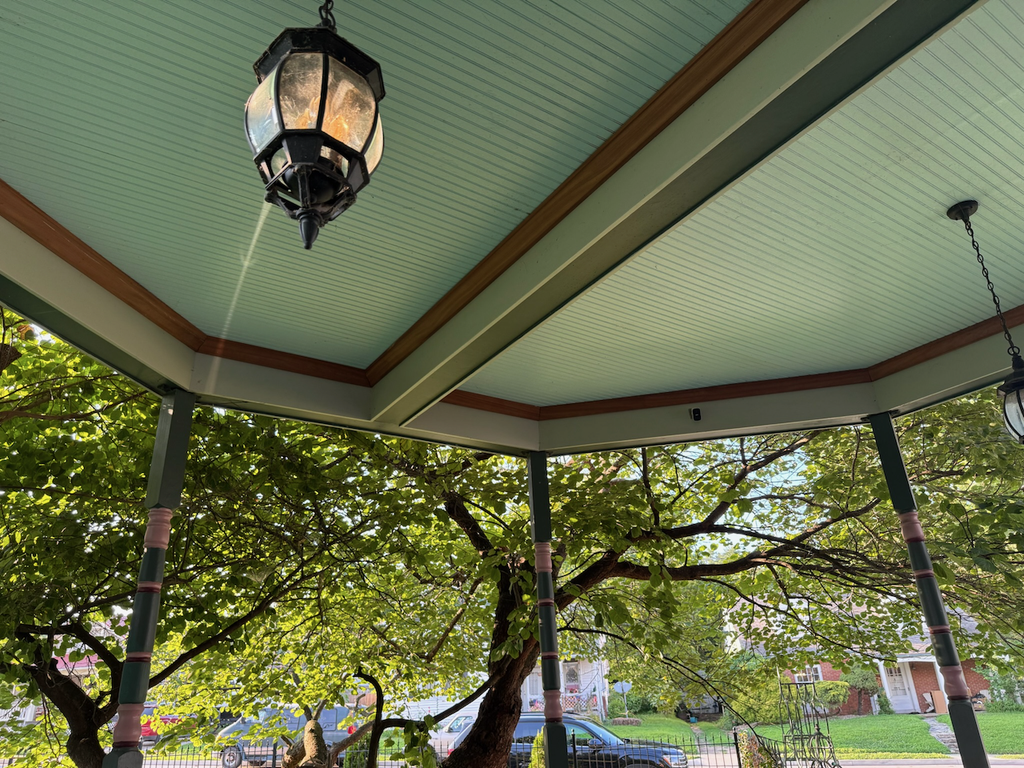
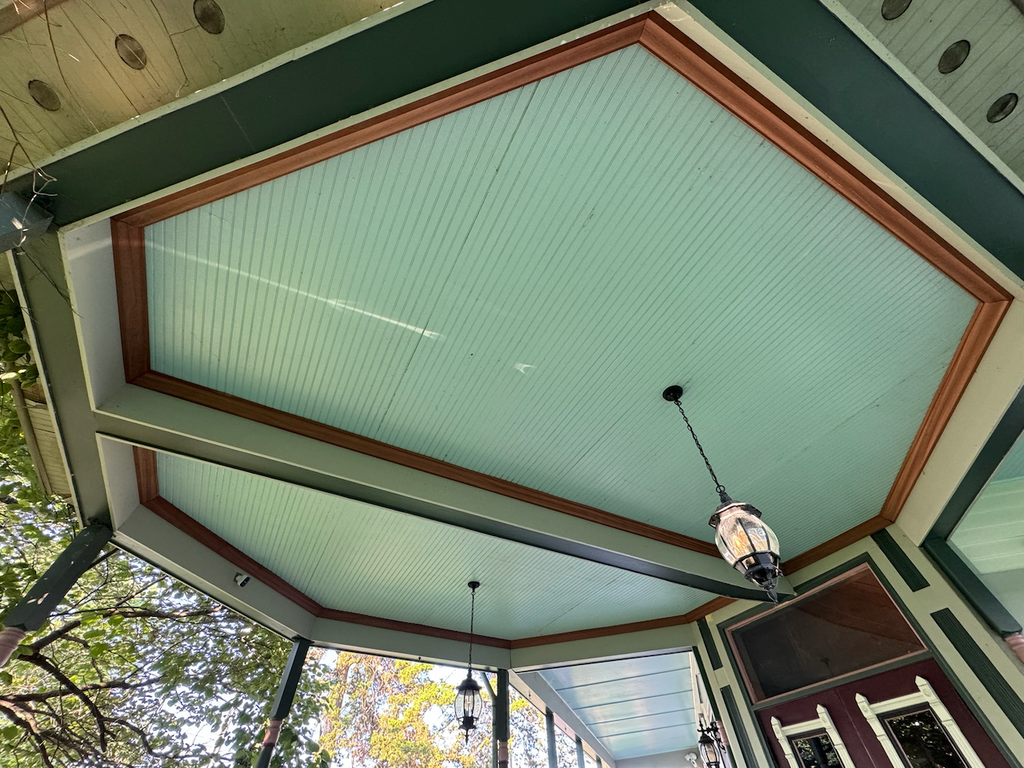
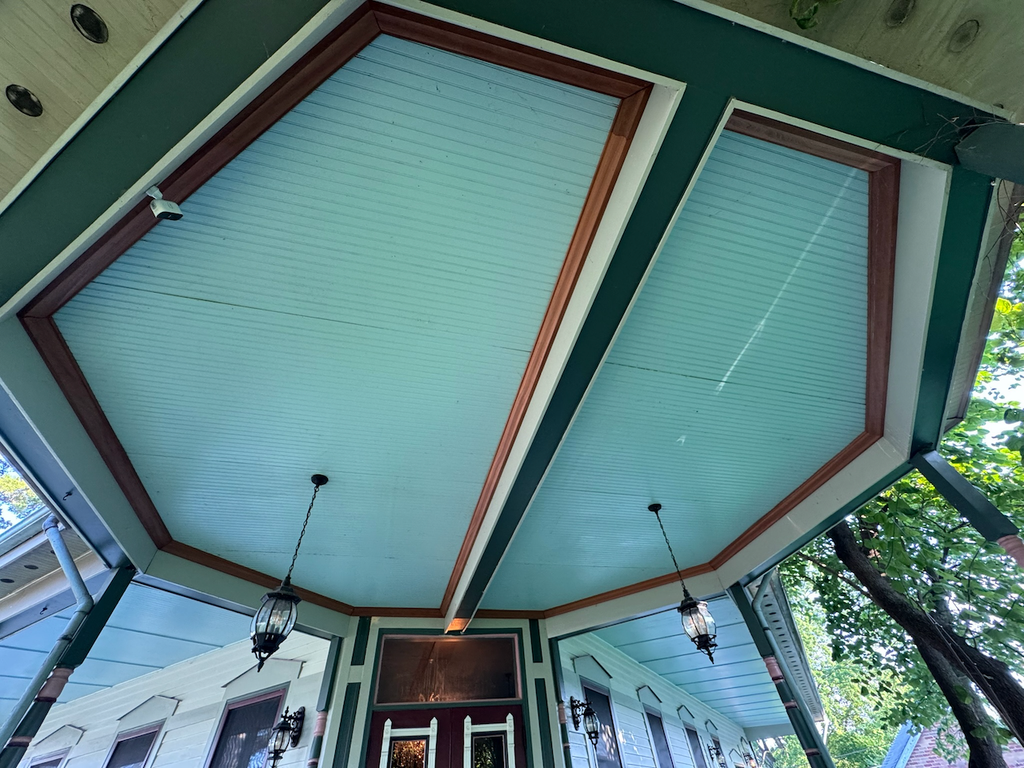
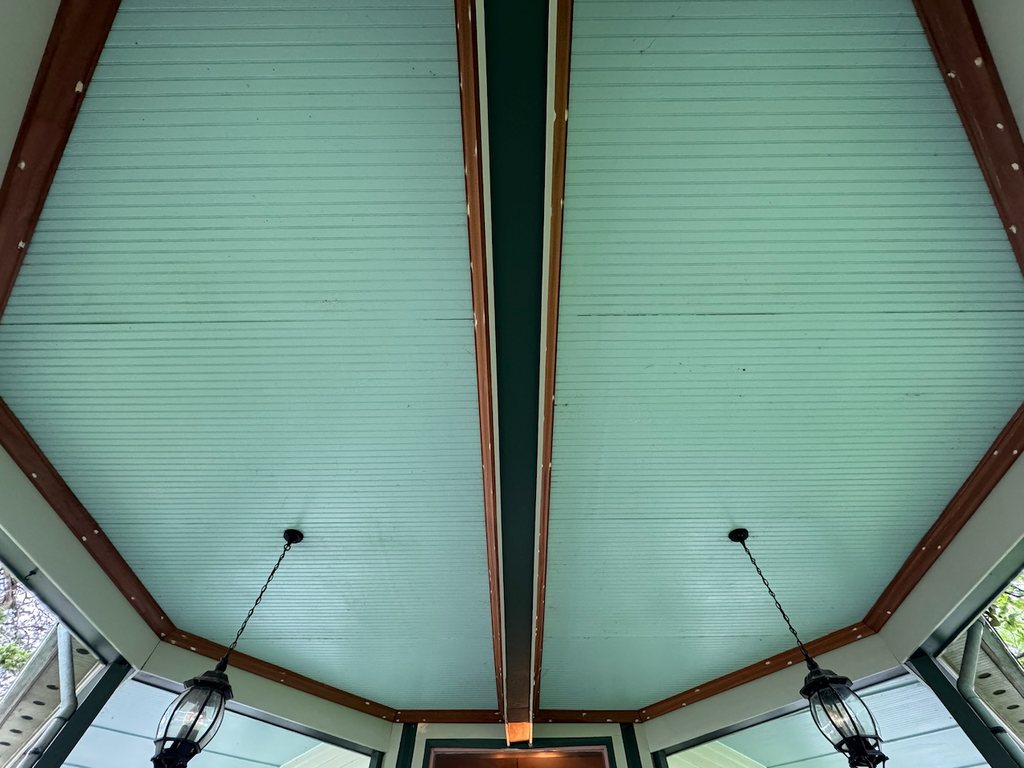
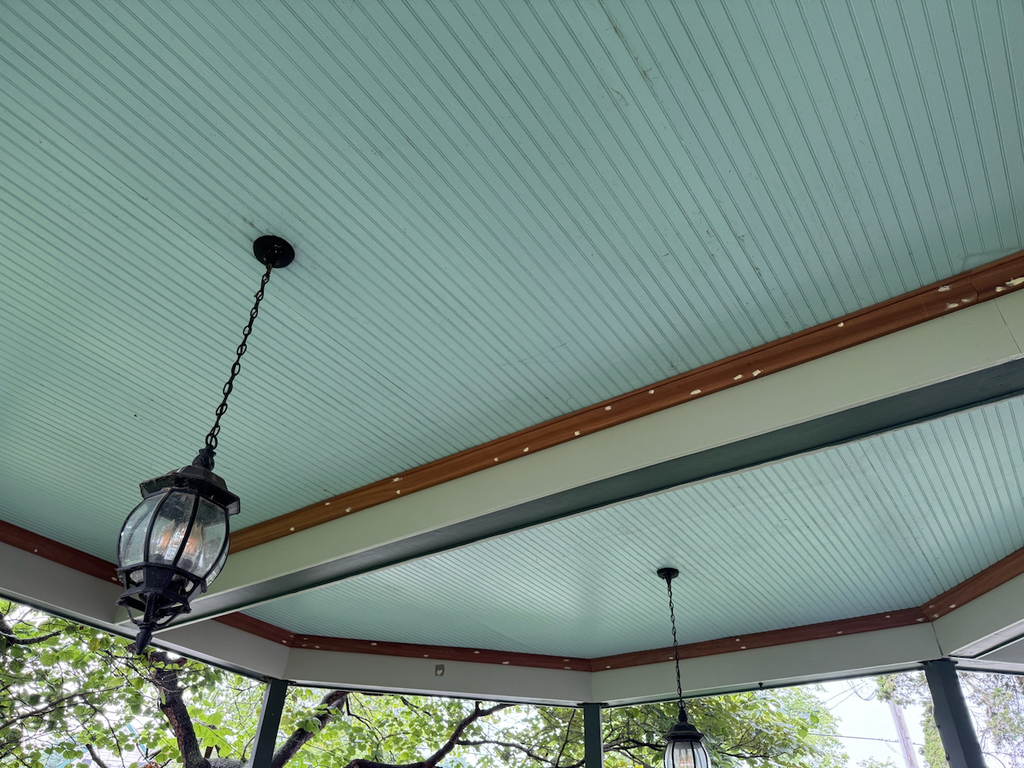
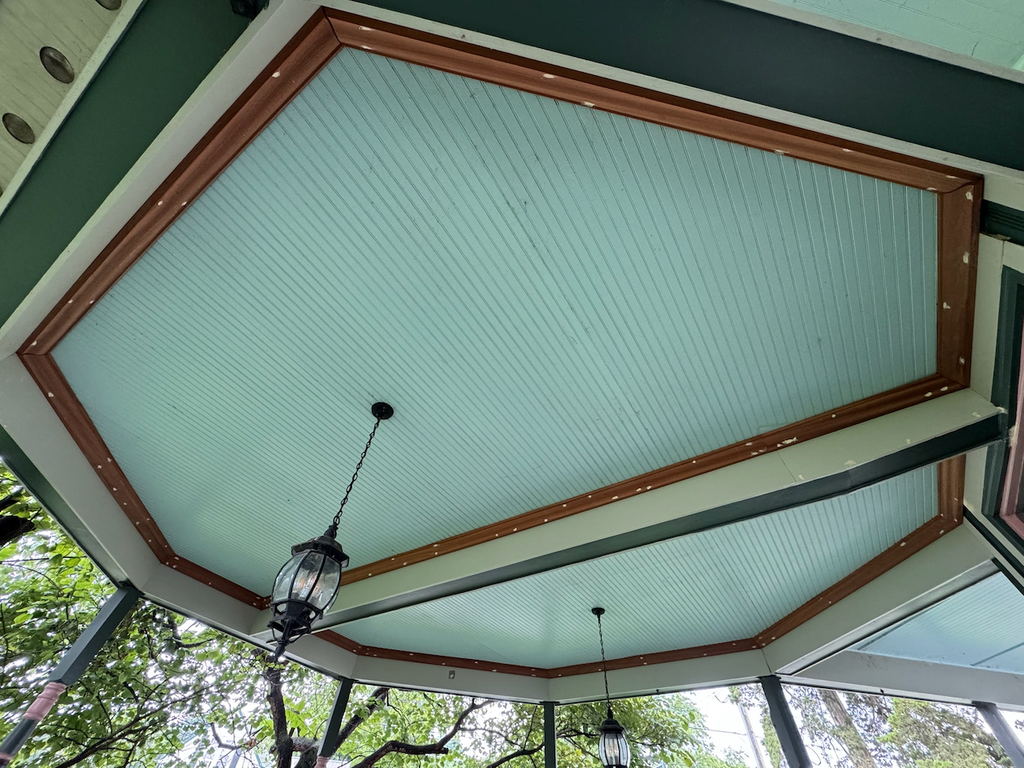
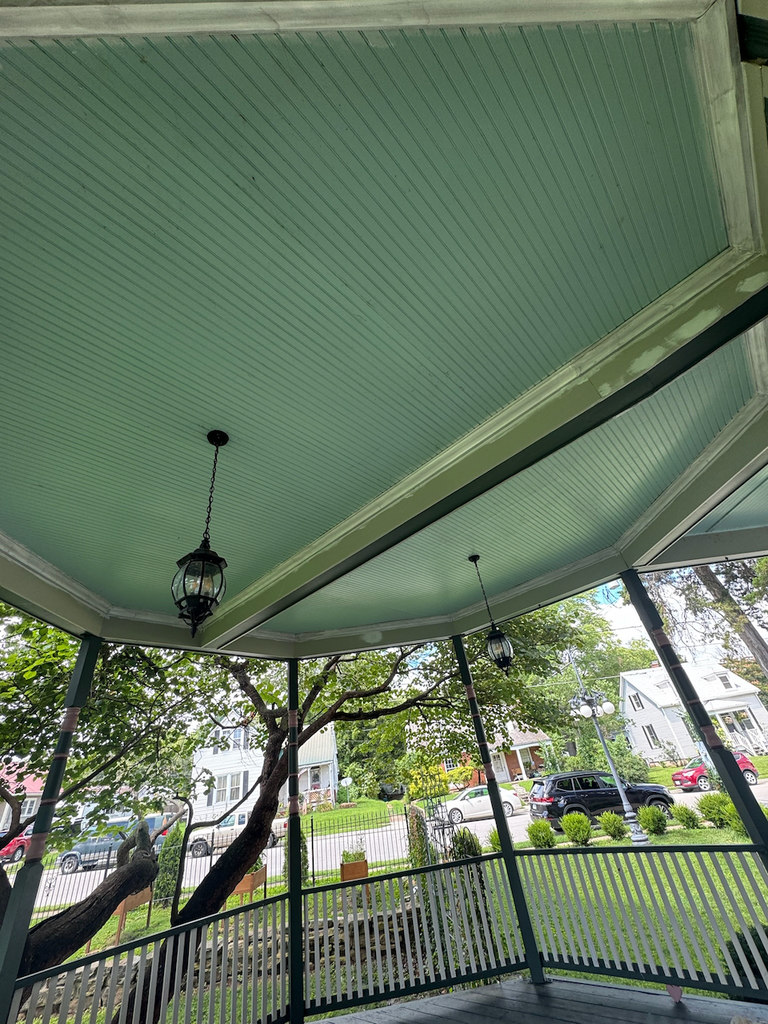
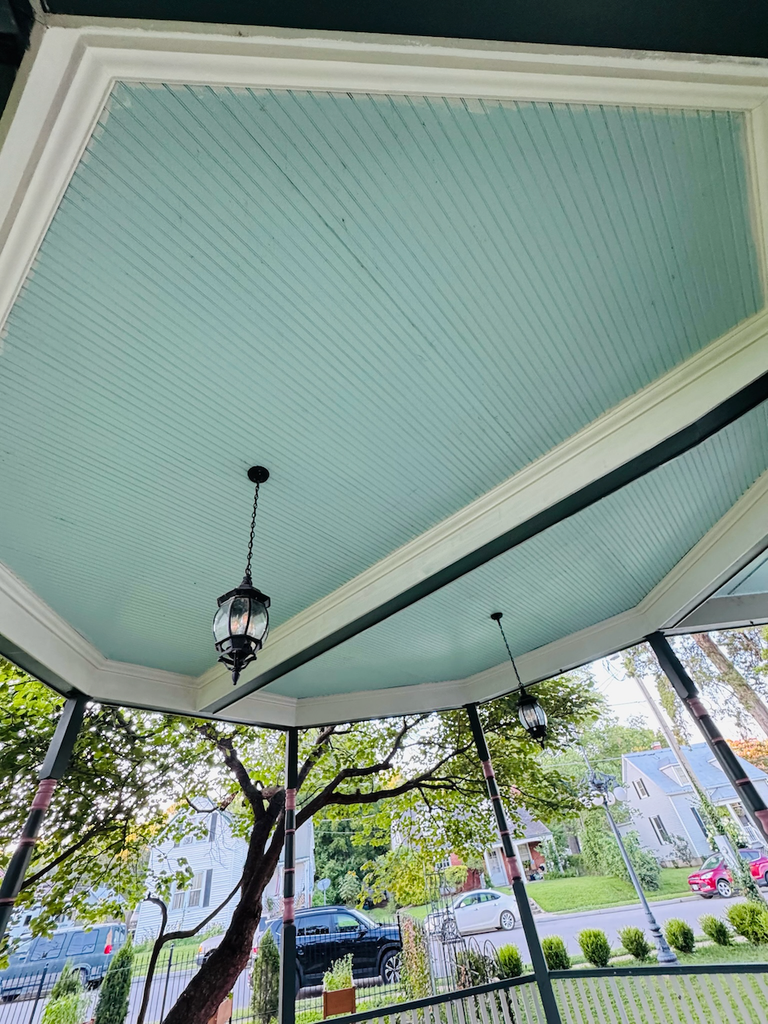
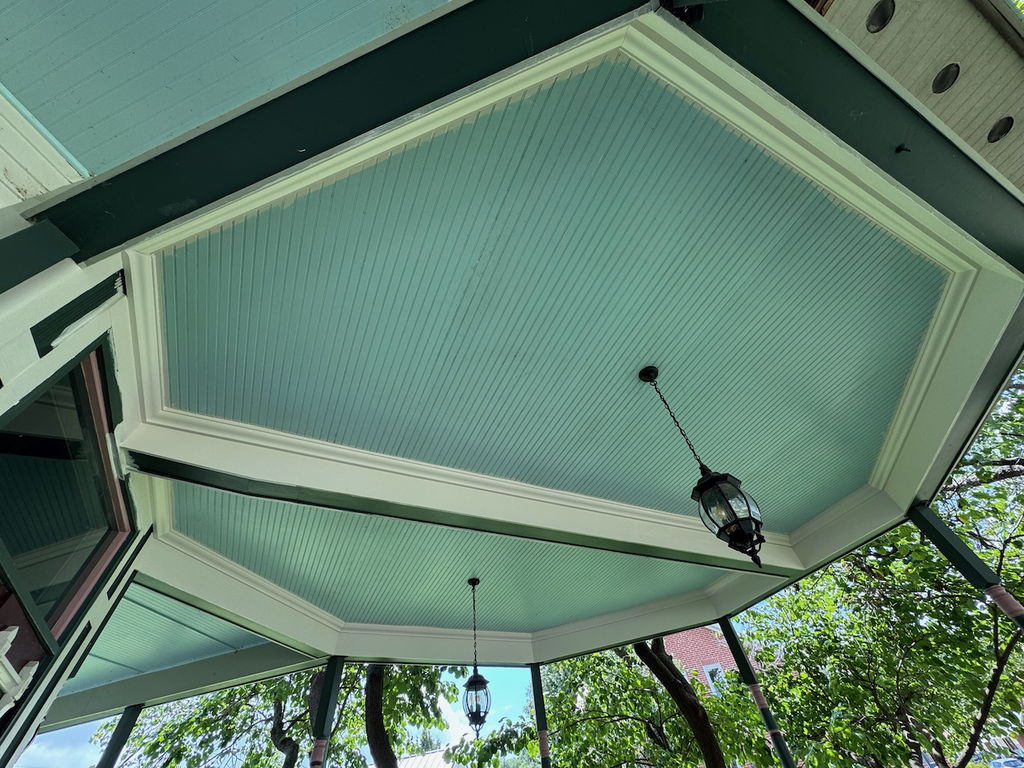
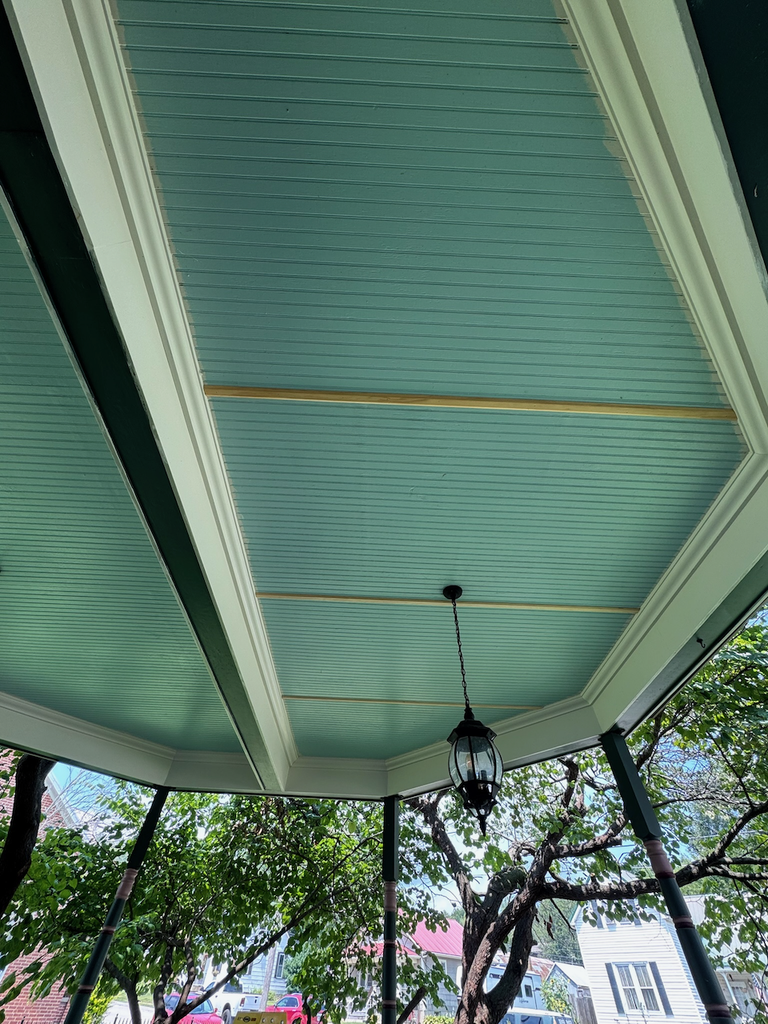
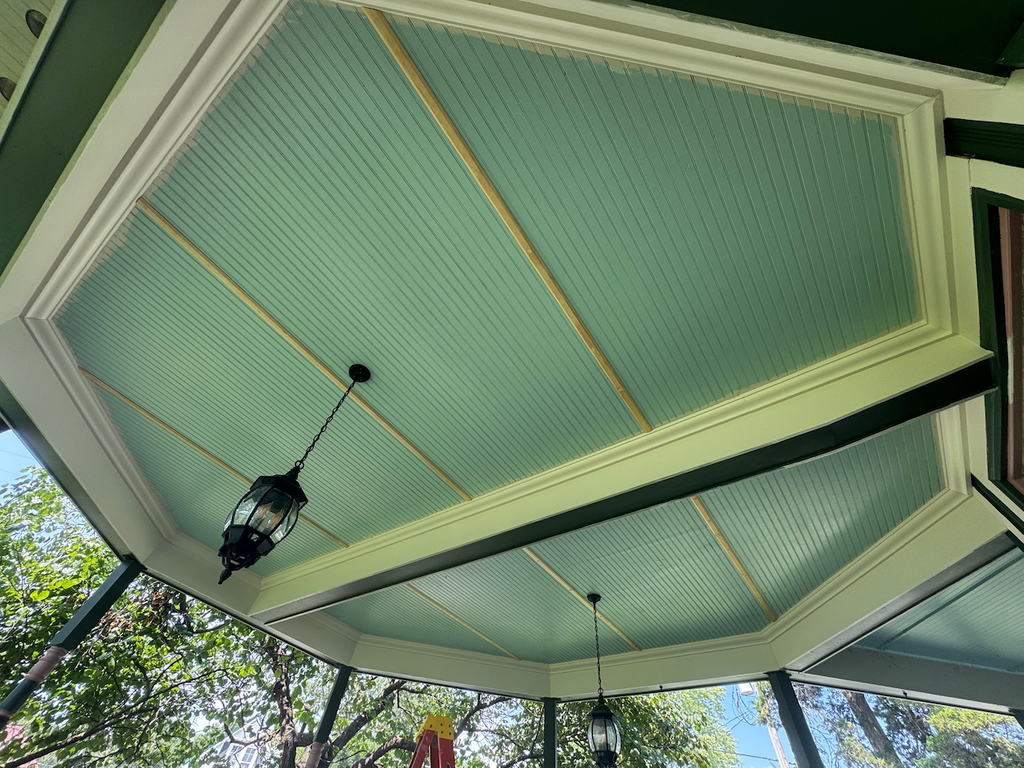
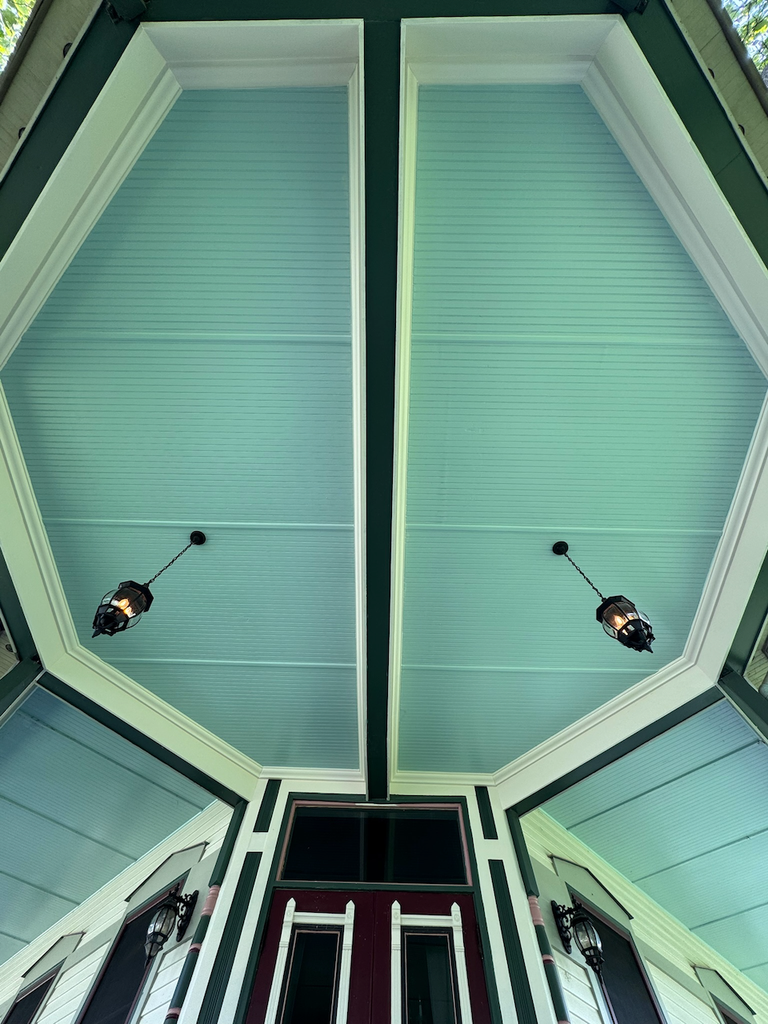
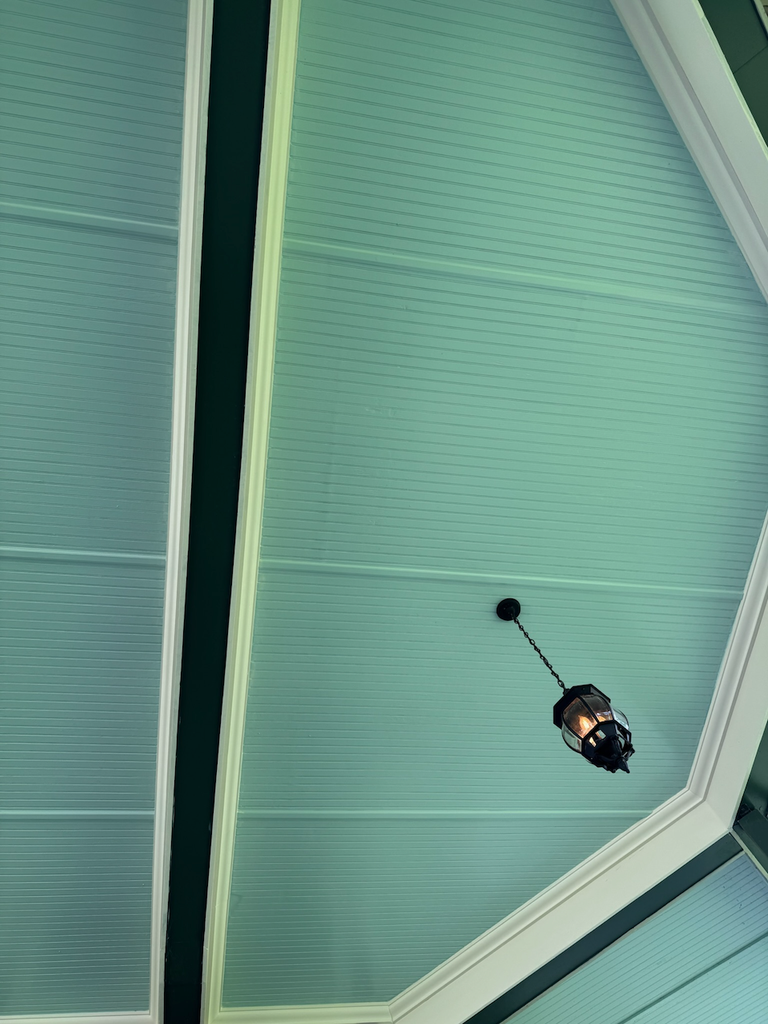
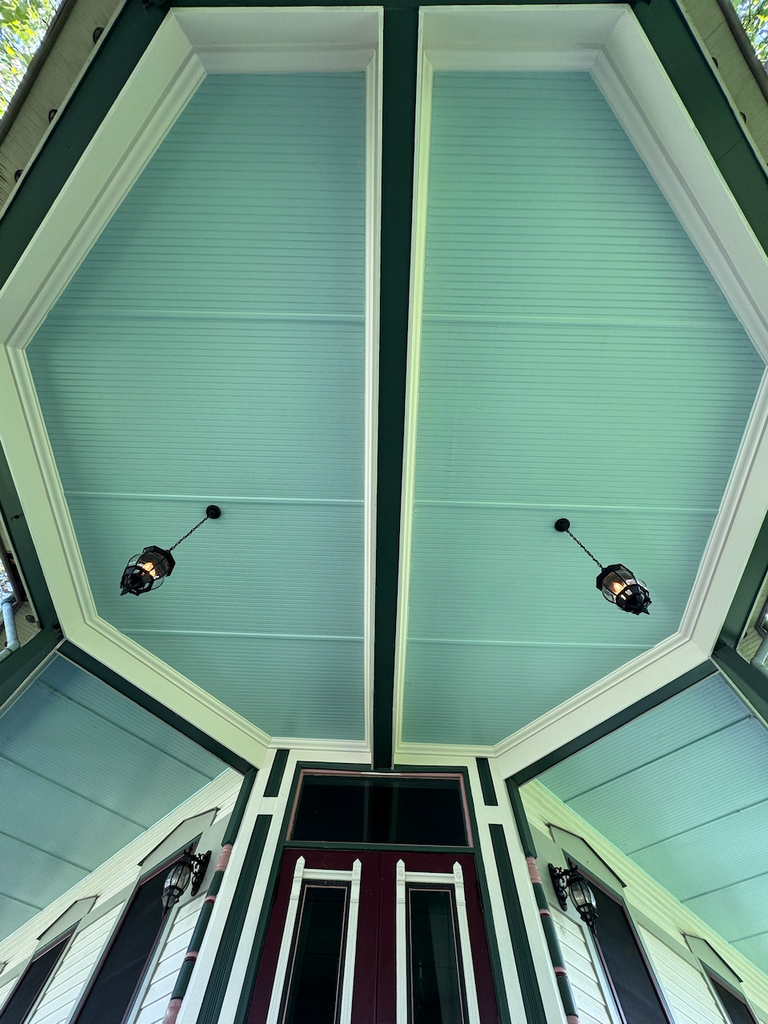
We recently finished the porch bay ceiling, including crown molding, batten strips, and fresh Haint Blue paint. We’ve been documenting our progress on our Facebook page, but we wanted to provide a more detailed write-up here on the blog.
This is a particularly meaningful project to close out, since it was one of the first trouble areas we tackled when we made the Herzog our home in late 2019. We replaced the flat roof above and the ceiling below, but the finish work took a back seat.
Before digging in, a quick before and after:
Roof
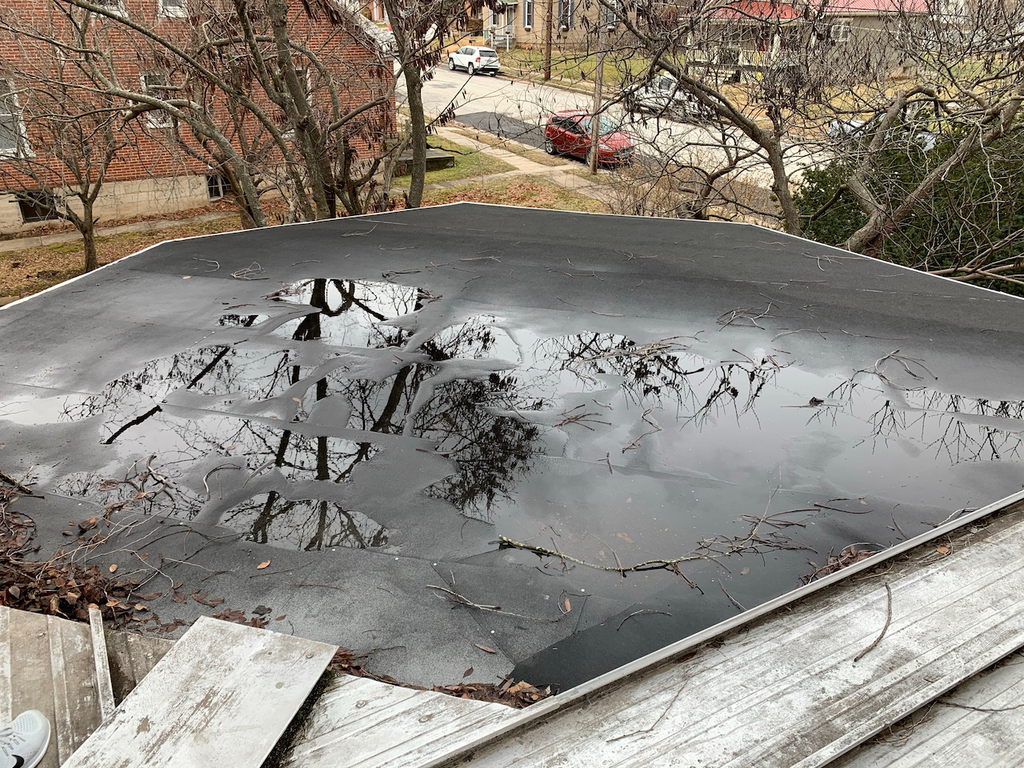
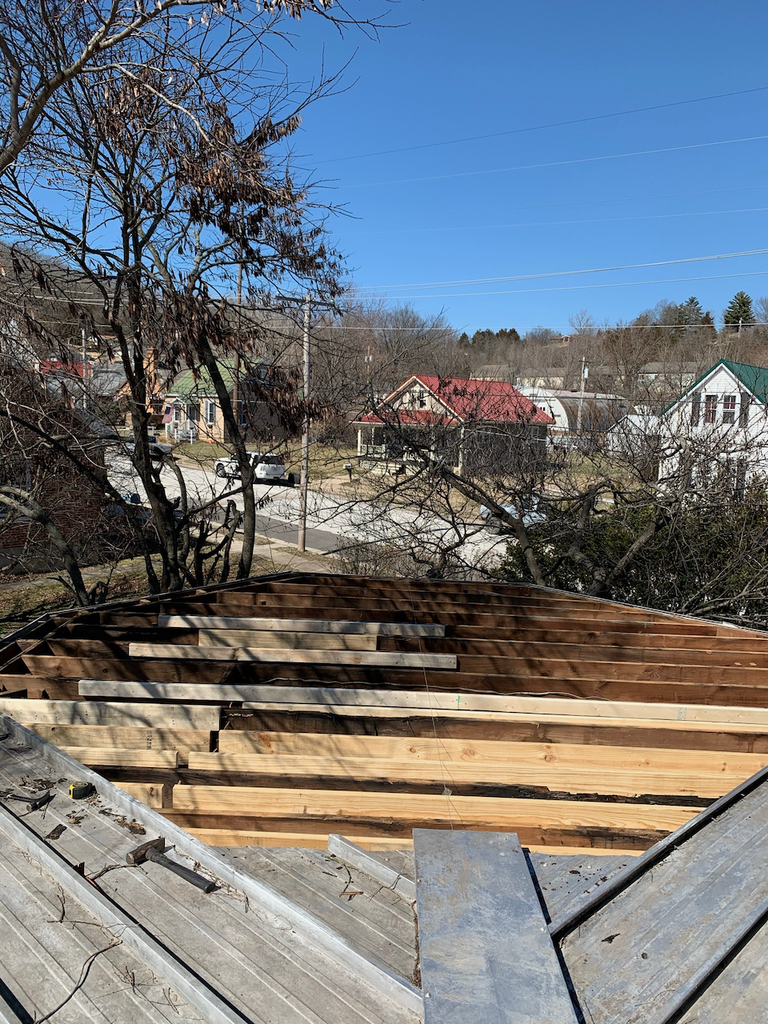
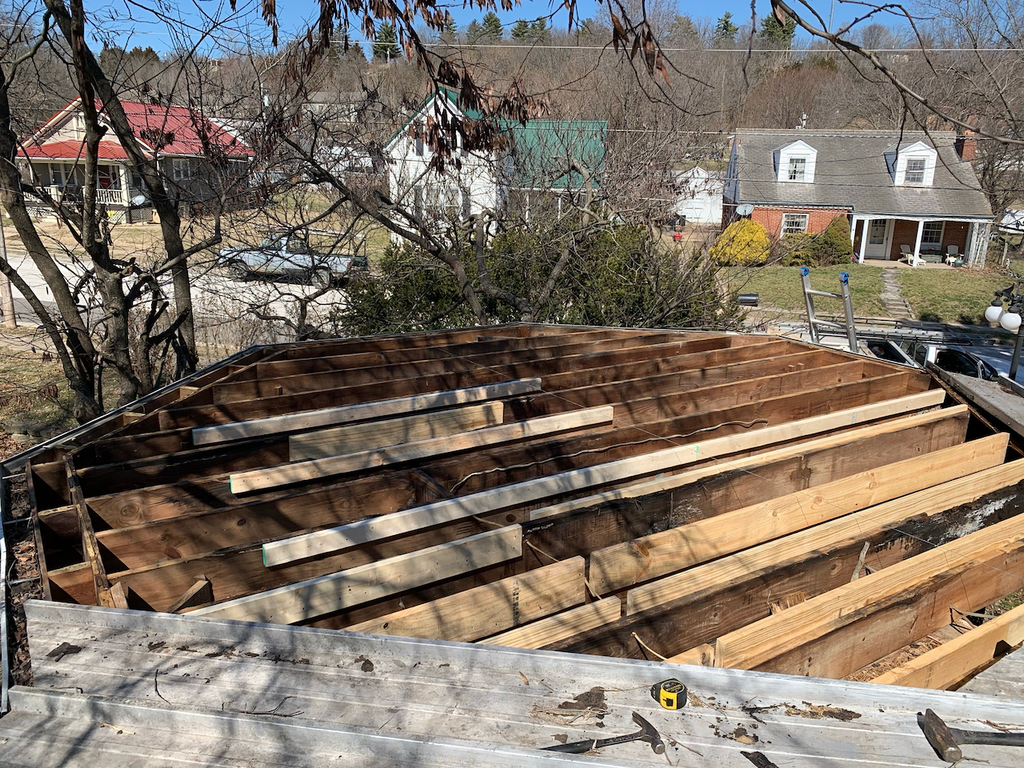
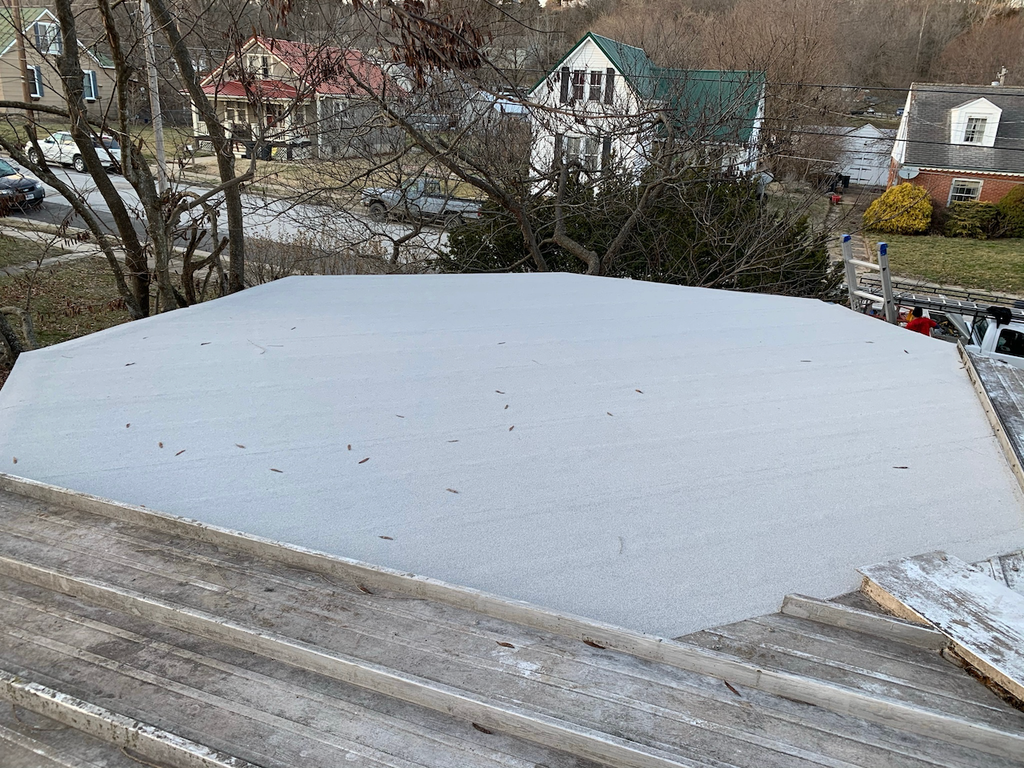
The first step was replacing the flat roof over this bay. The existing flat roof appeared to consist of an older, basic asphalt or rolled-roofing membrane that had reached the end of its useful life and had failed. Our roofing contractor removed the old roofing and decking, sistered the existing roof joists with new lumber to reinforce the framing and improve the slope for better drainage, and then installed the new roof assembly. The replacement was a CertainTeed Flintlastic self-adhered modified-bitumen system using Flintlastic SA PlyBase and SA Cap materials. Purpose-built for flat and low-slope roofs, the new assembly provides a much more durable, weather-resistant waterproofing system.
Ceiling
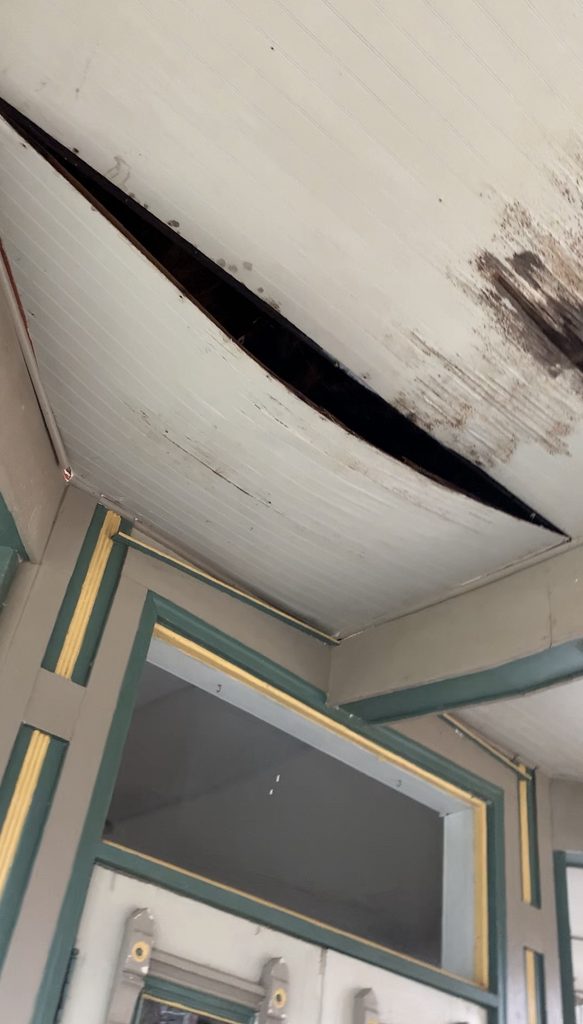
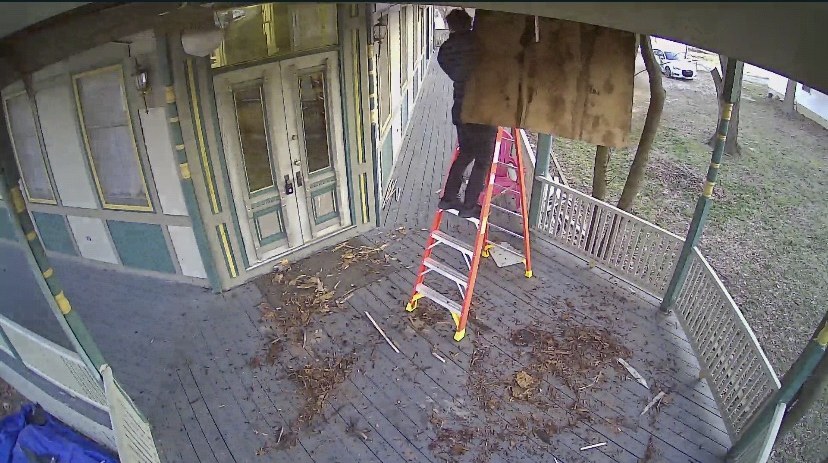
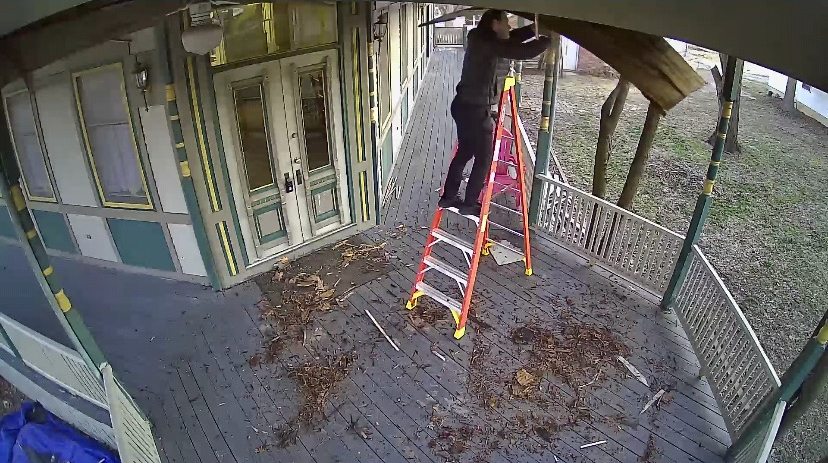
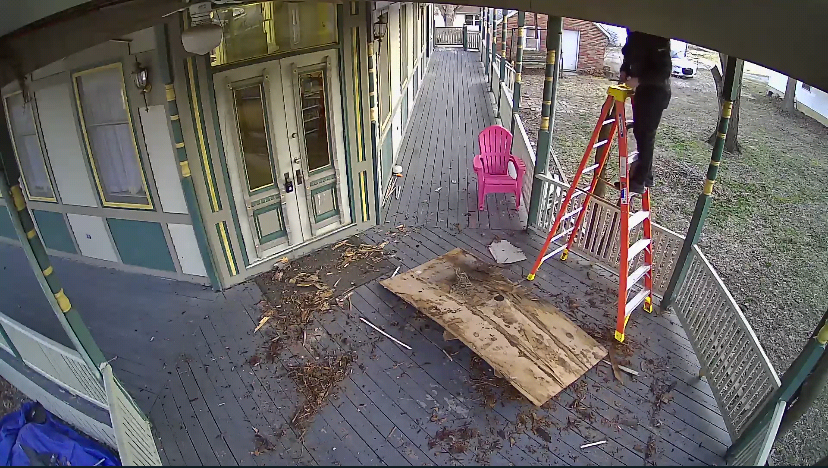
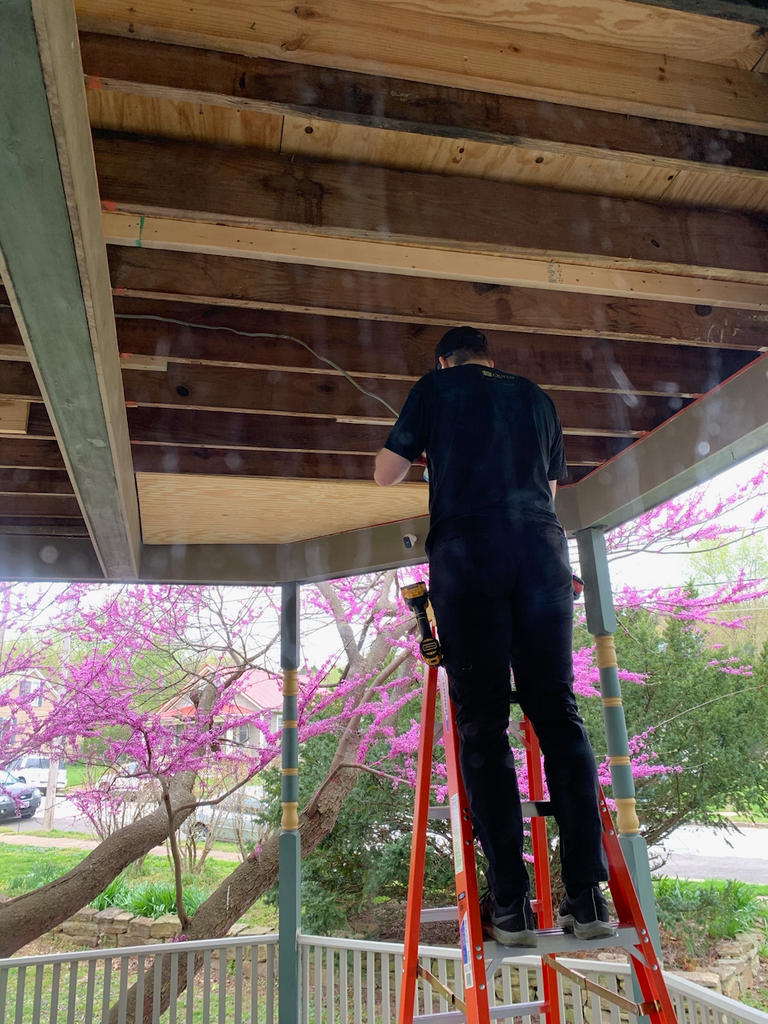
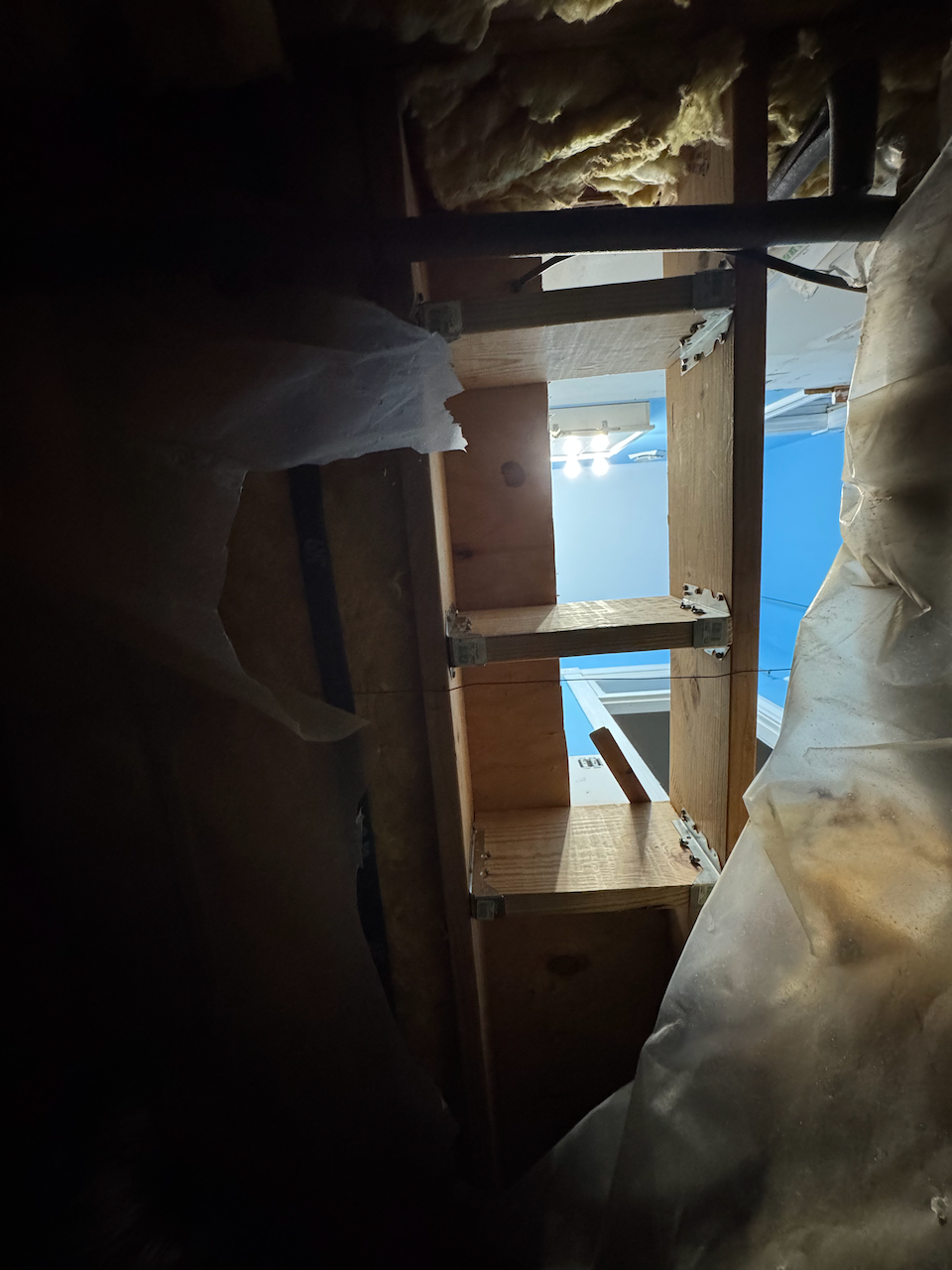
Next up was replacing the old ceiling. We’ve gotten much better at capturing progress photos over the years. The photos below came from our security camera and show me pulling down the old ceiling.
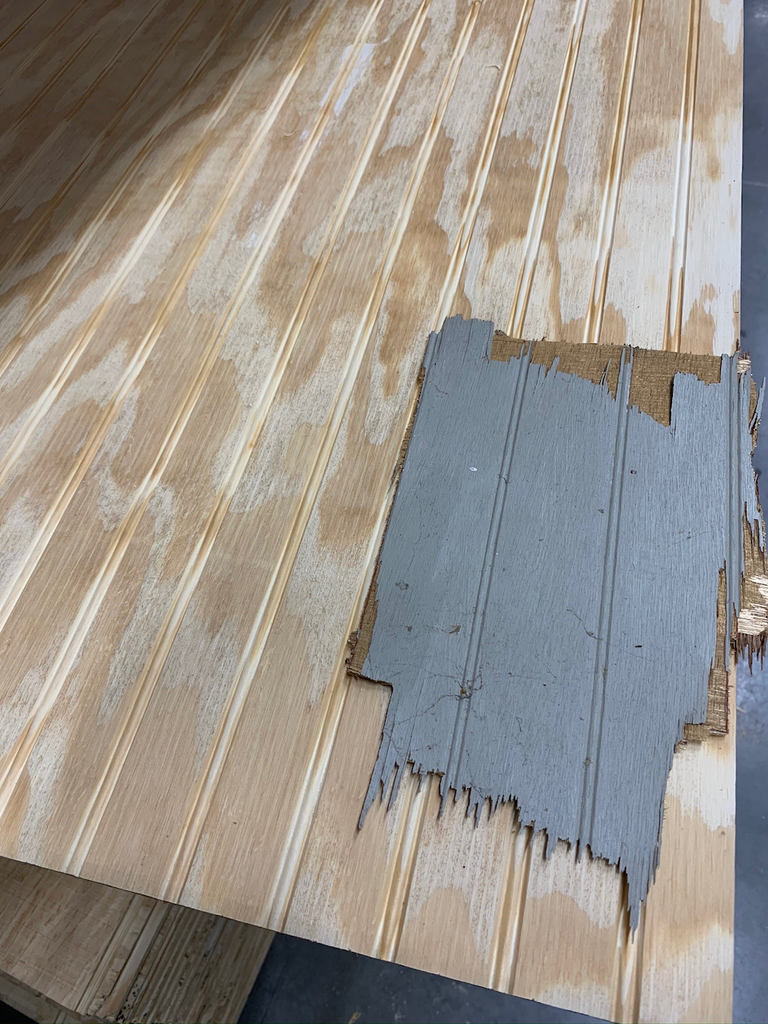
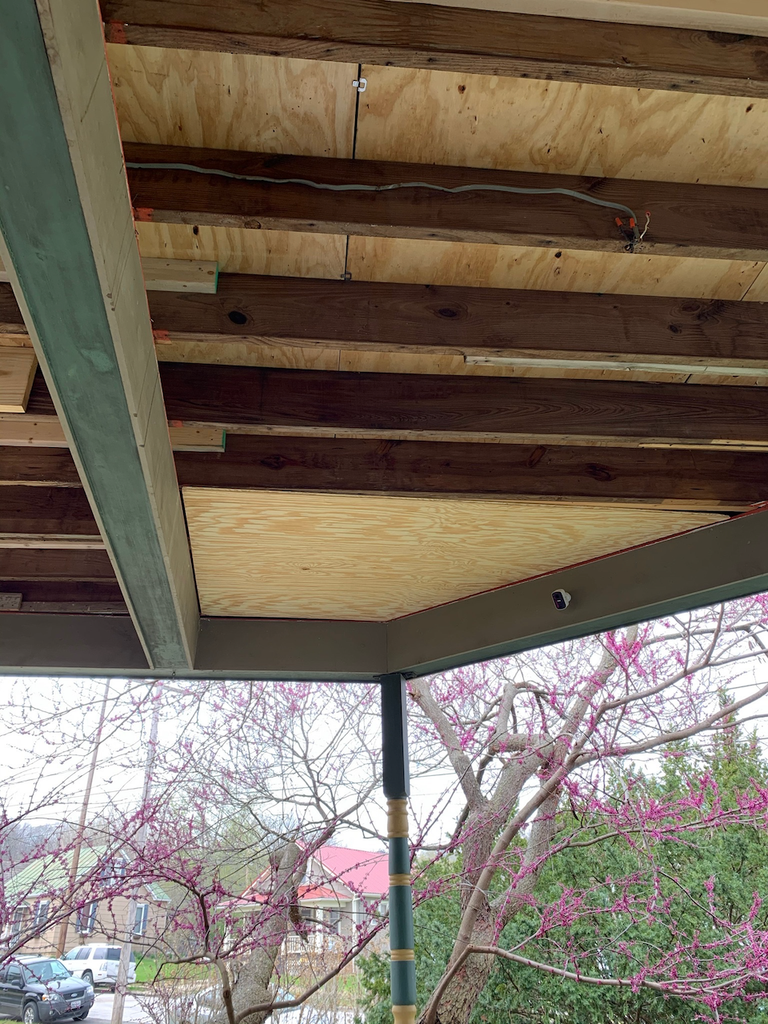
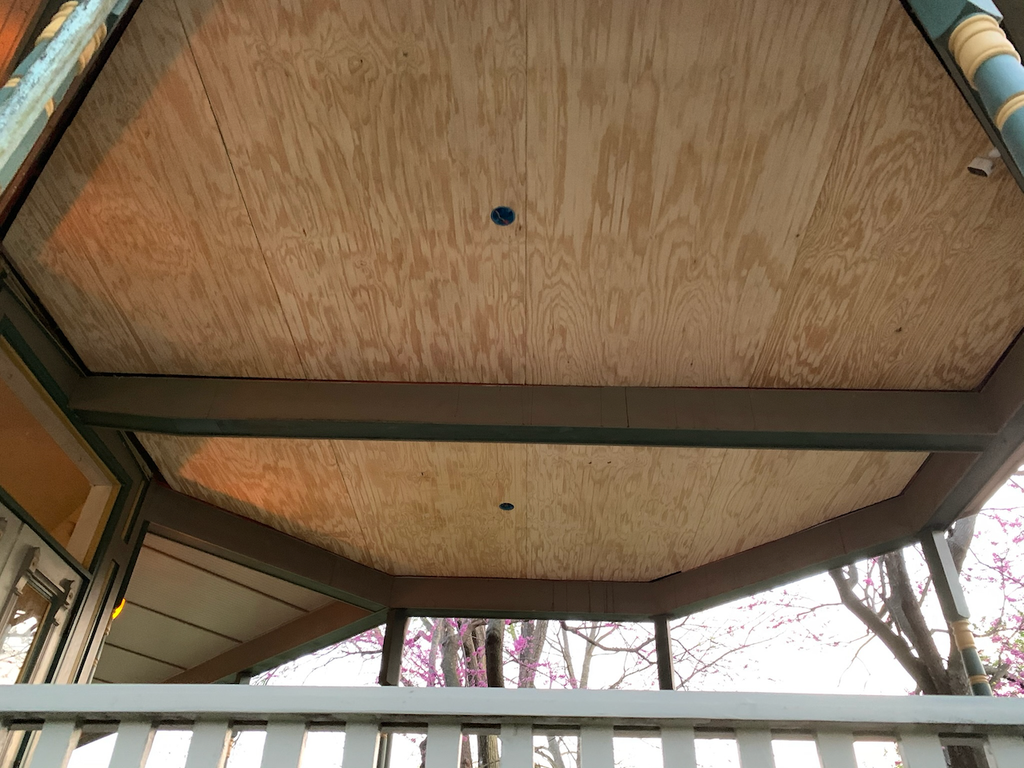
Here’s a photo showing a sample of the old ceiling against the new wood replacement.
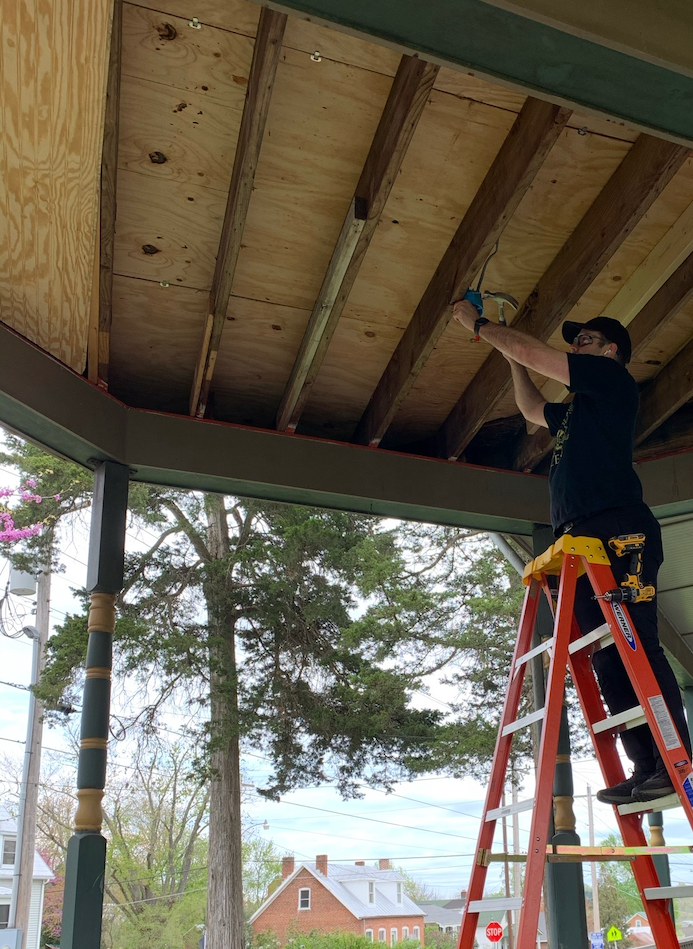
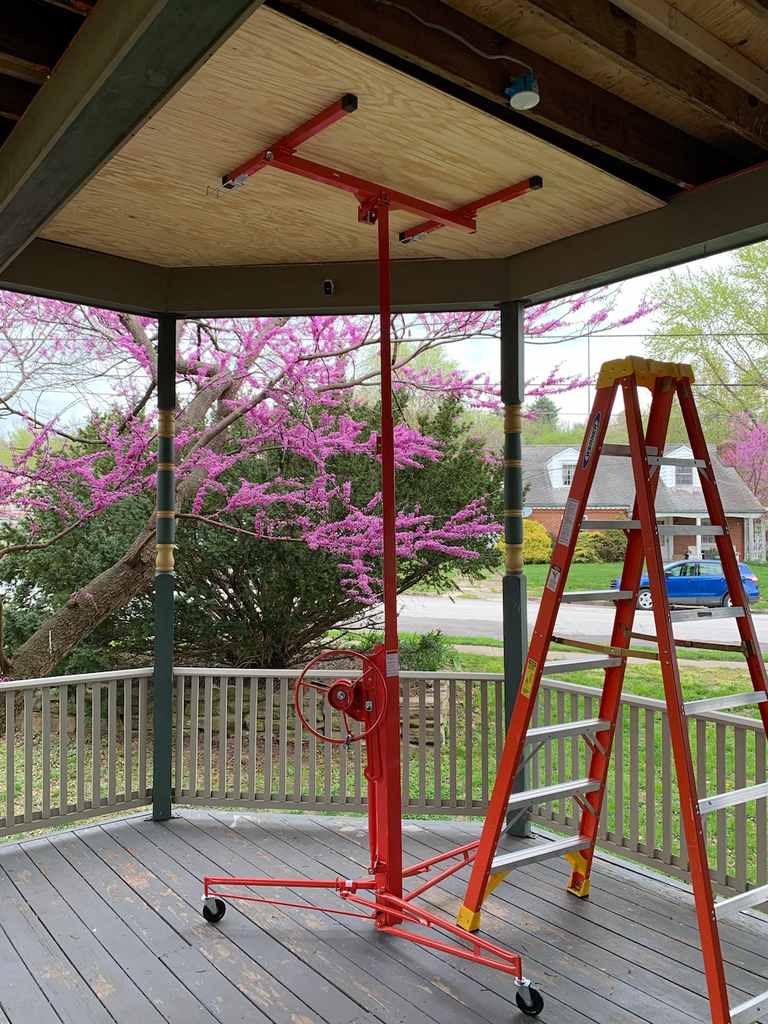
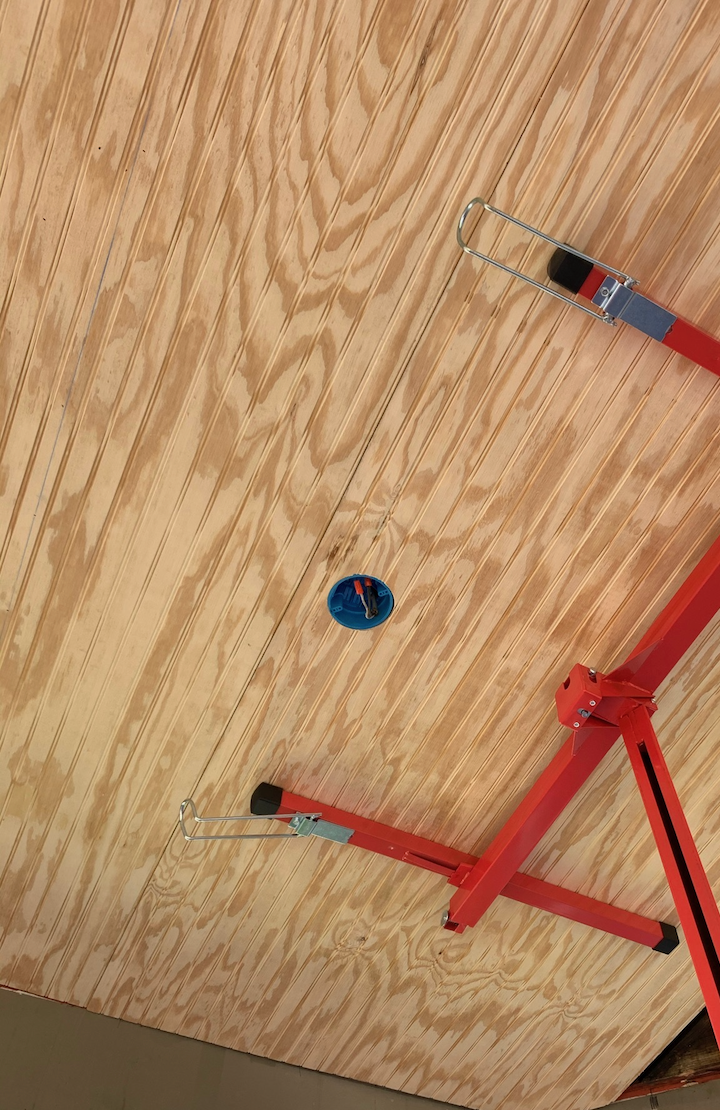
Next came the electrical prep, followed by hanging the new ceiling.
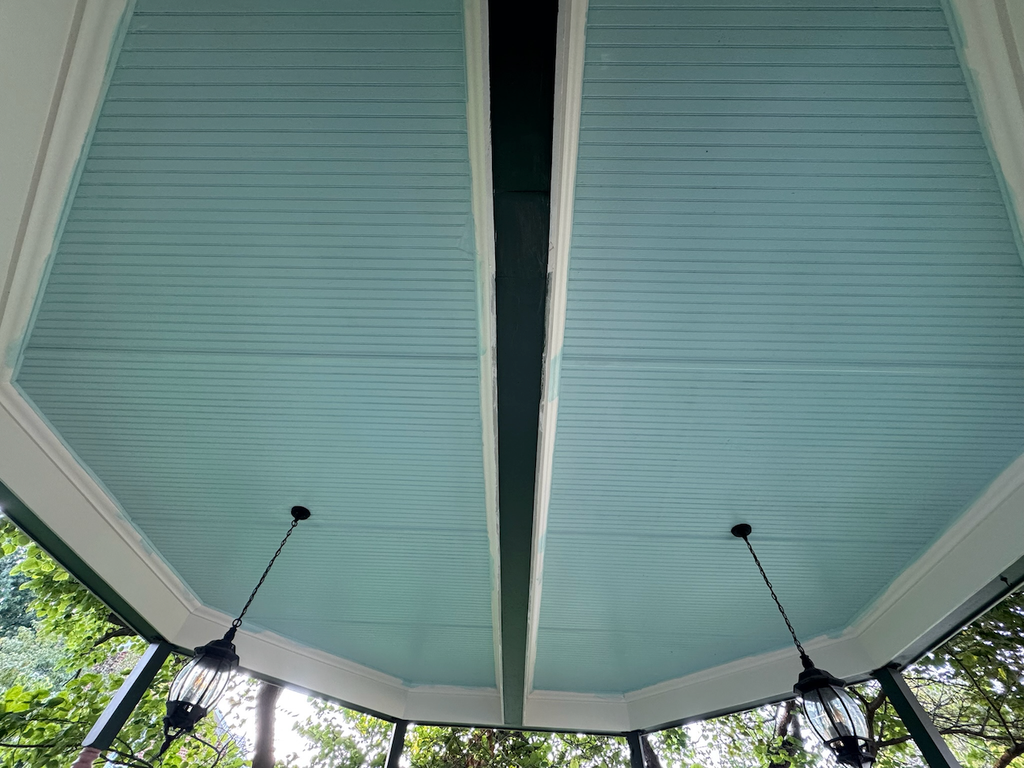
The light fixtures were installed, and we painted the remainder of the porch. The finish work took a back seat. Let’s hop into the time machine and leap from 2020 to 2026. Here’s where we’re starting today:
The goal is to cover up all of the gaps, which calls for crown molding for the perimeter and batten strips for the seams.
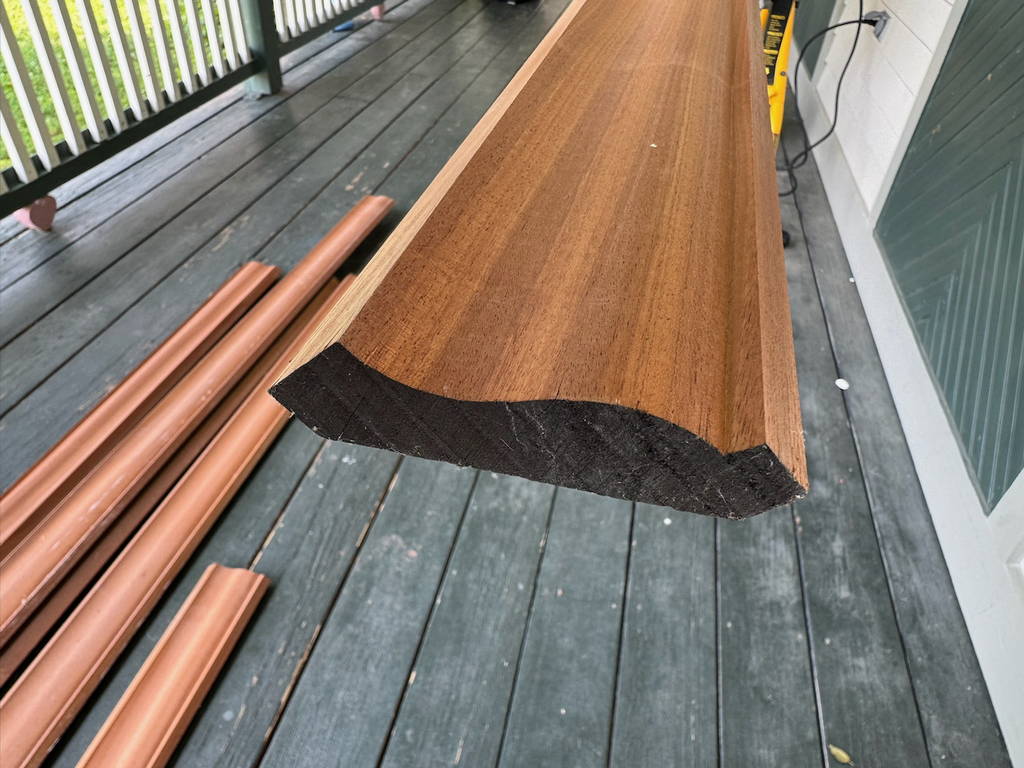
When we were having the millwork produced in 2022 for the historic upper cornice, we decided to have enough produced to install as a crown in the porch bay area. This is a hardwood called Sapele and it’s an absolute joy to work with:
Crown
The first step is to cut and dry-fit the crown. When we saw that beautiful Sapele in place, it was tough to paint it. We did wrestle with the idea of trying to keep the natural wood but it simply didn’t work.
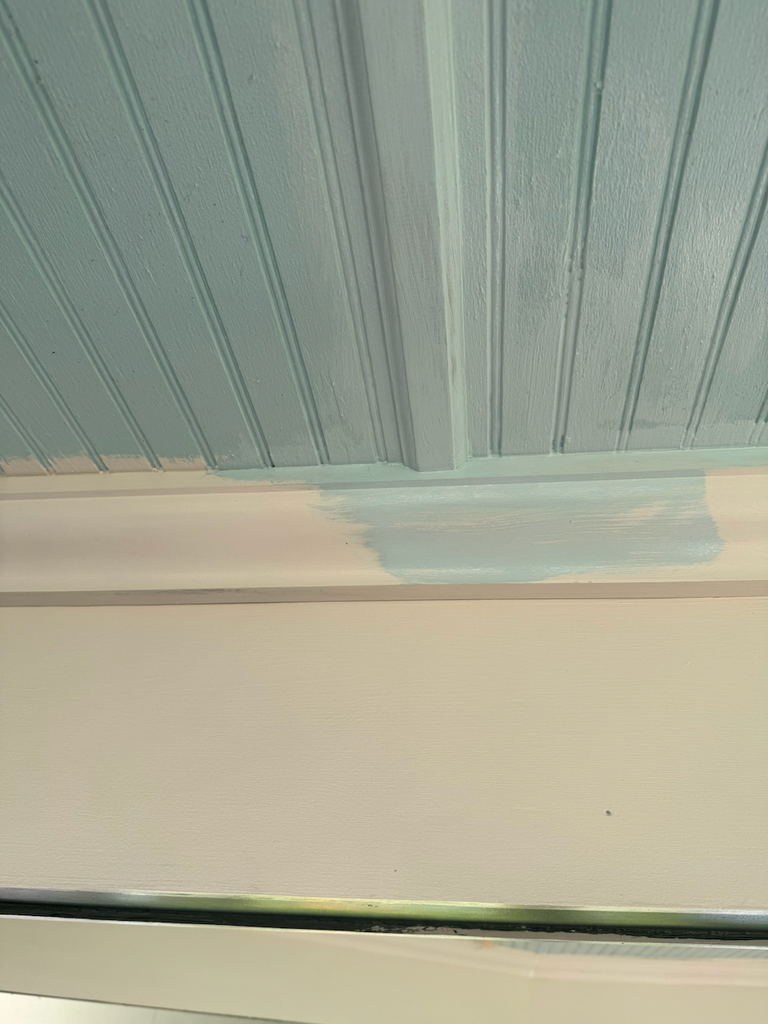
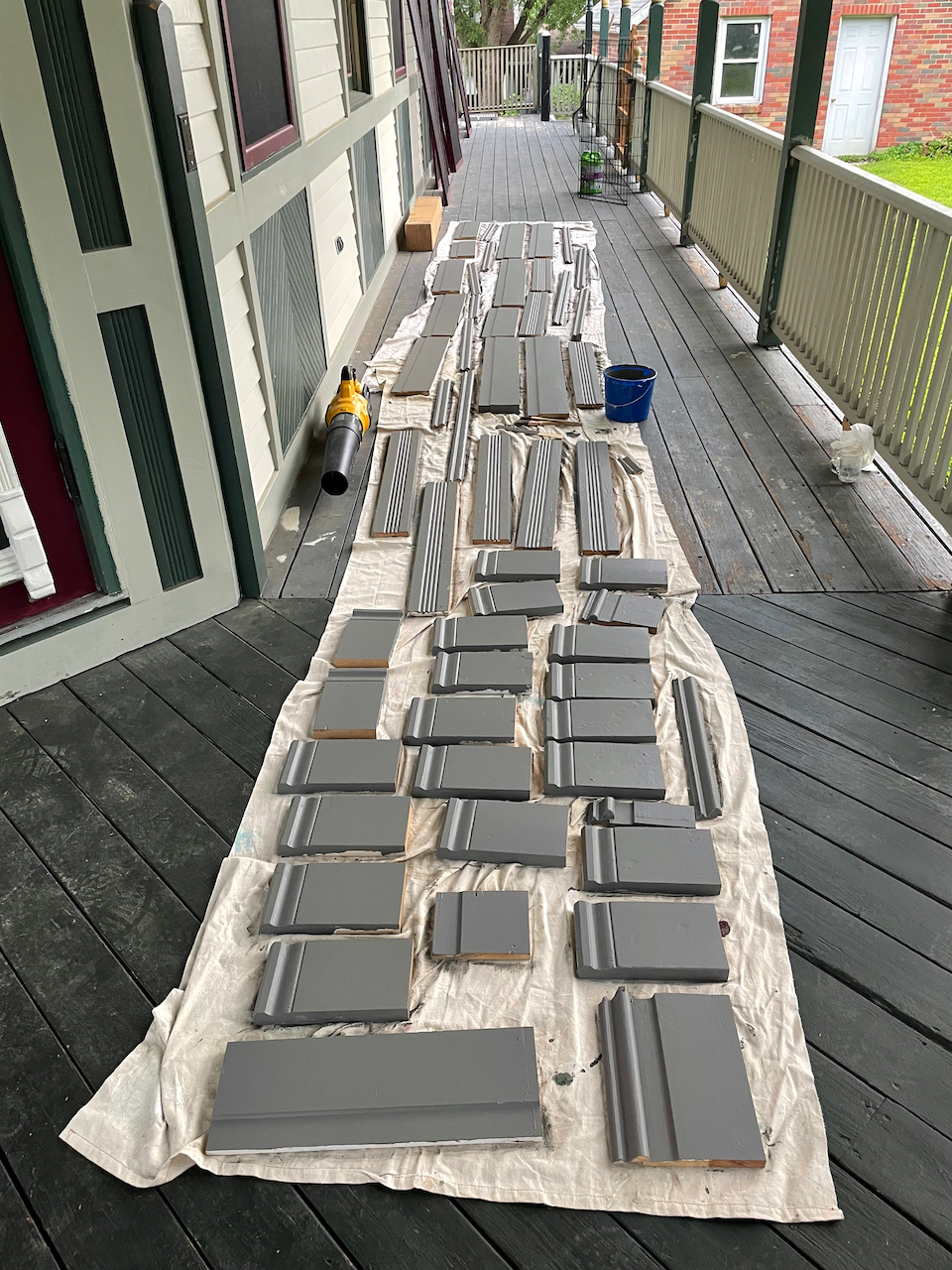
Once the crown was dry-fitted, the nail holes were filled. Then the crown was primed, caulked, and painted with two coats.
Batten Strips
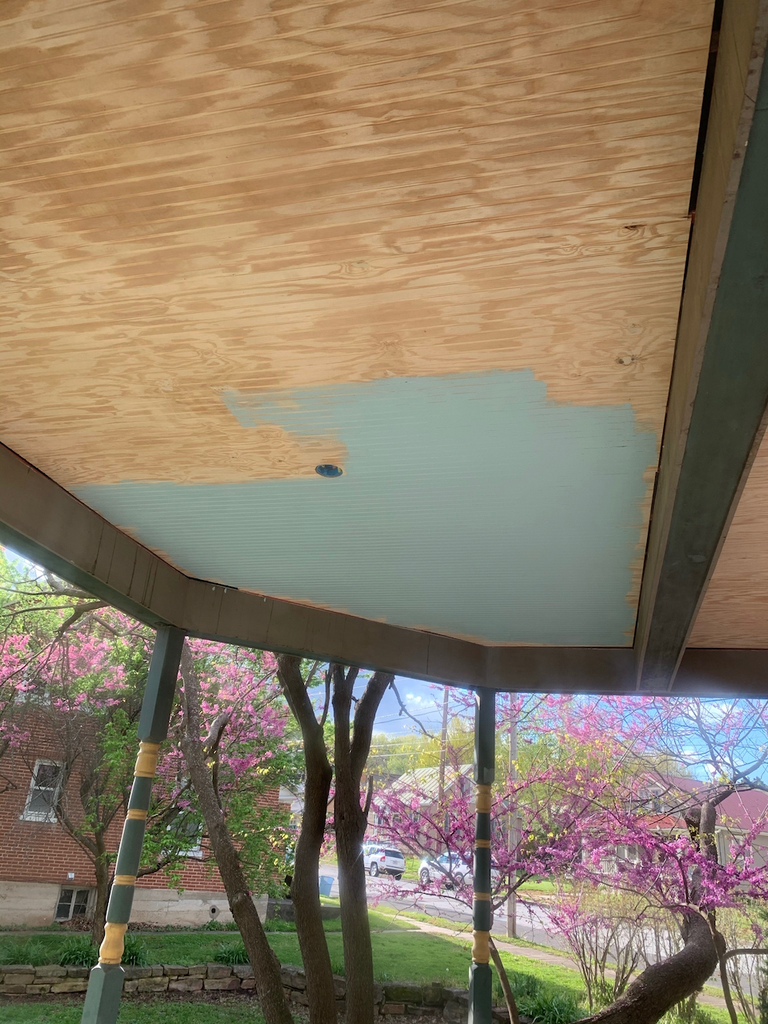
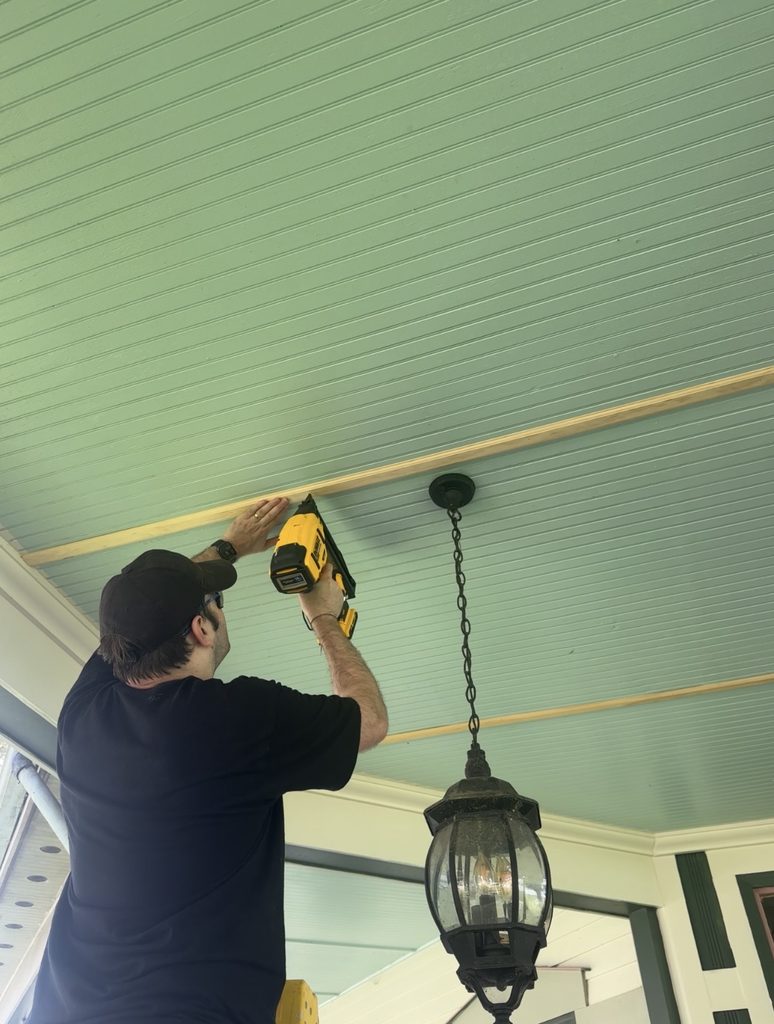
Now that the crown is mostly done, the final task is installing the batten strips for the ceiling seams. Similar process to the crown: dry fit, fill holes, sand, caulk, and paint. While we were at it, we cleaned and gave the ceiling a fresh coat of Haint Blue.
Screenshot
Finishing
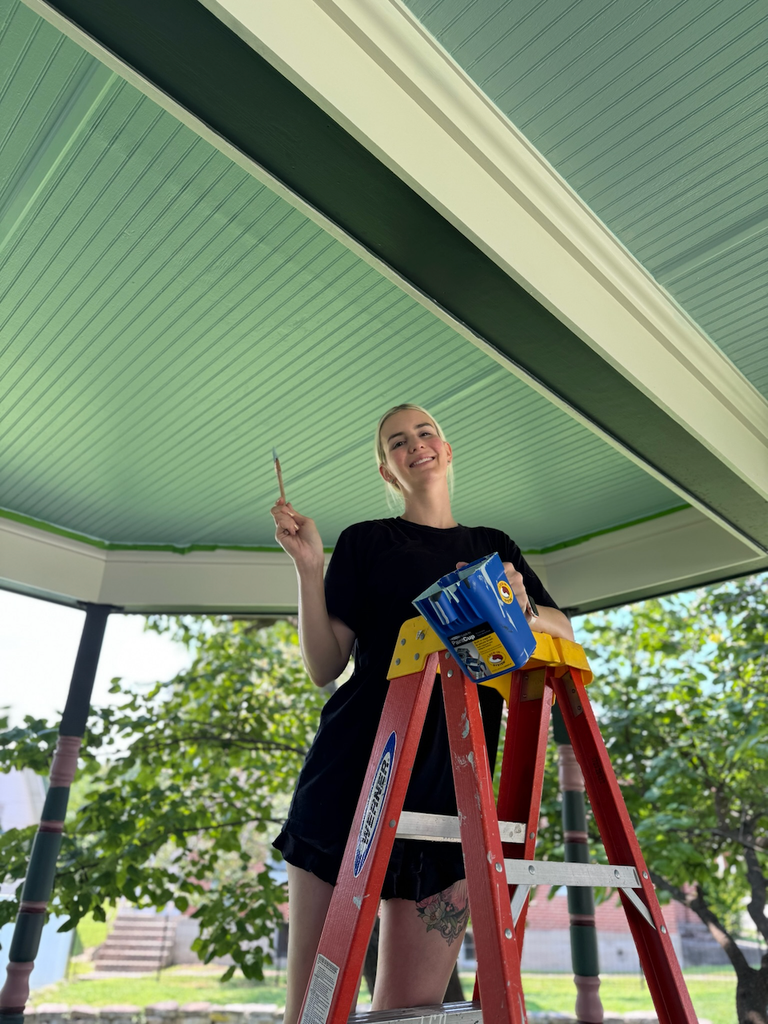
With everything sealed and painted, the last step was truly satisfying: the final coat of paint.
There we have it. A finished project. Now, just 9,999 more to go!
We remodeled the main guest bathroom off the family room. By far, the toughest interior space we have tackled. As with many bathroom remodels, this project was plagued by surprises and difficult challenges. Let’s get into it.
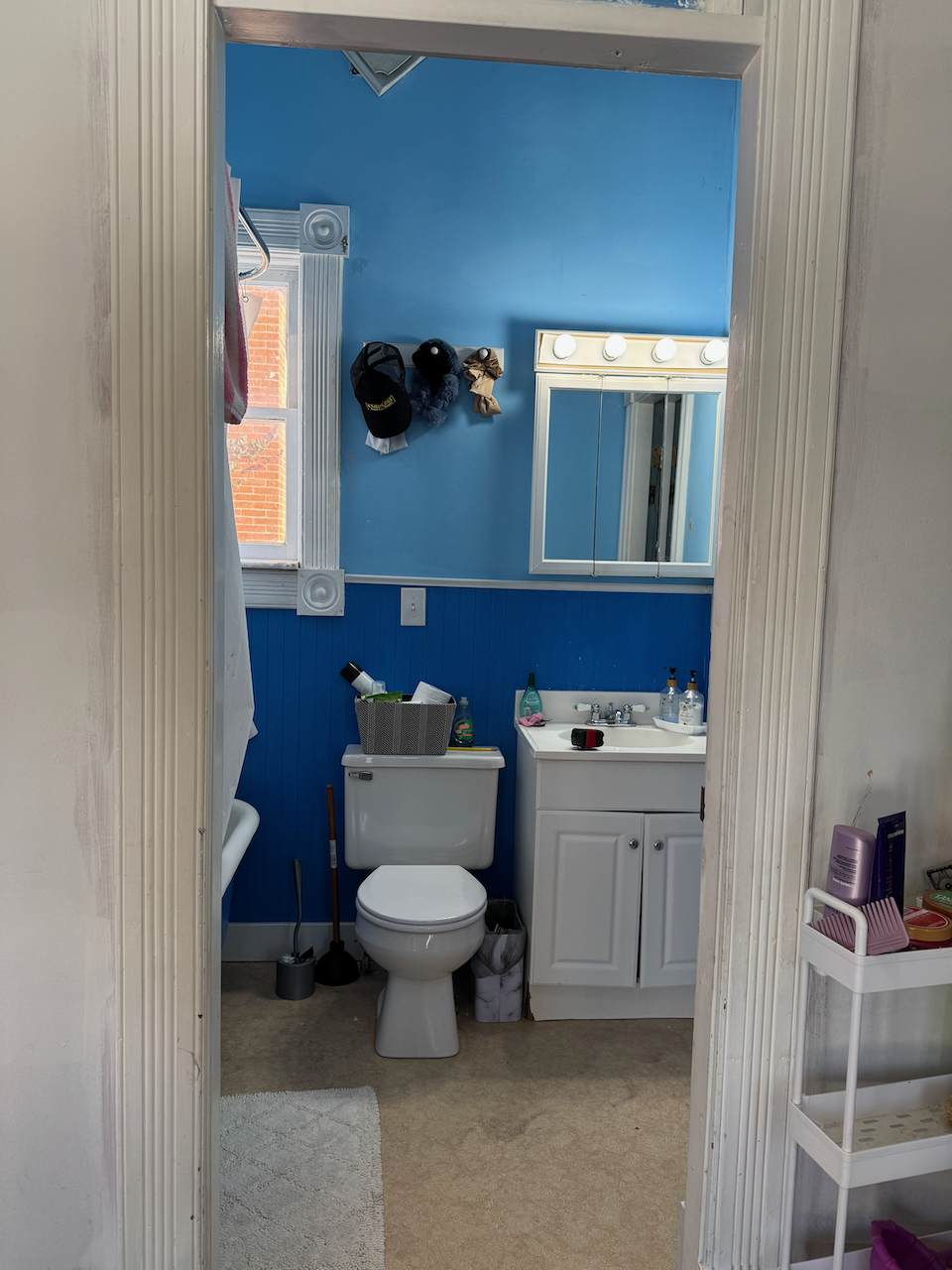
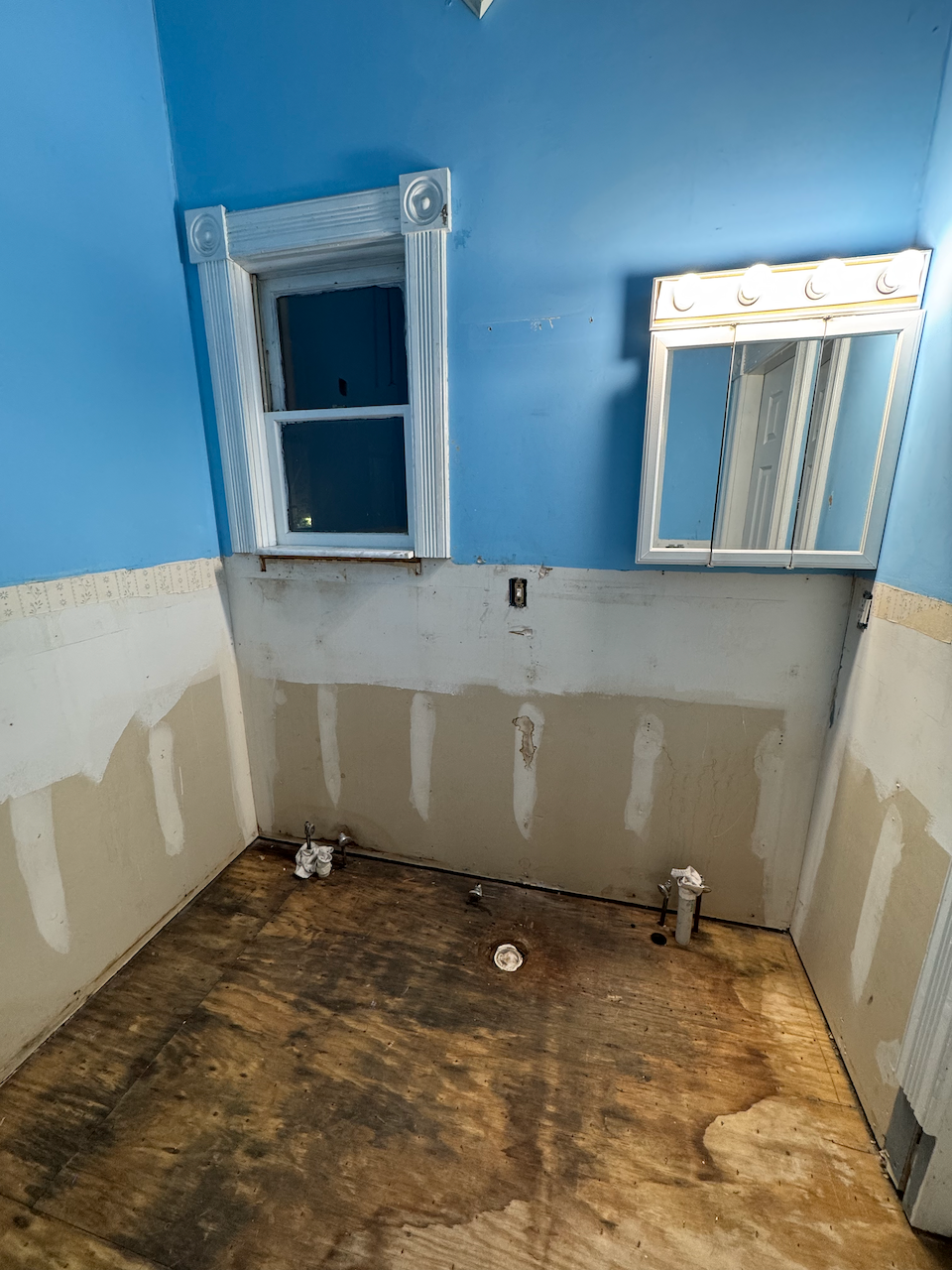
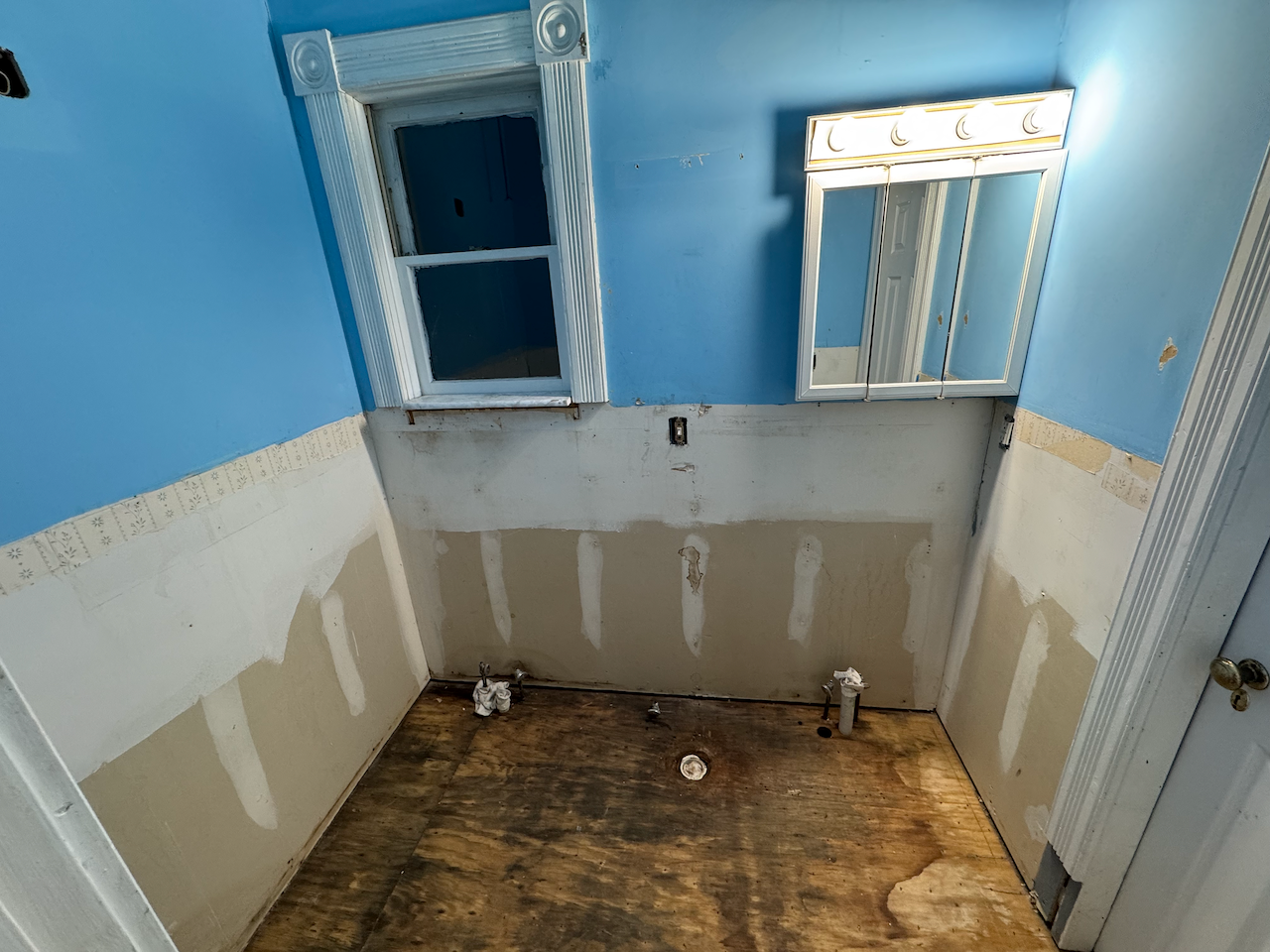
Here’s a quick snapshot at the before and progress:
Background & Before Photos
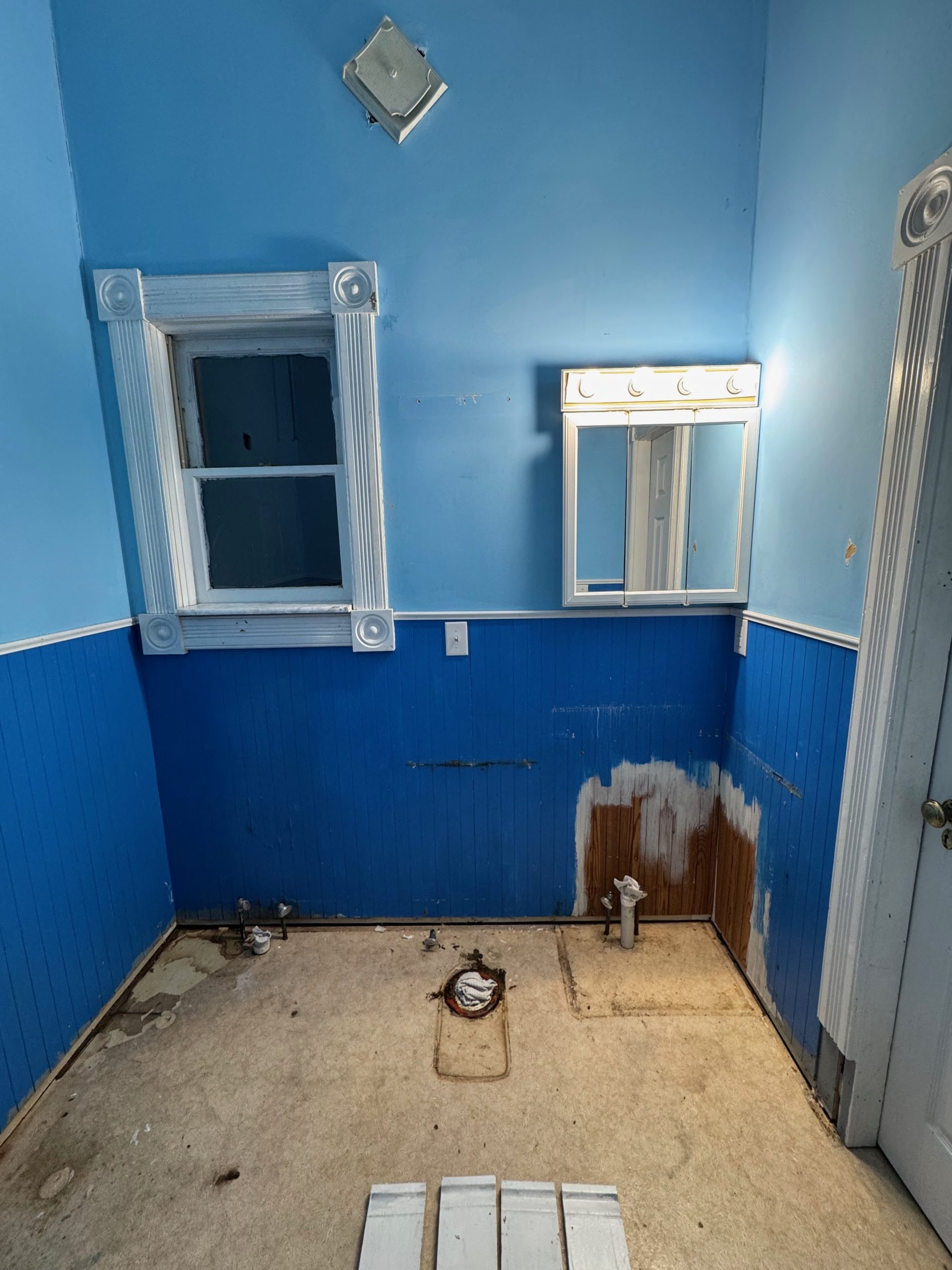
This is one of the two first-floor bathrooms. It’s part of the 1980s addition, which, when the house was a B&B, was used by the inkeeper. Today, the bathroom and connected bedroom are part of our primary family living area, right off the family room we remodeled a few years back. Prior to the remodel, definitely the most used bathroom in the entire house.
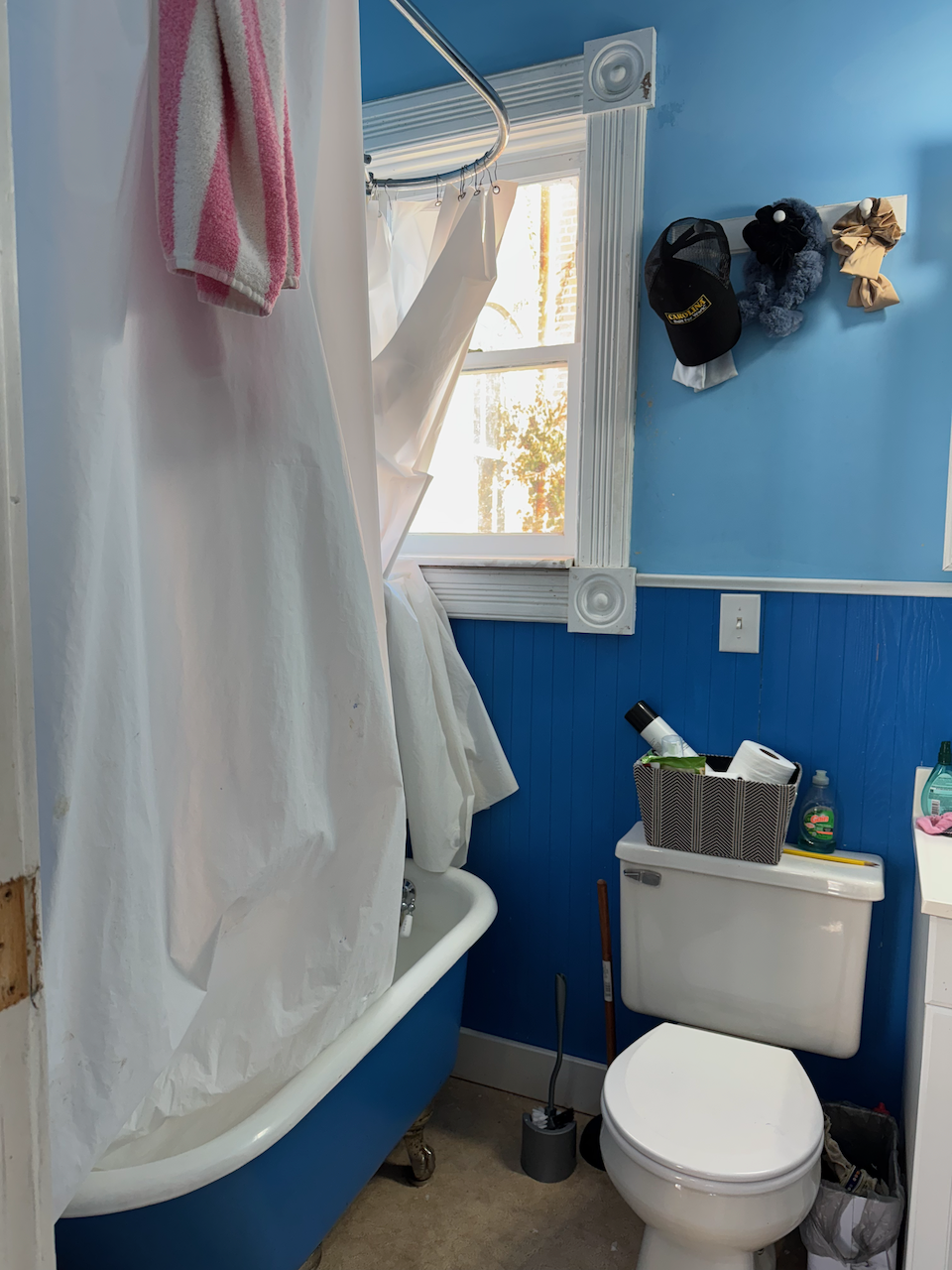
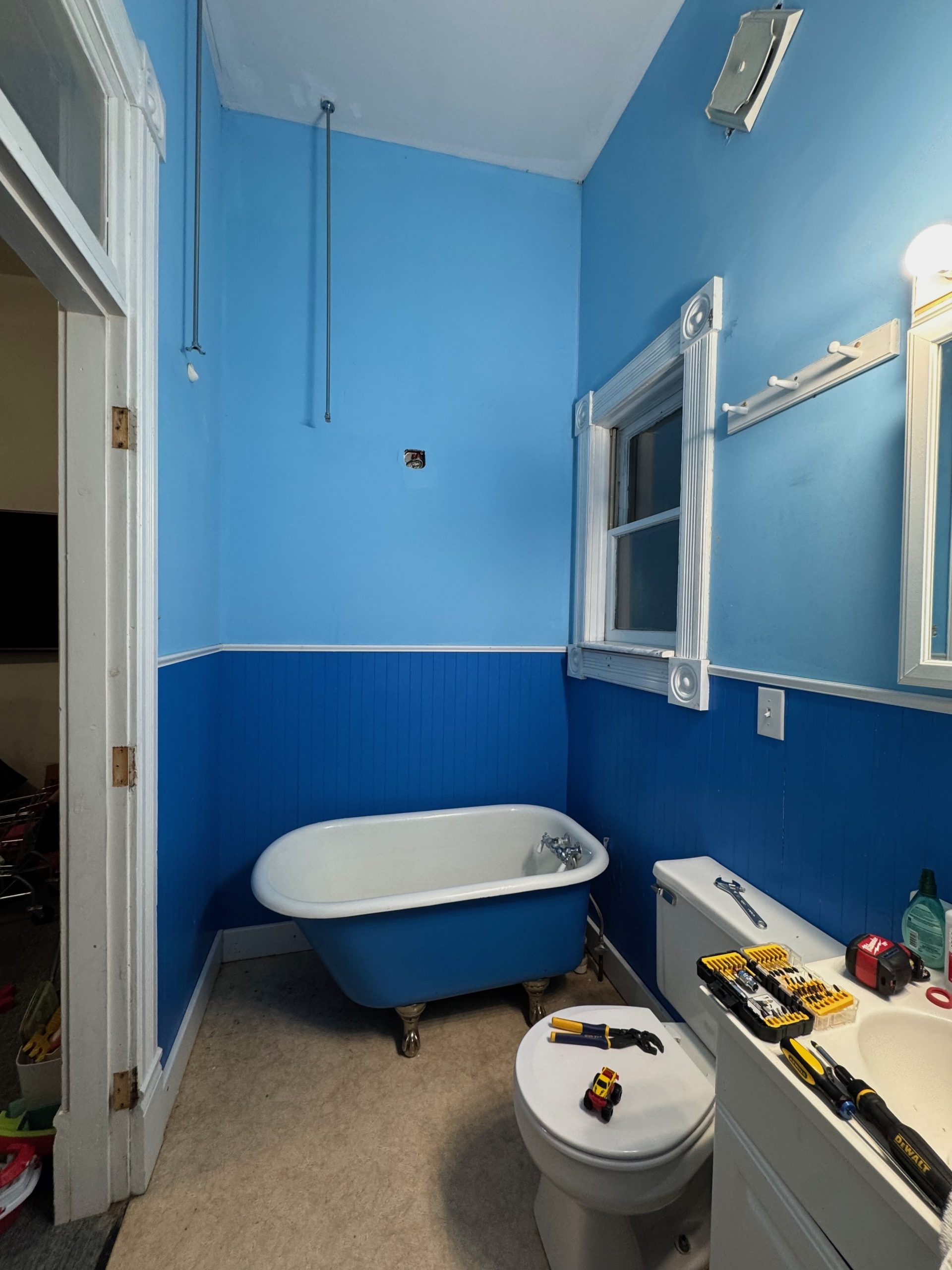
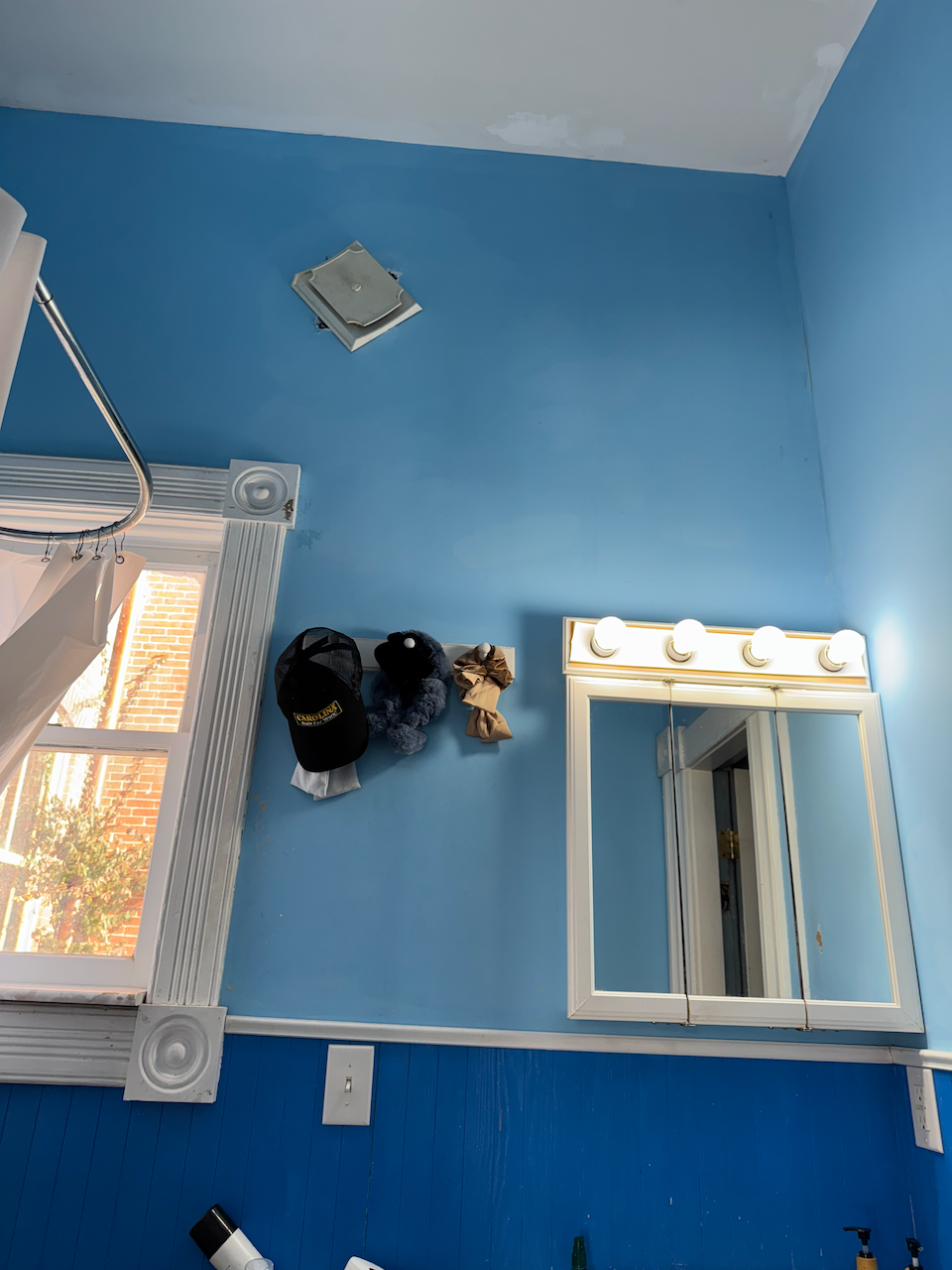
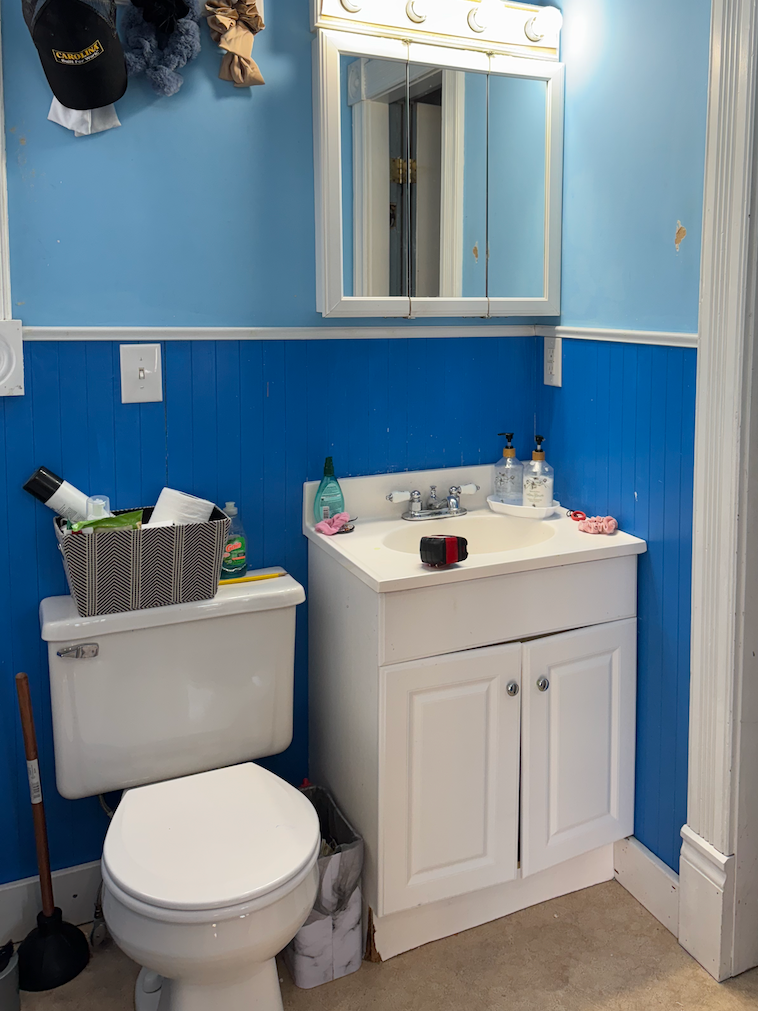
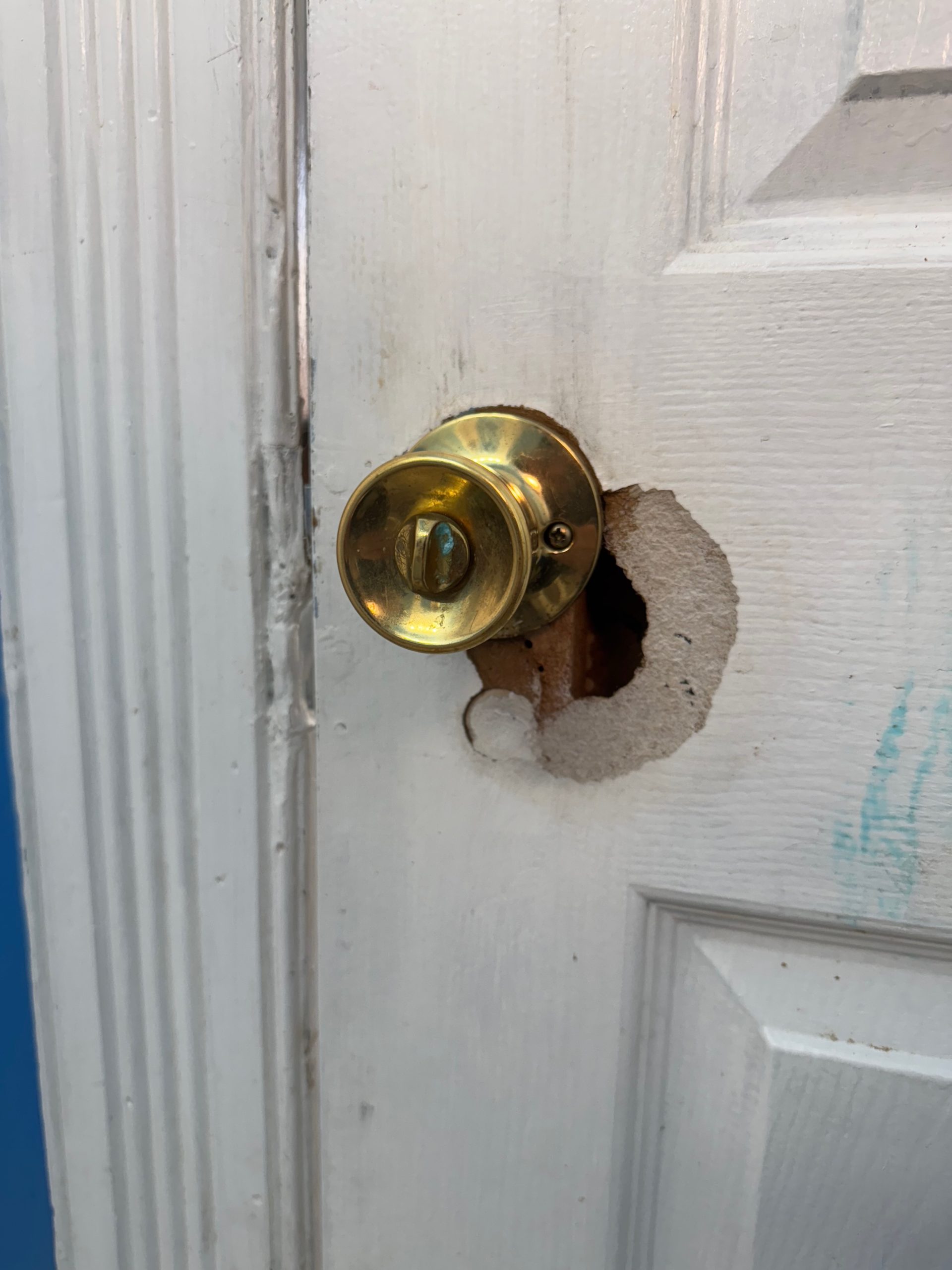
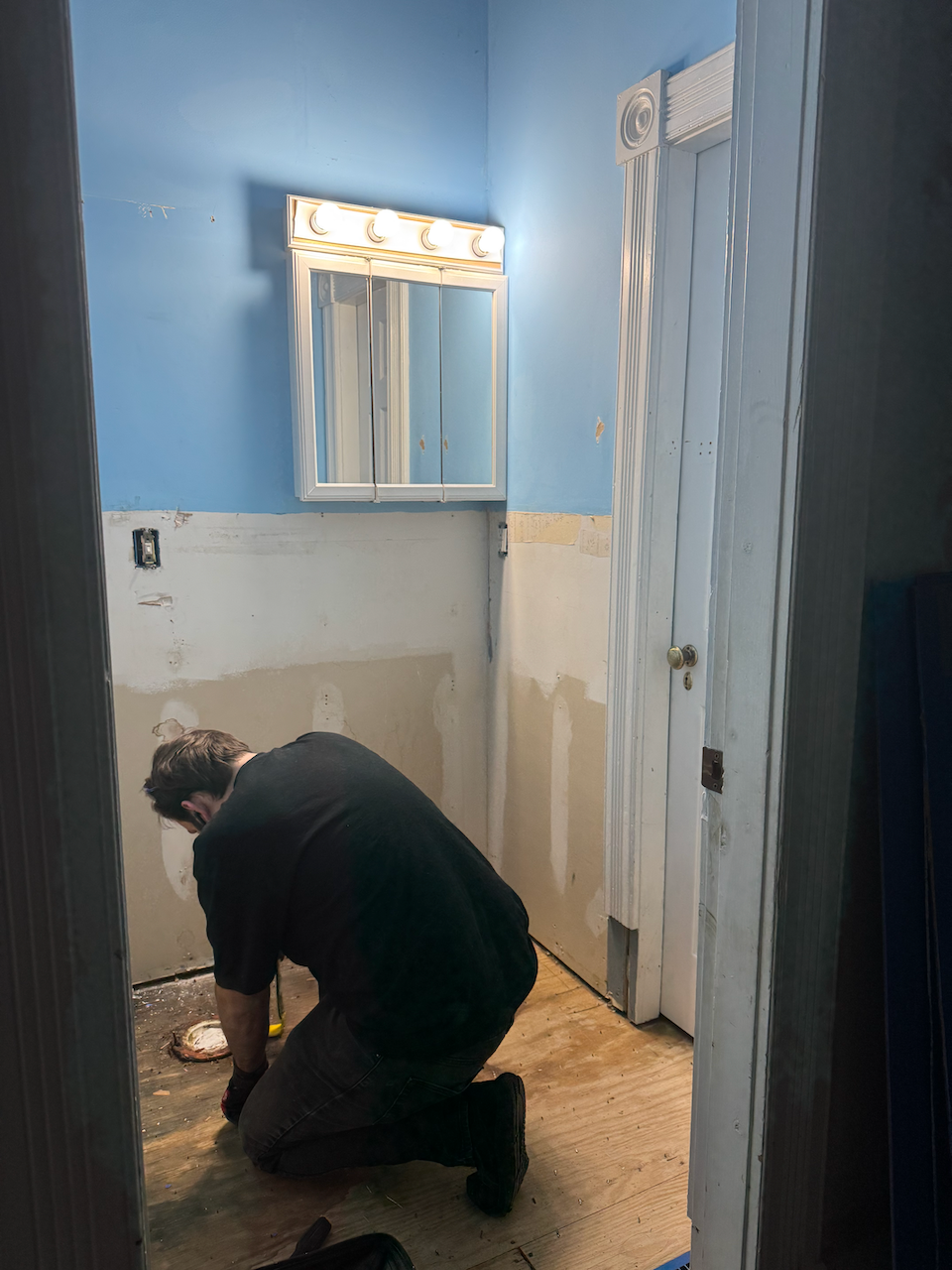
Of all the spaces in the house, this was in the worst shape. The floor was spent, the vanity was literally falling apart, the veneer on the lighting was peeling off, and there was a hole in the door for some unknown reason. The condition of the bathroom is consistent with how it was when we bought the house, and as it goes, took a back seat to much larger projects.
I’m sure there’s a story here from the previous owner. In a single photo, the motivation for the bathroom reno.
Subfloor Replacement
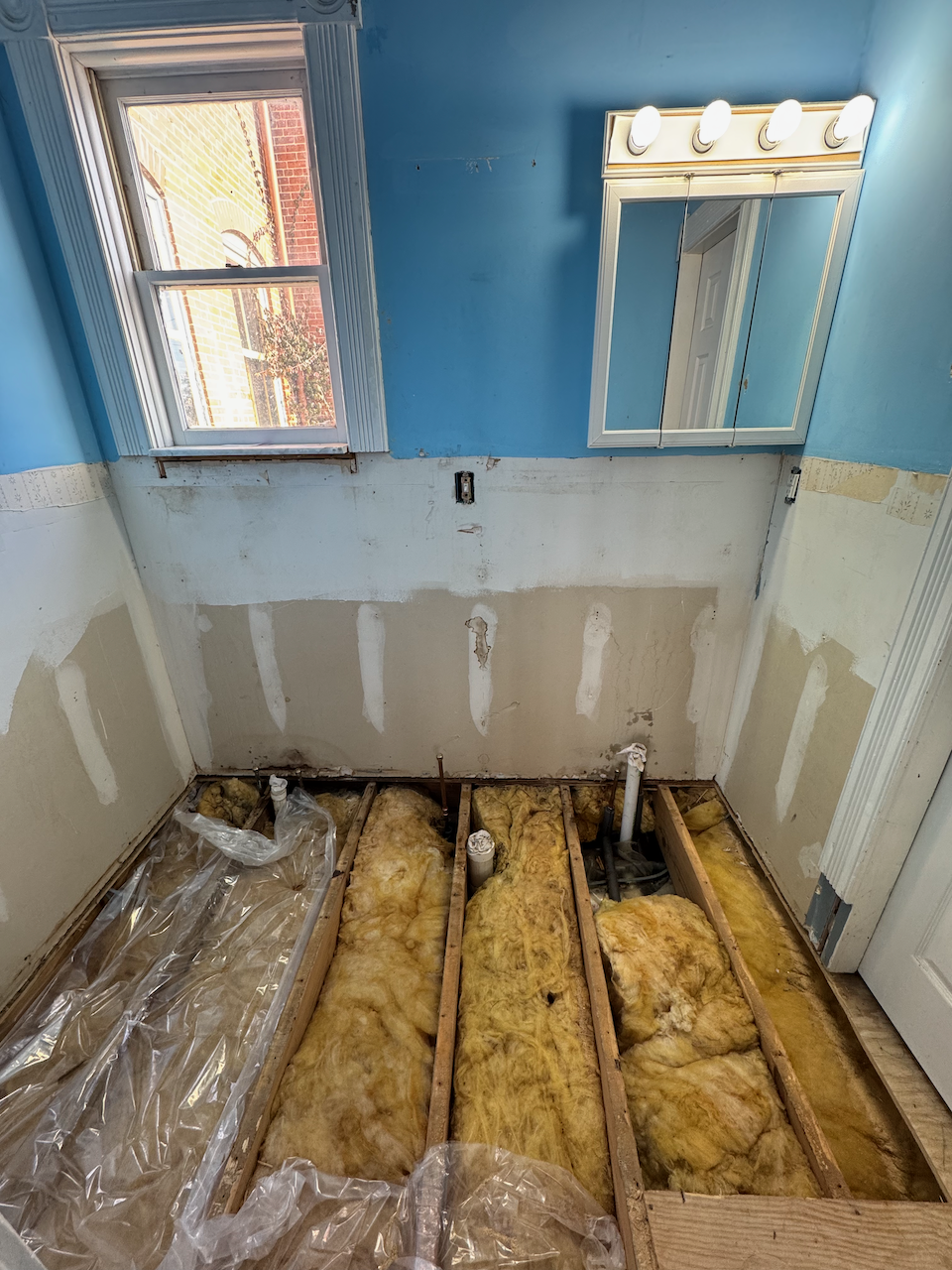
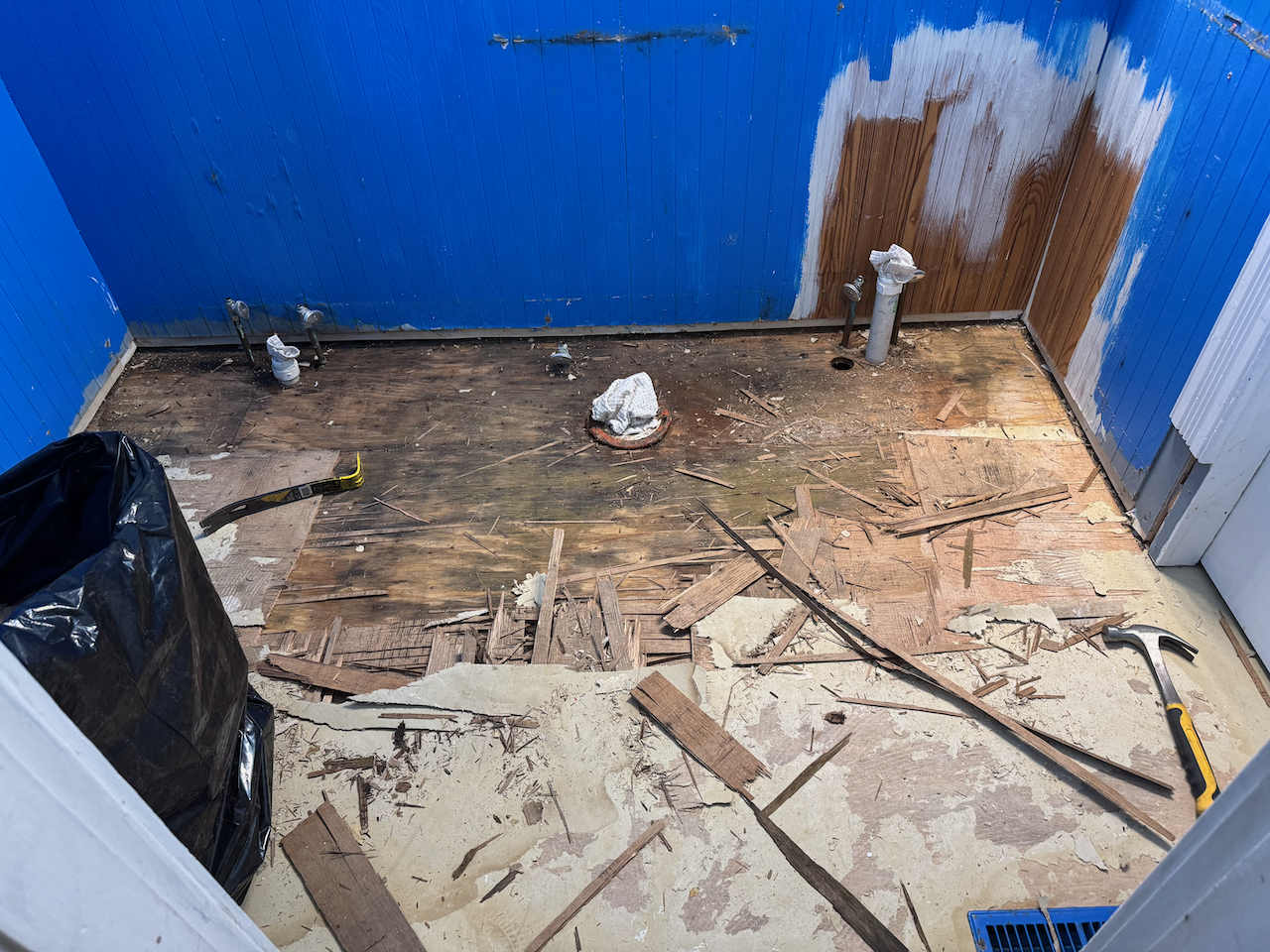
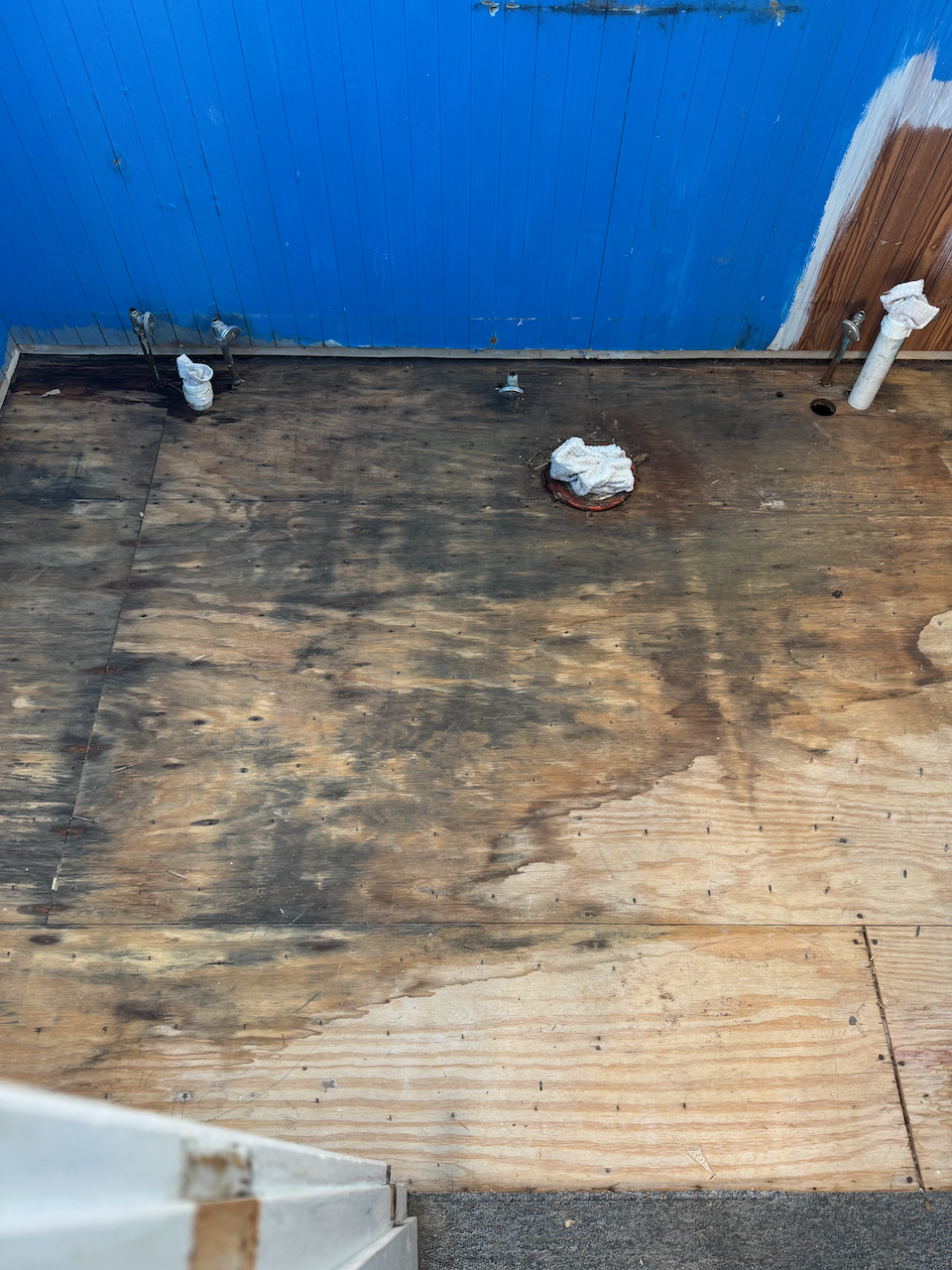
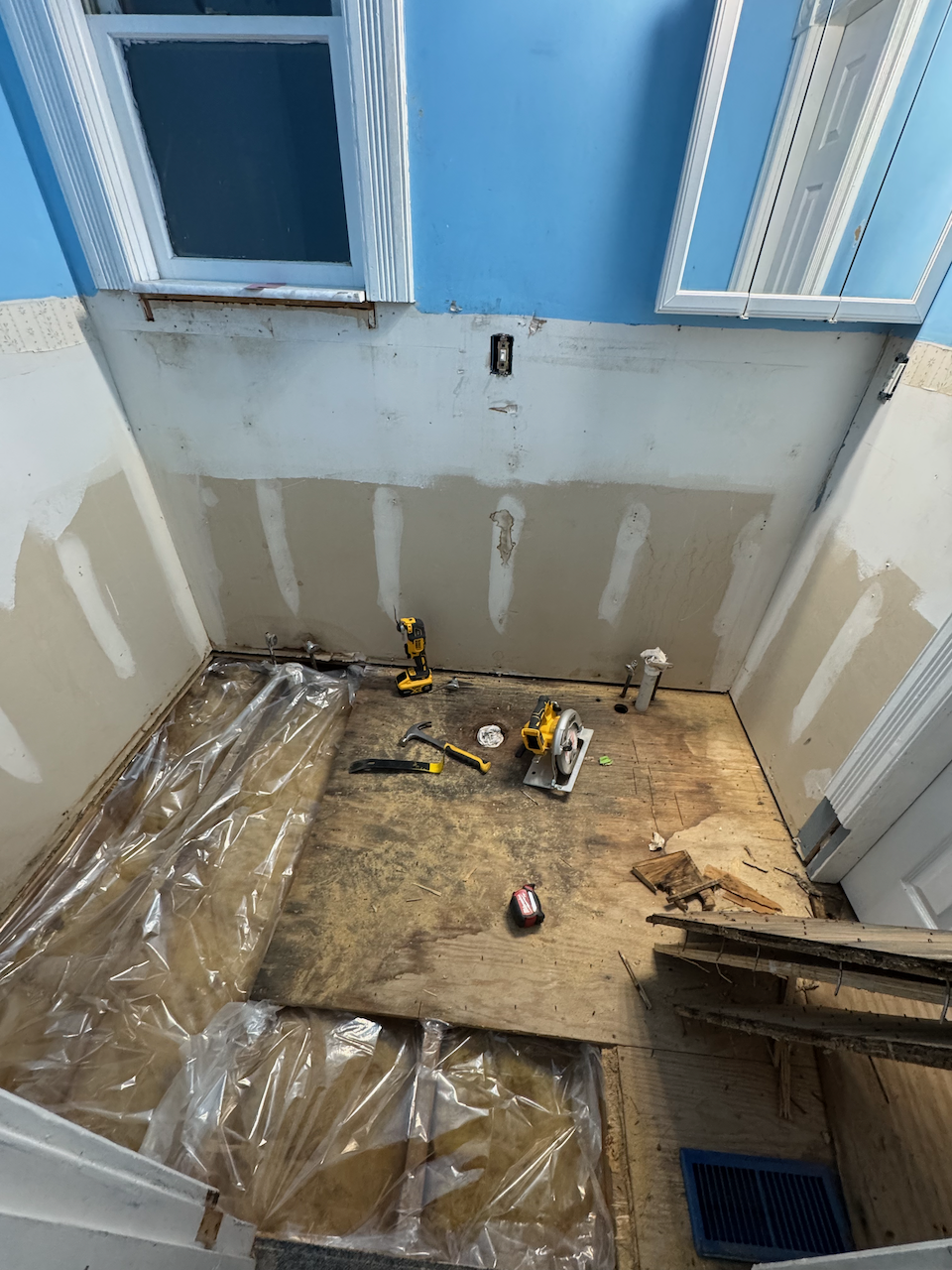
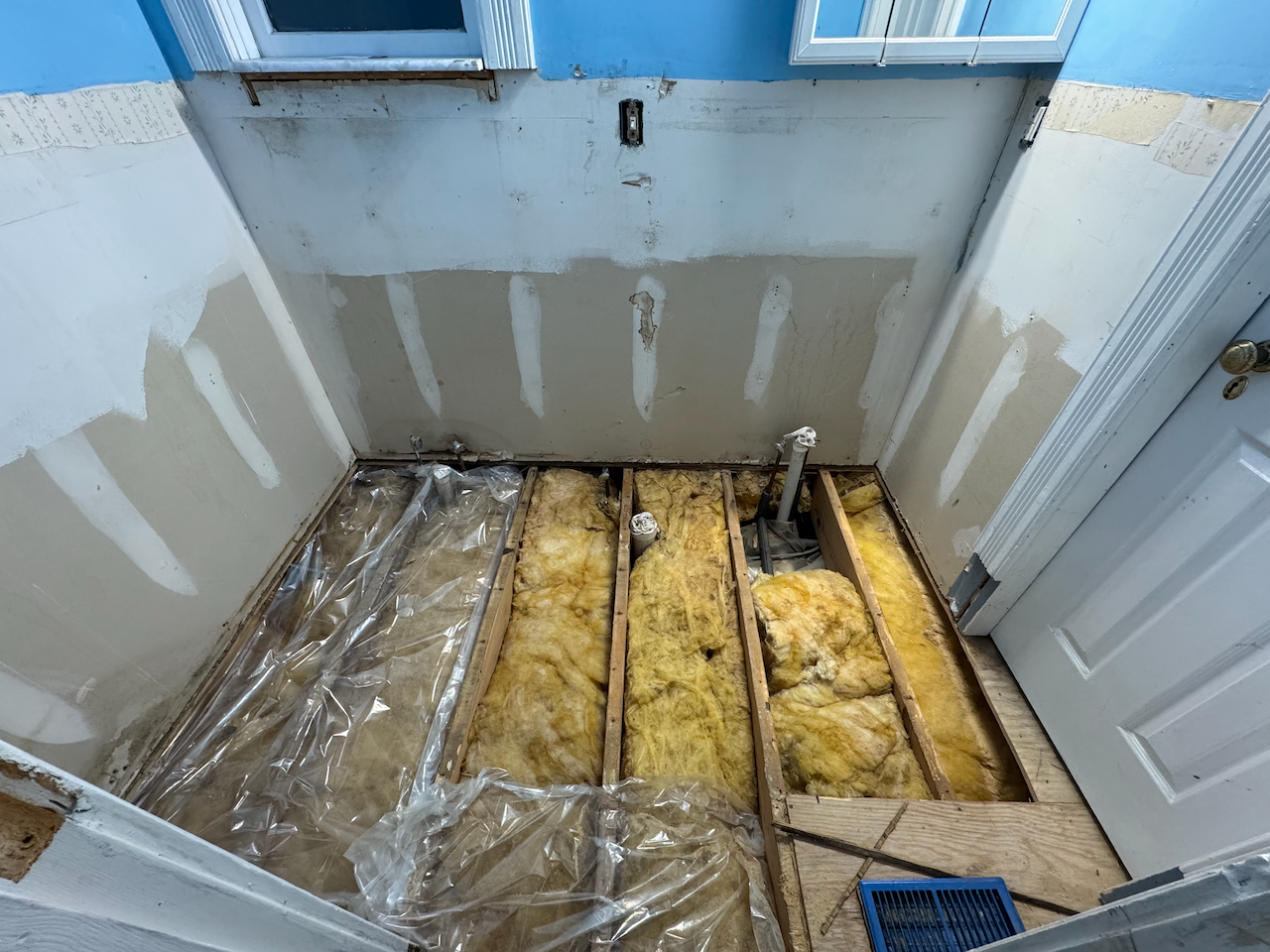
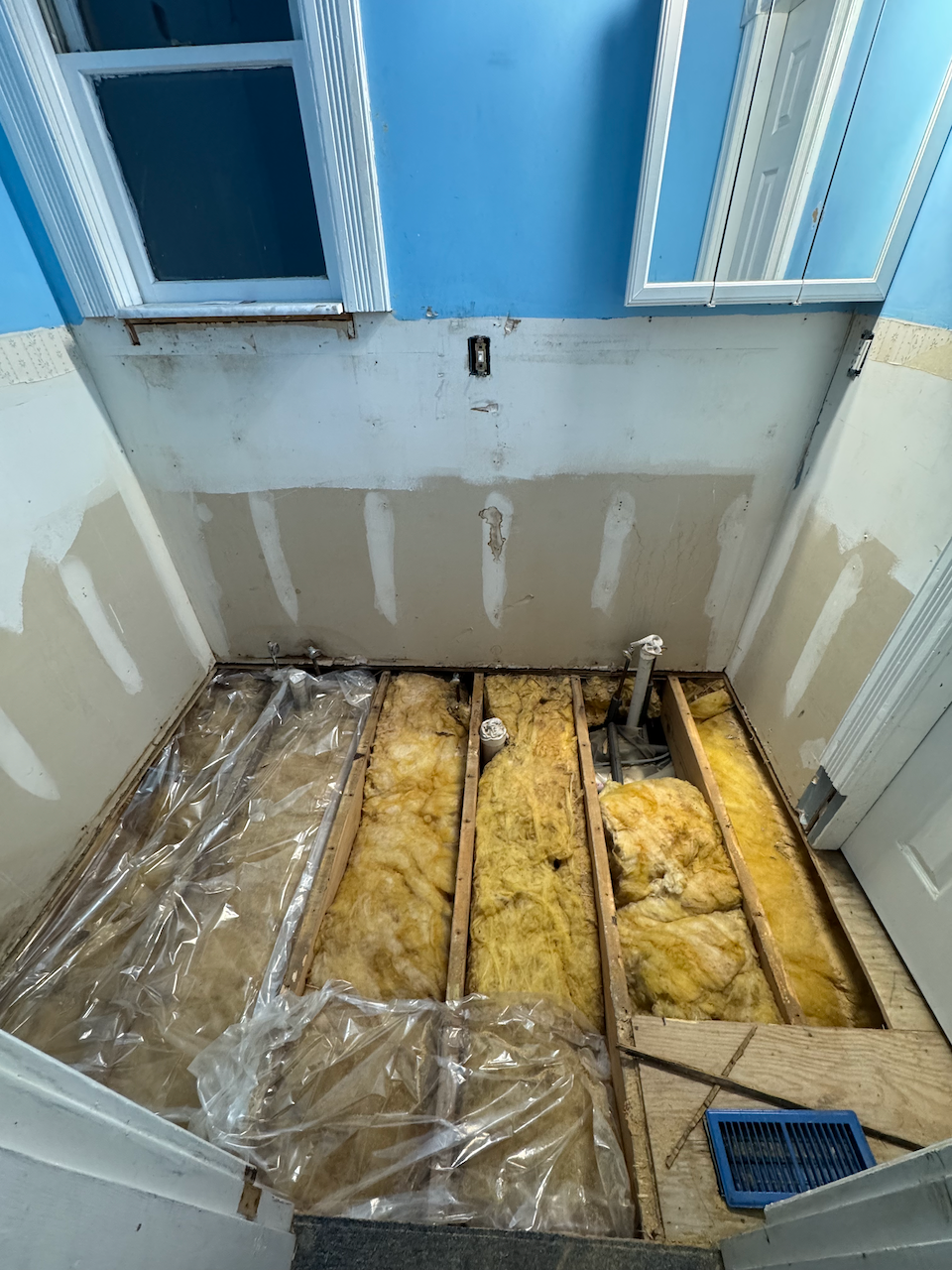
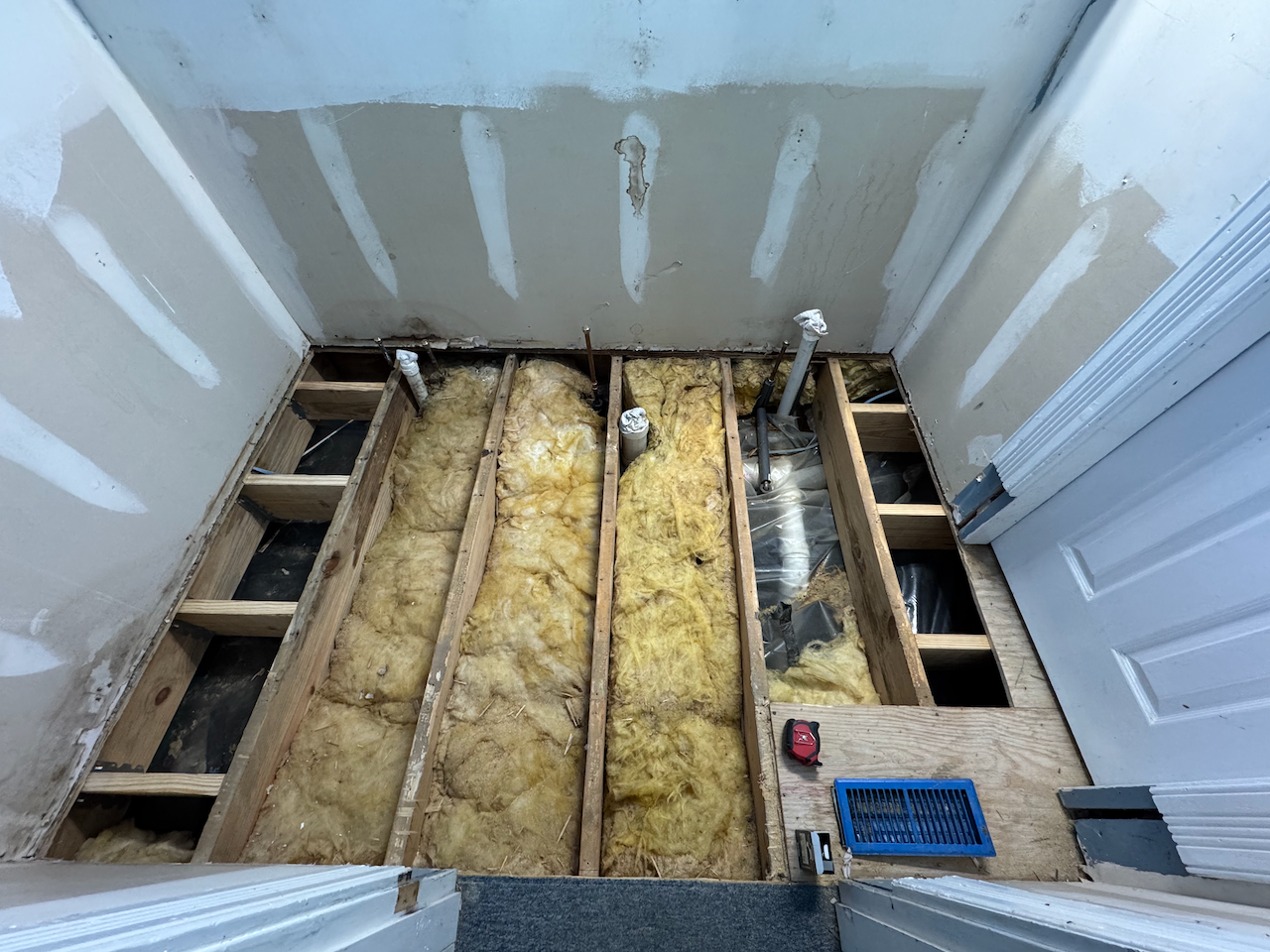
A closer look at the flooring revealed nothing was sealed. The baseboards, toilet, and beneath the pipe escutcheons were not caulked, allowing water to reach the subfloor.
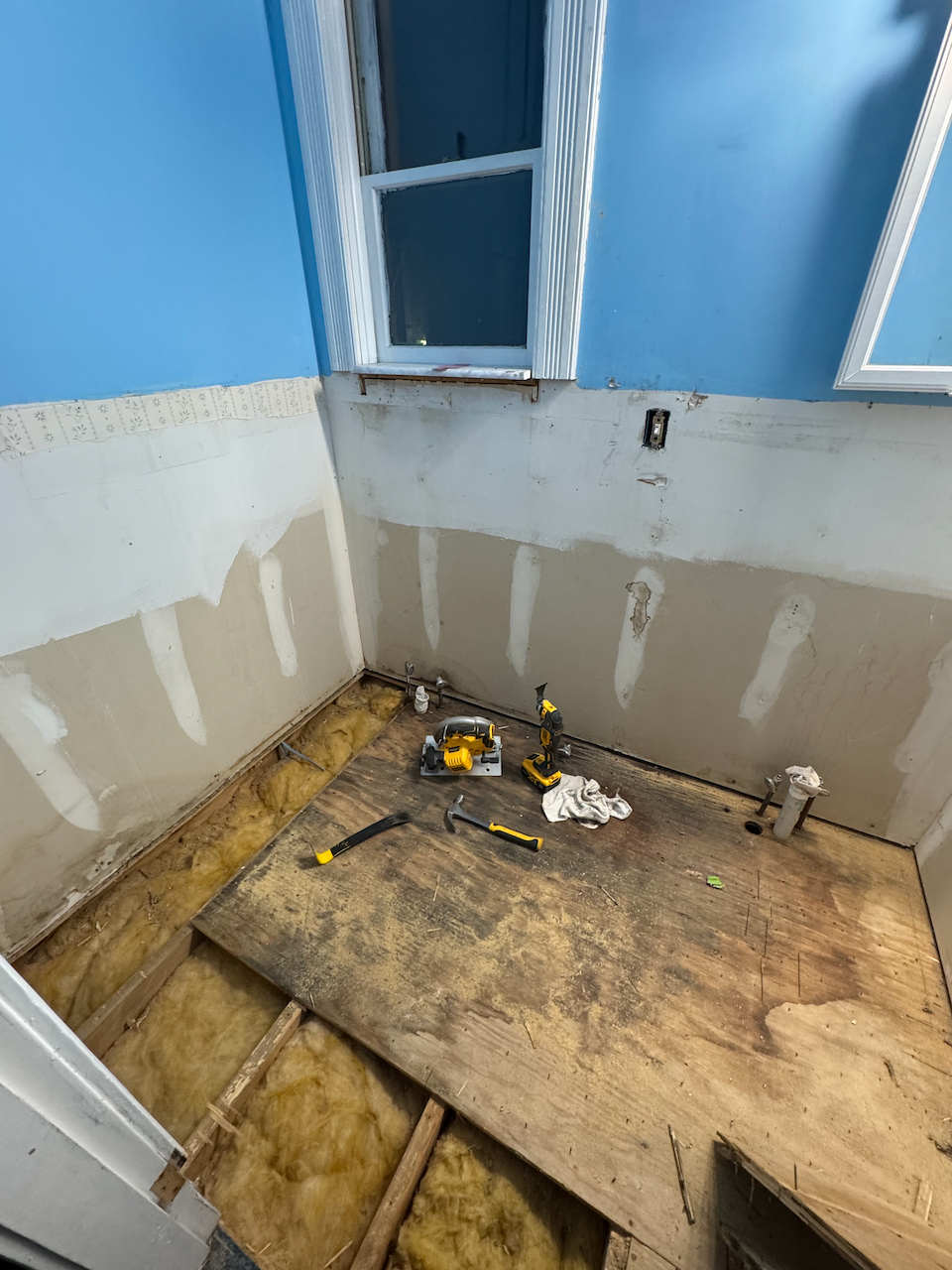
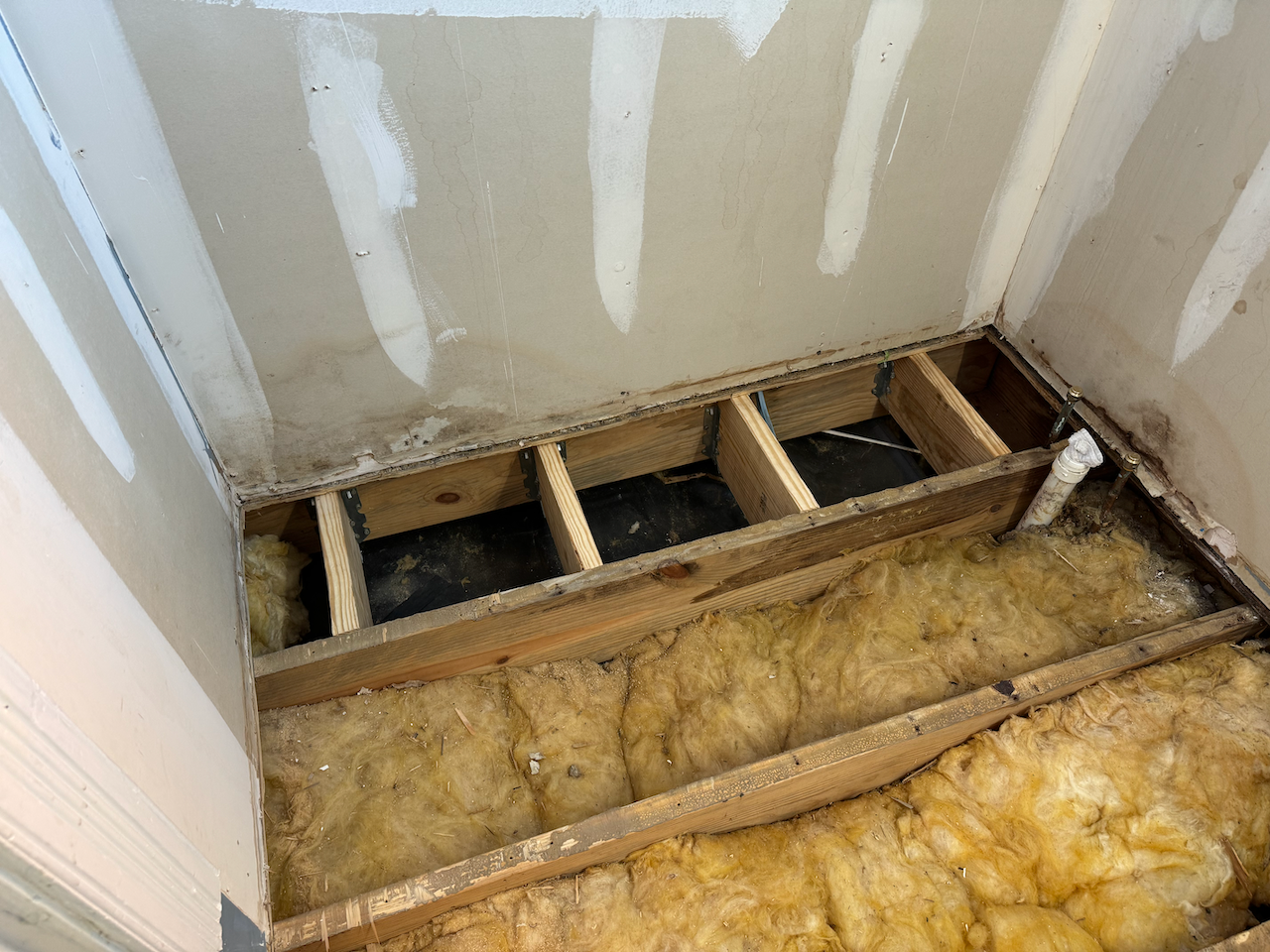
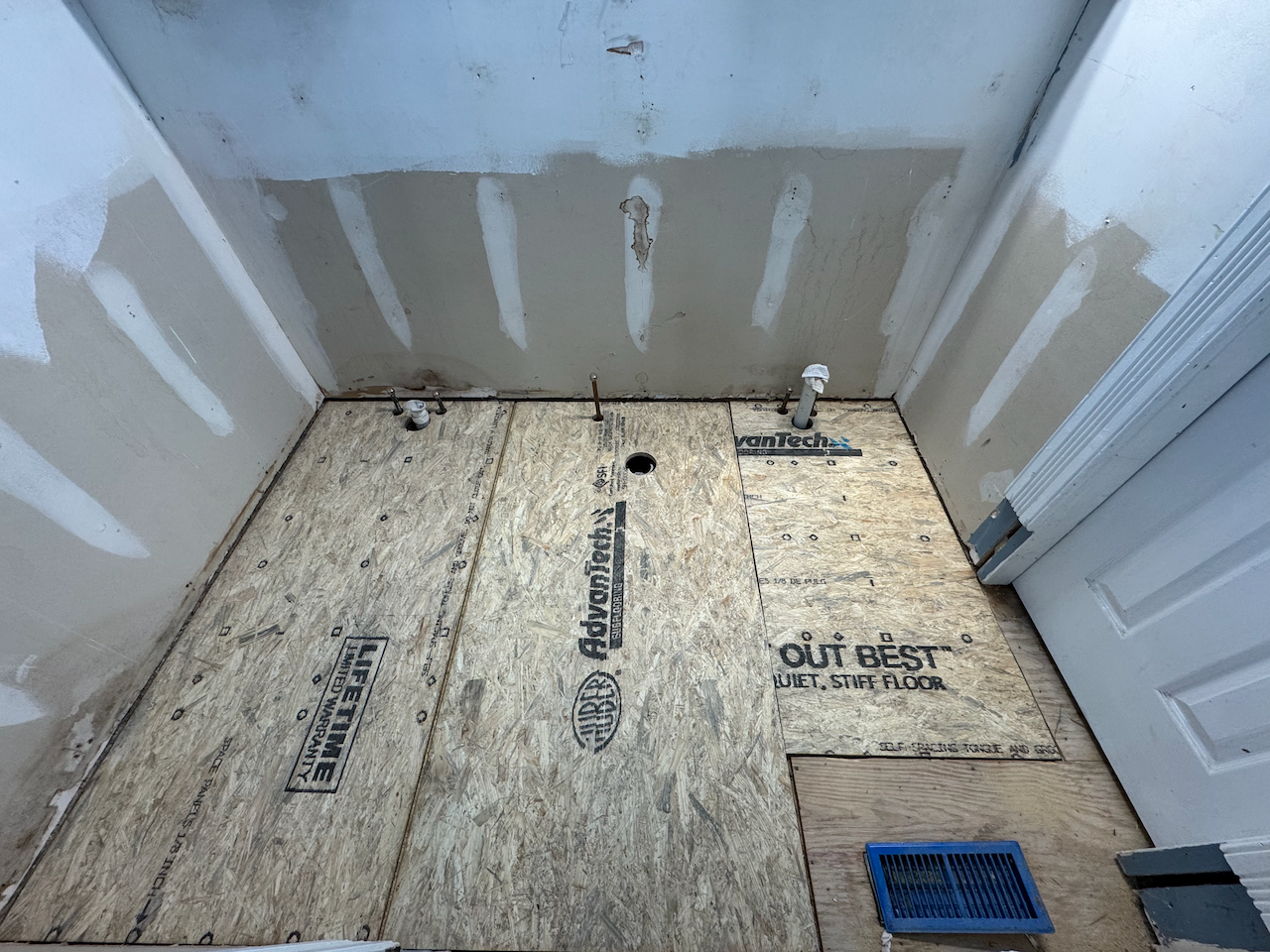
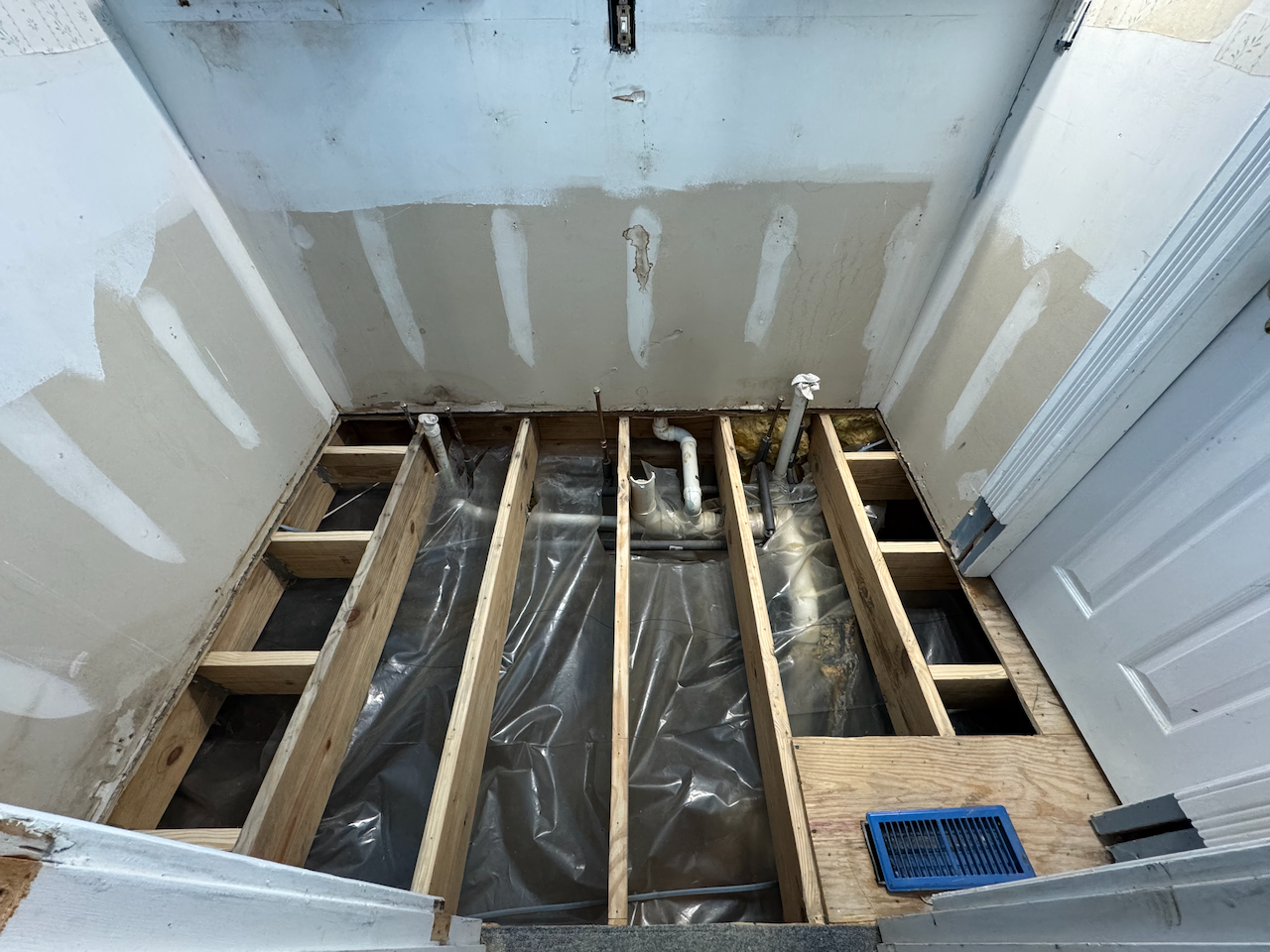
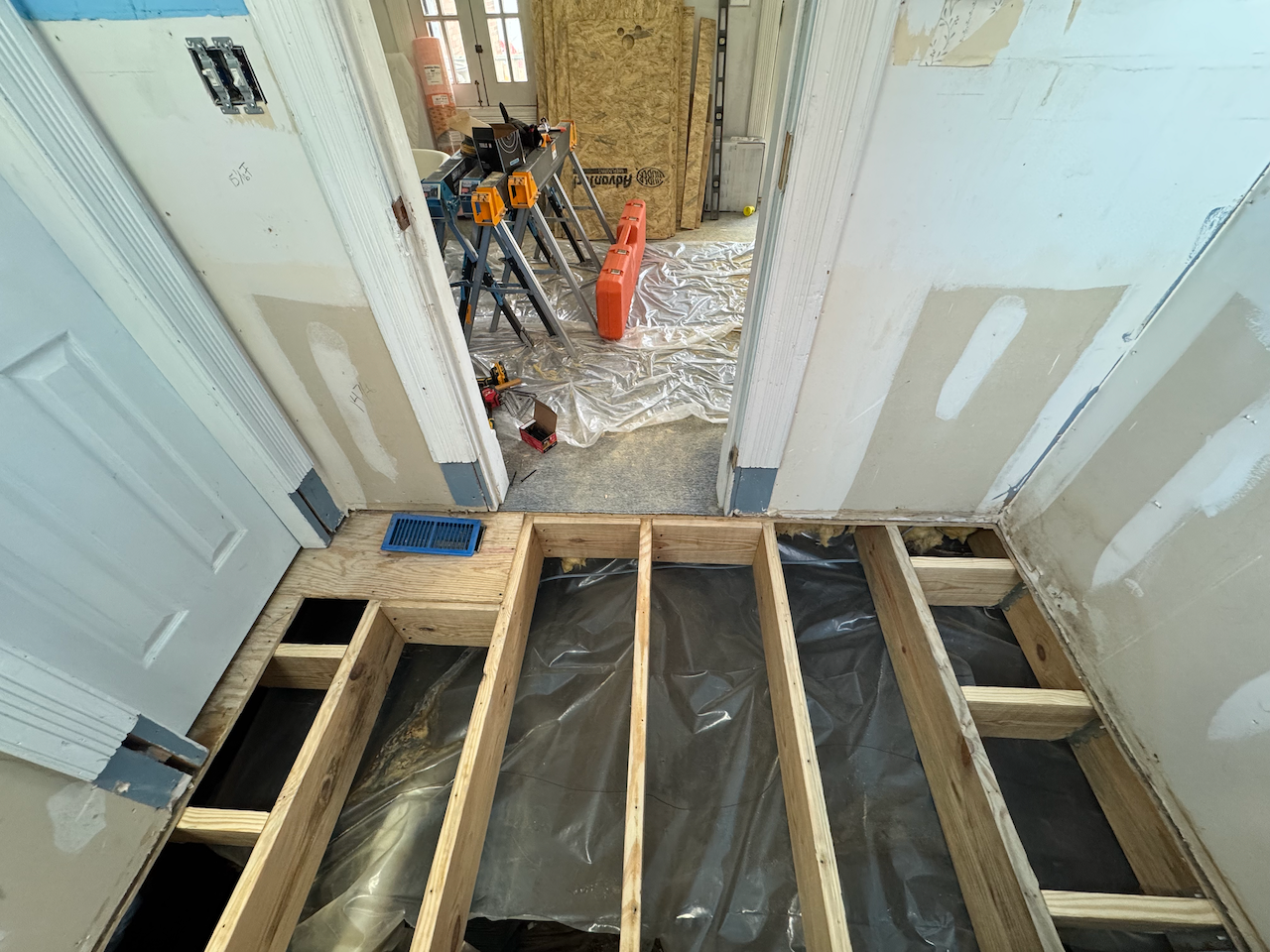
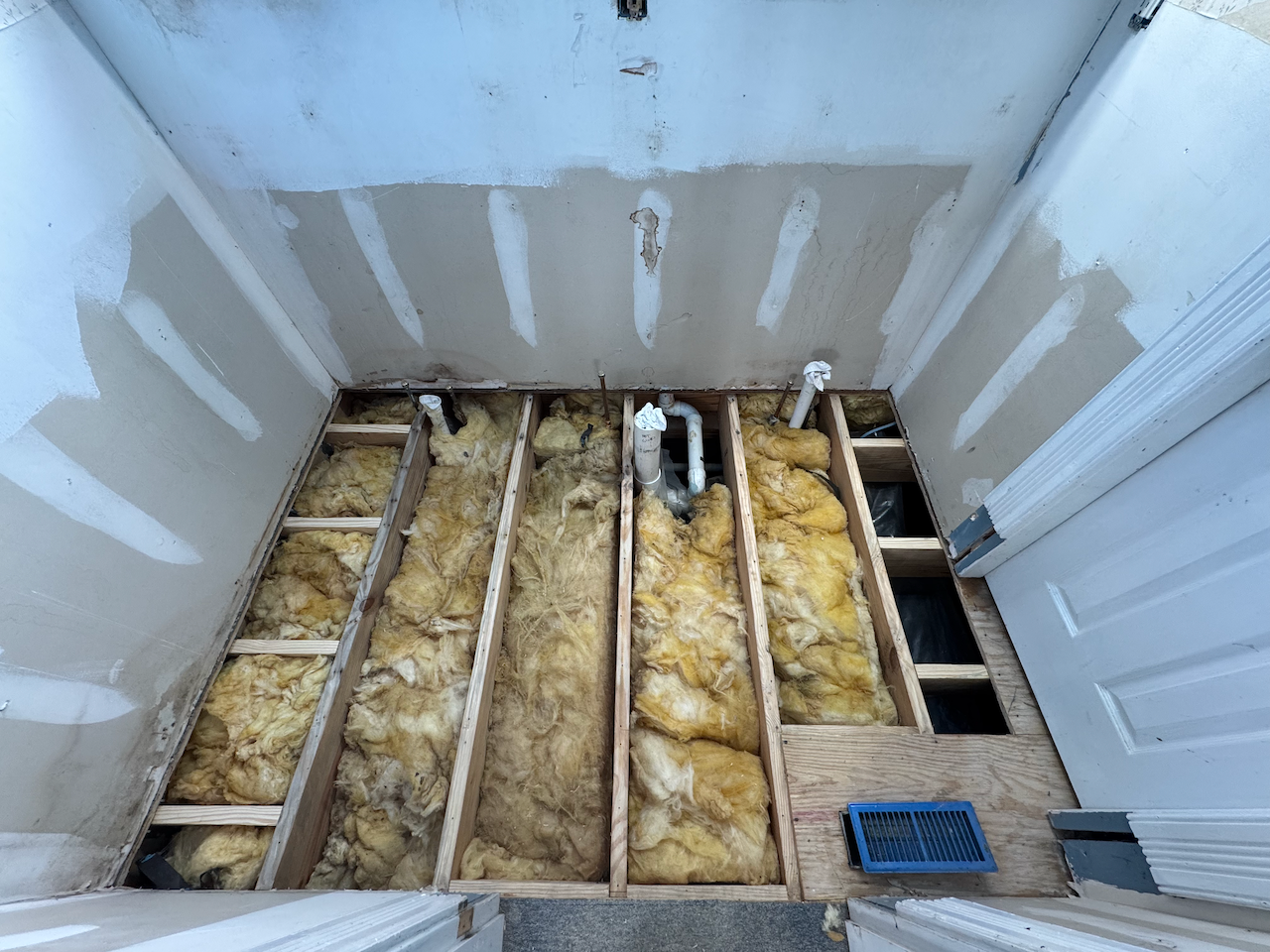
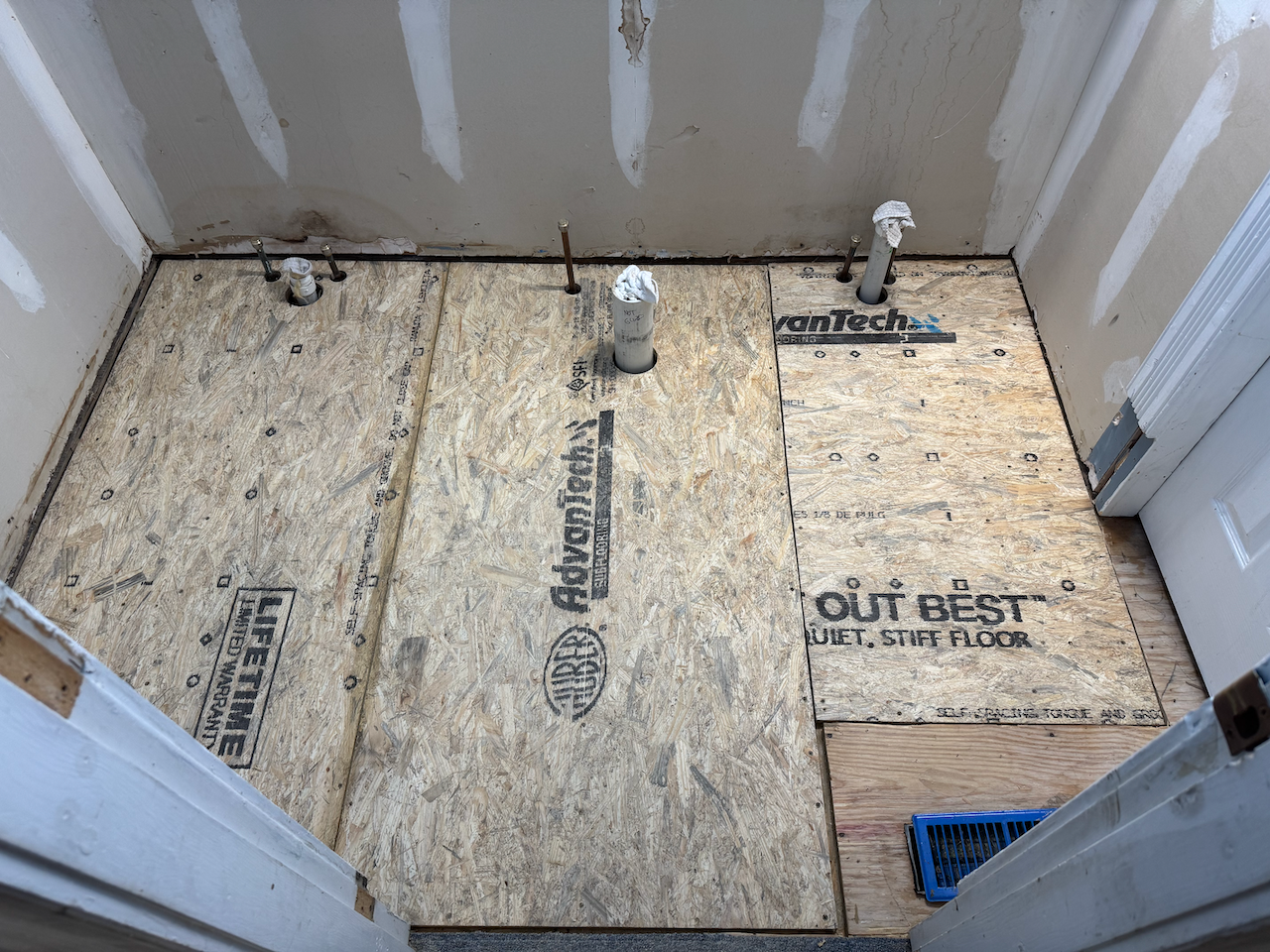
So, first surprise, the subfloor needs to be replaced. Down to the floor joists we go!
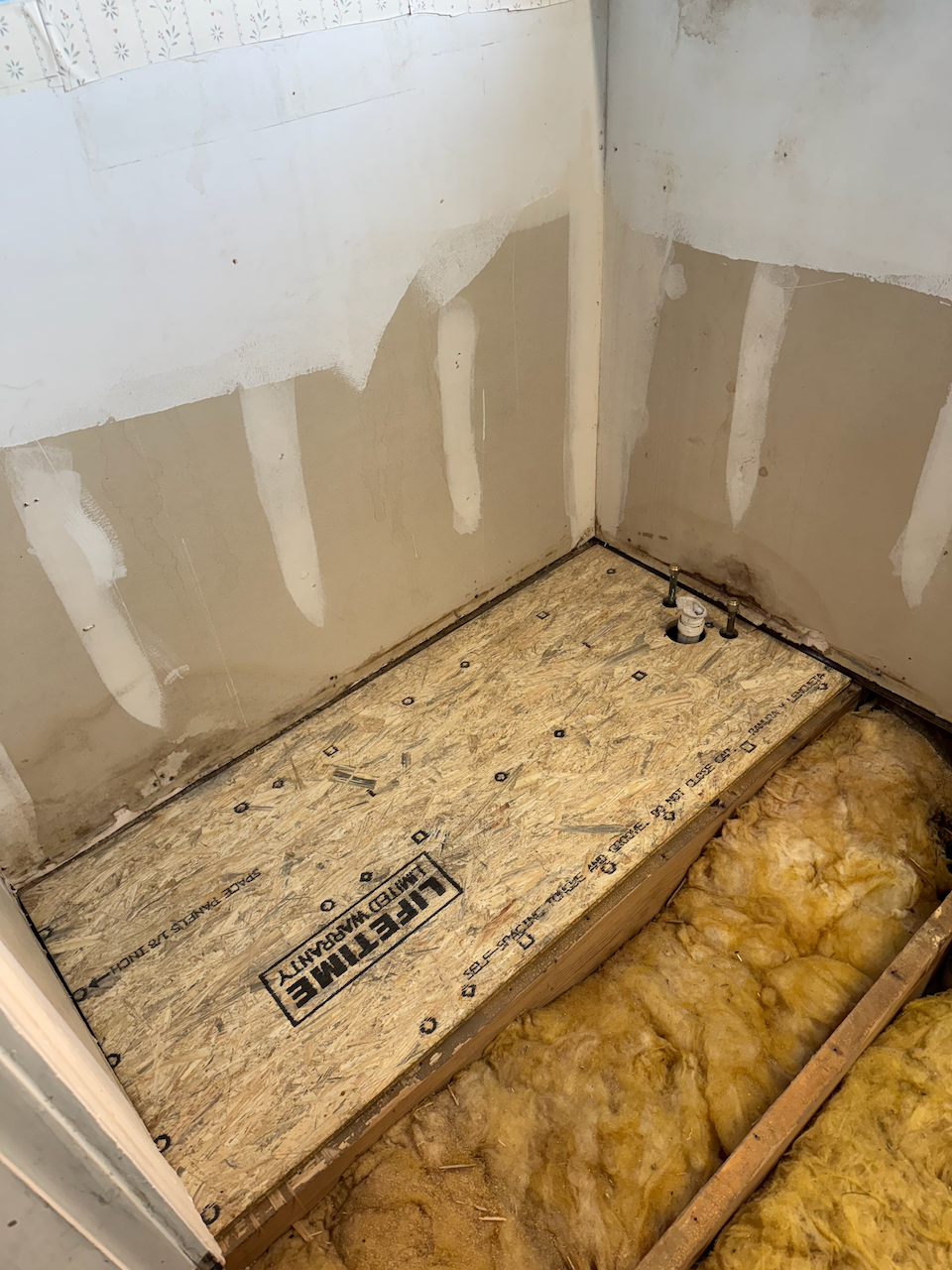
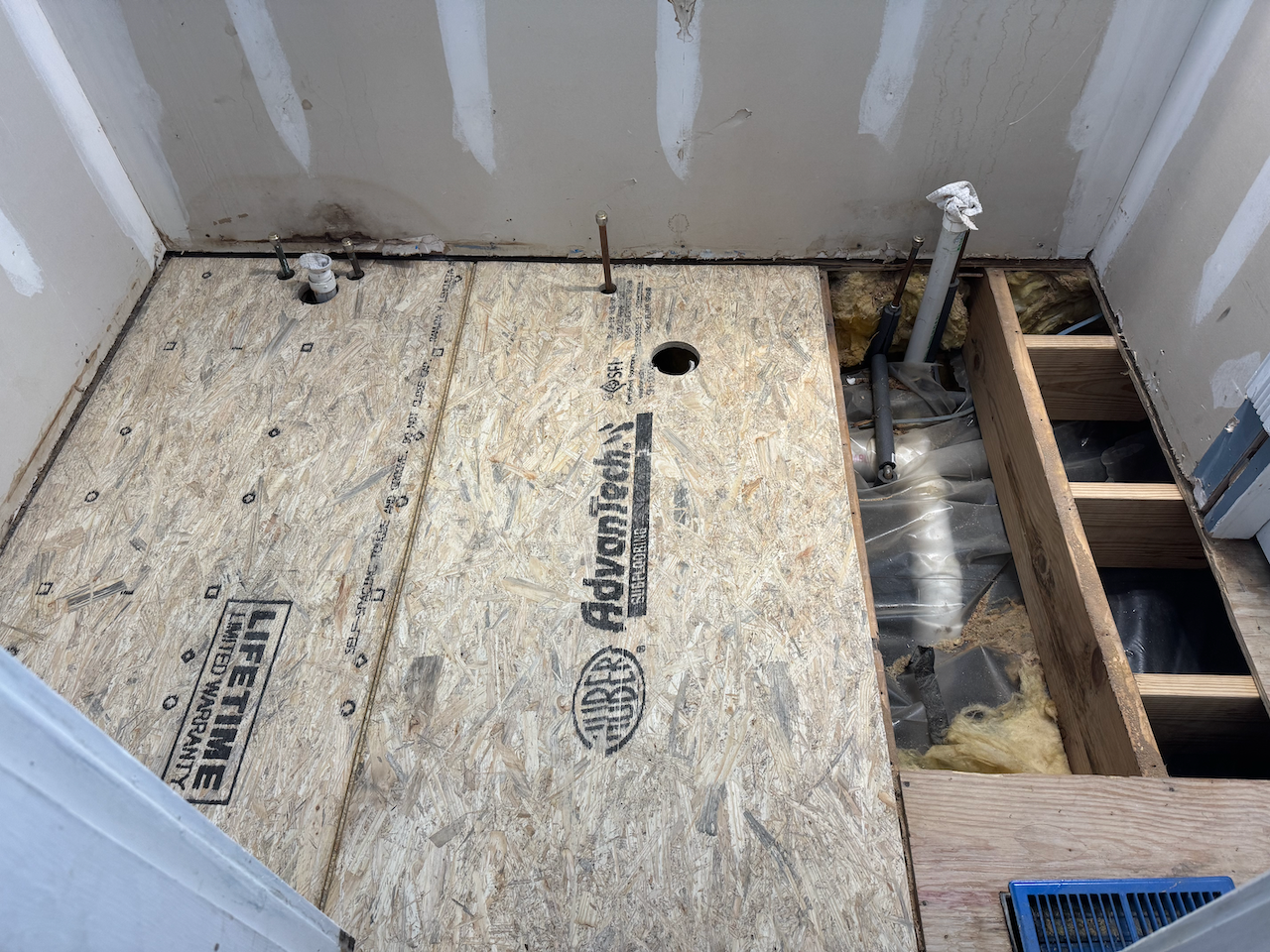
Working through the layers, not liking what we’re findingOh, boy. That’s not good.Removing the toilet flange and starting on the subfloor demoSubfloor removed, next up is blocking, given that the subfloor was original to the additionBlocking required on both the left and right sideTight spaces required crawlspace access to fasten the blockingBlocking done, next up is the new subfloorAdvanTech is heavy! Next up is filling the screw holes and gaps
Renovation
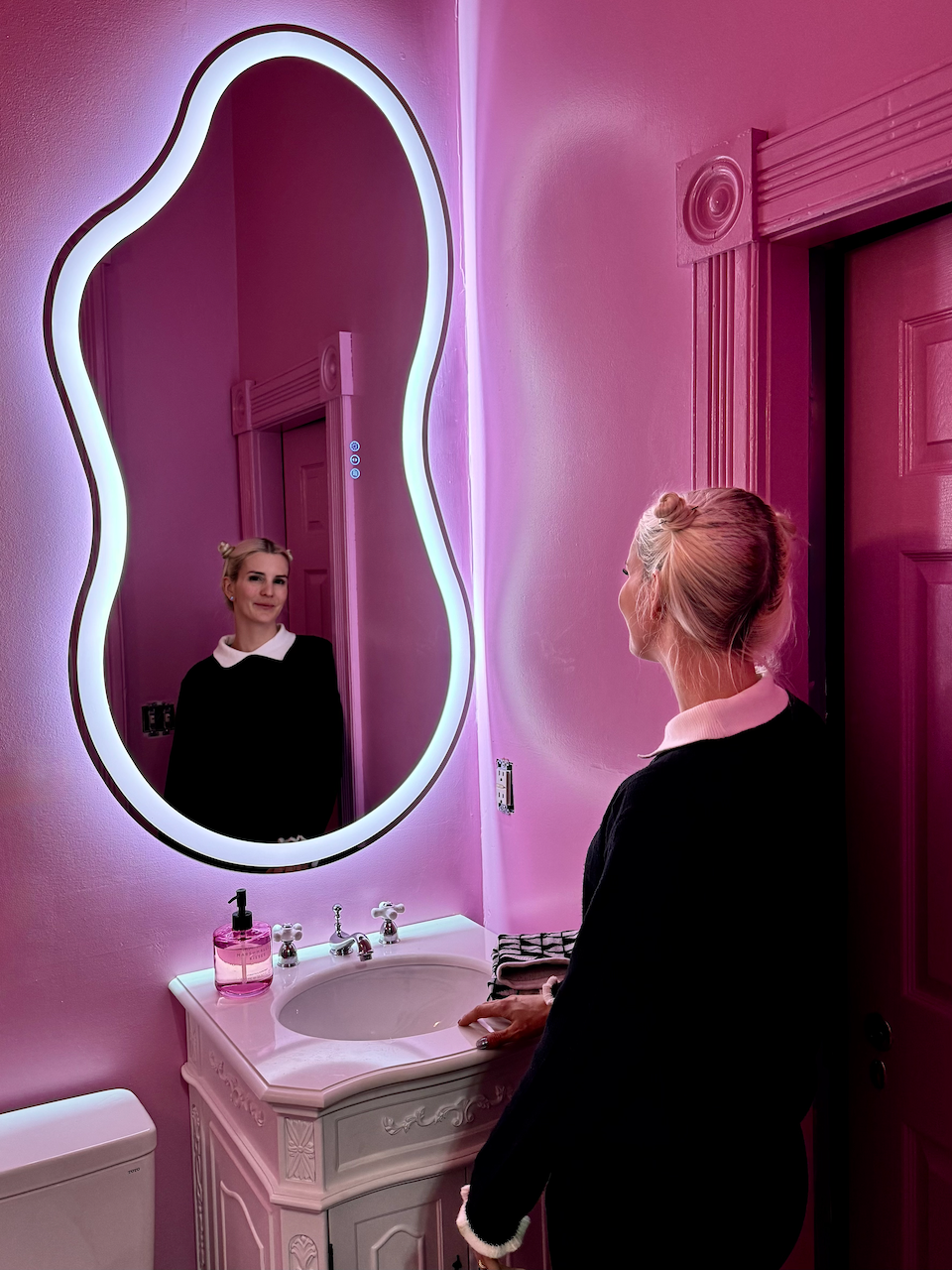
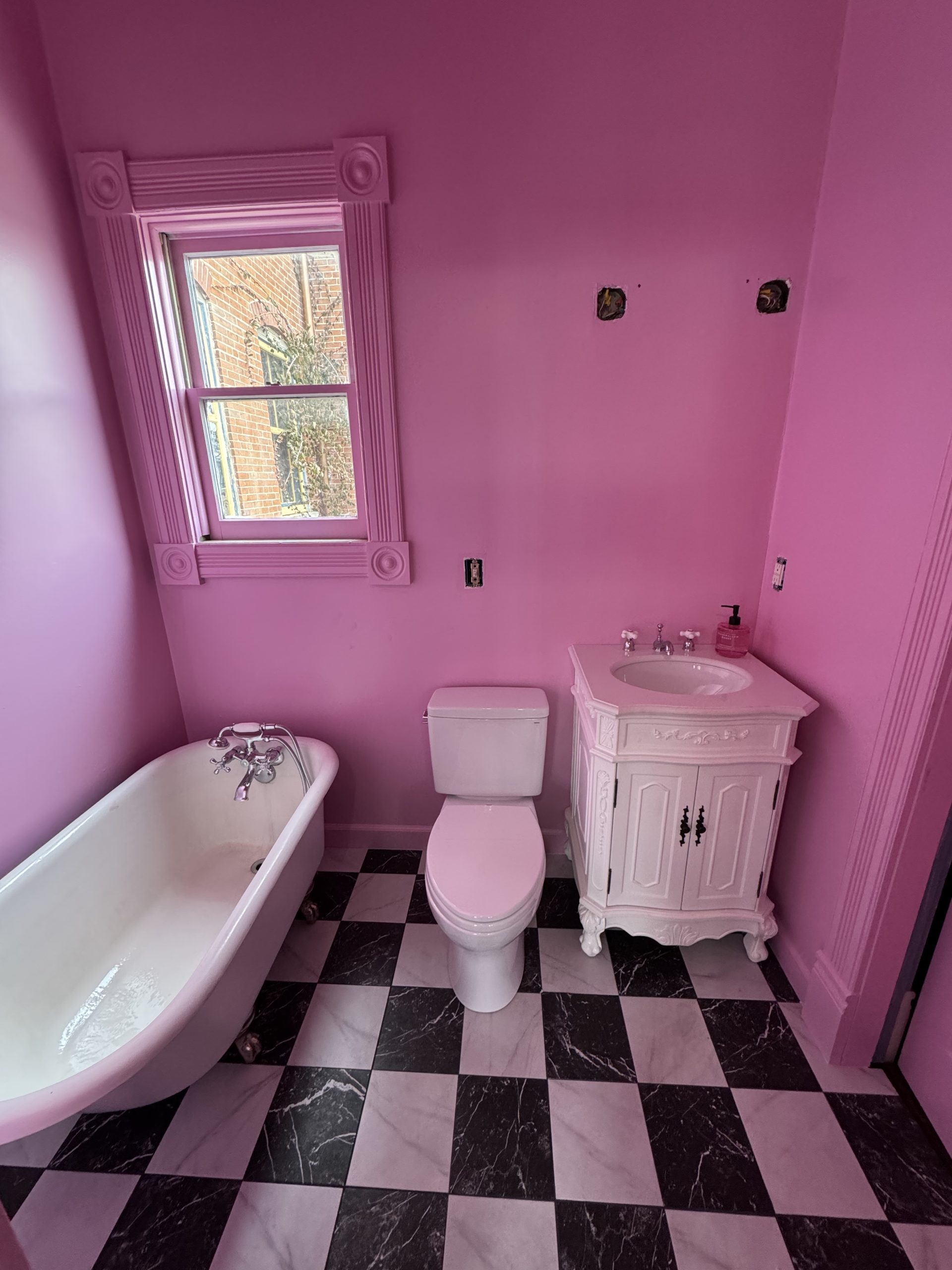
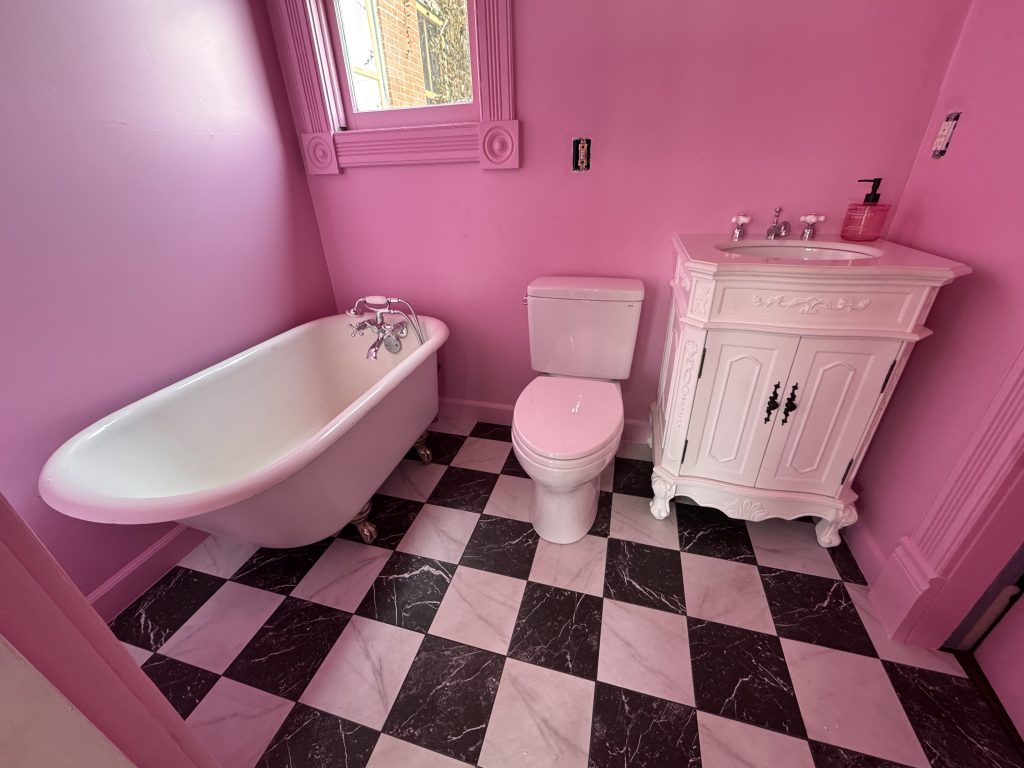
With the subfloor construction behind us, it’s time to rebuild this bathroom. Since this is not a historic space and is part of the 1980s addition, we decided on a design fusion of historic and modern elements. The casing, bullseyes, and plinths are already Victorian-inspired. The clawfoot tub was manufactured somewhere in the 1920s. We chose a new vanity that is a nod to the home.
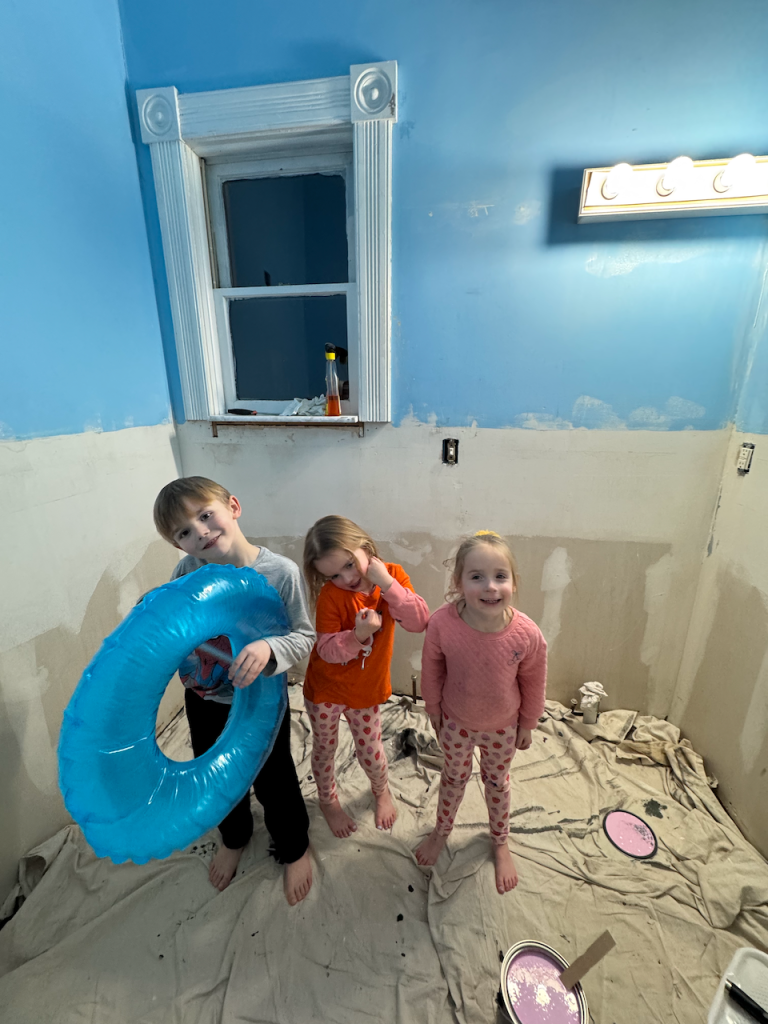
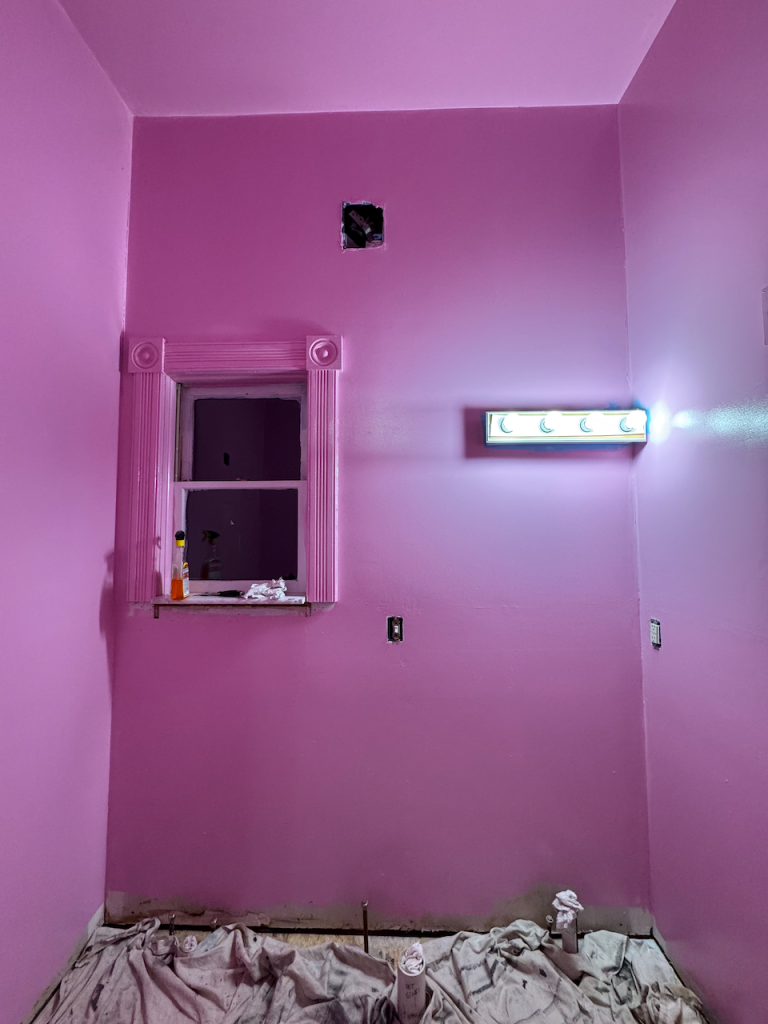
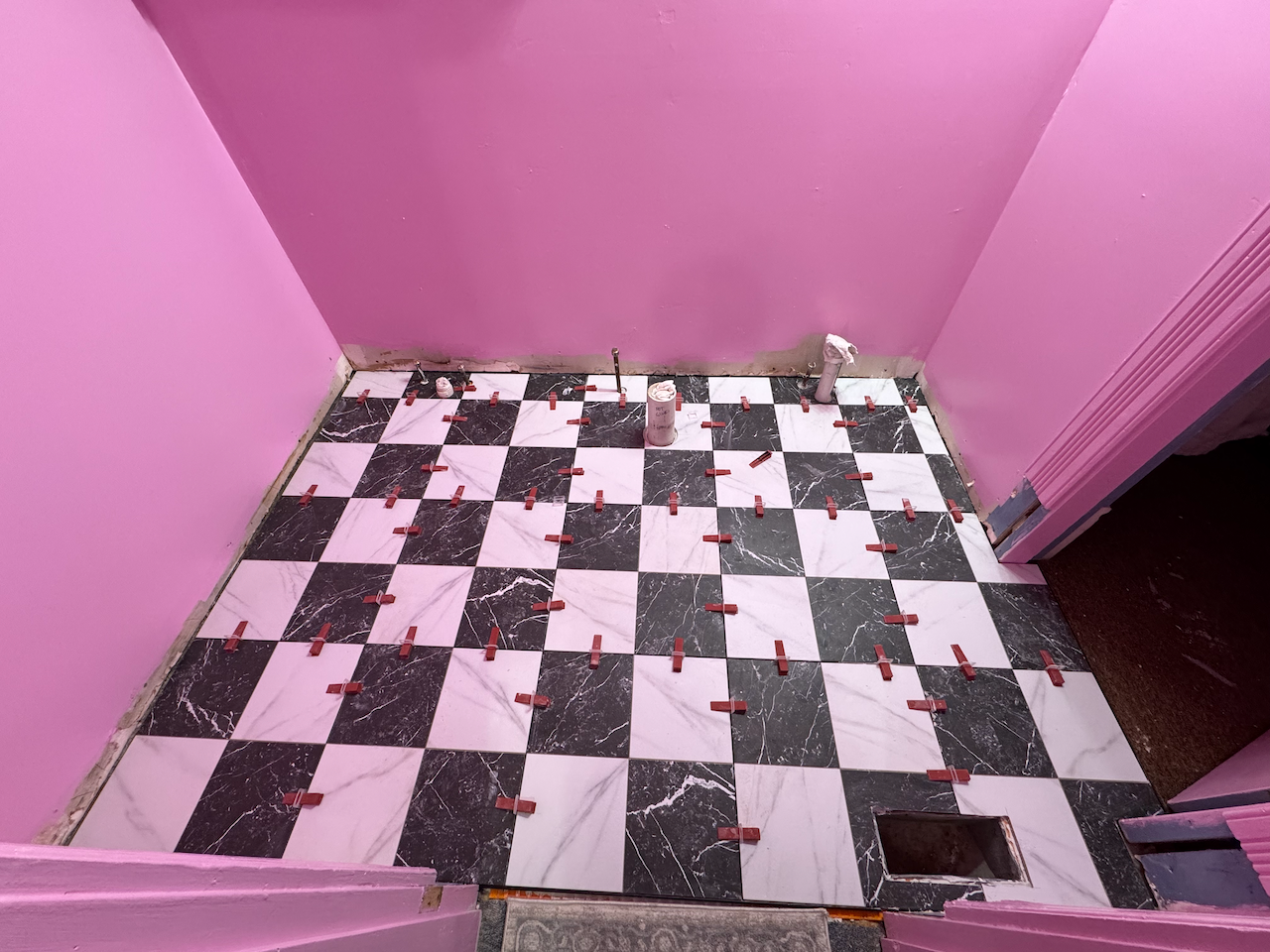
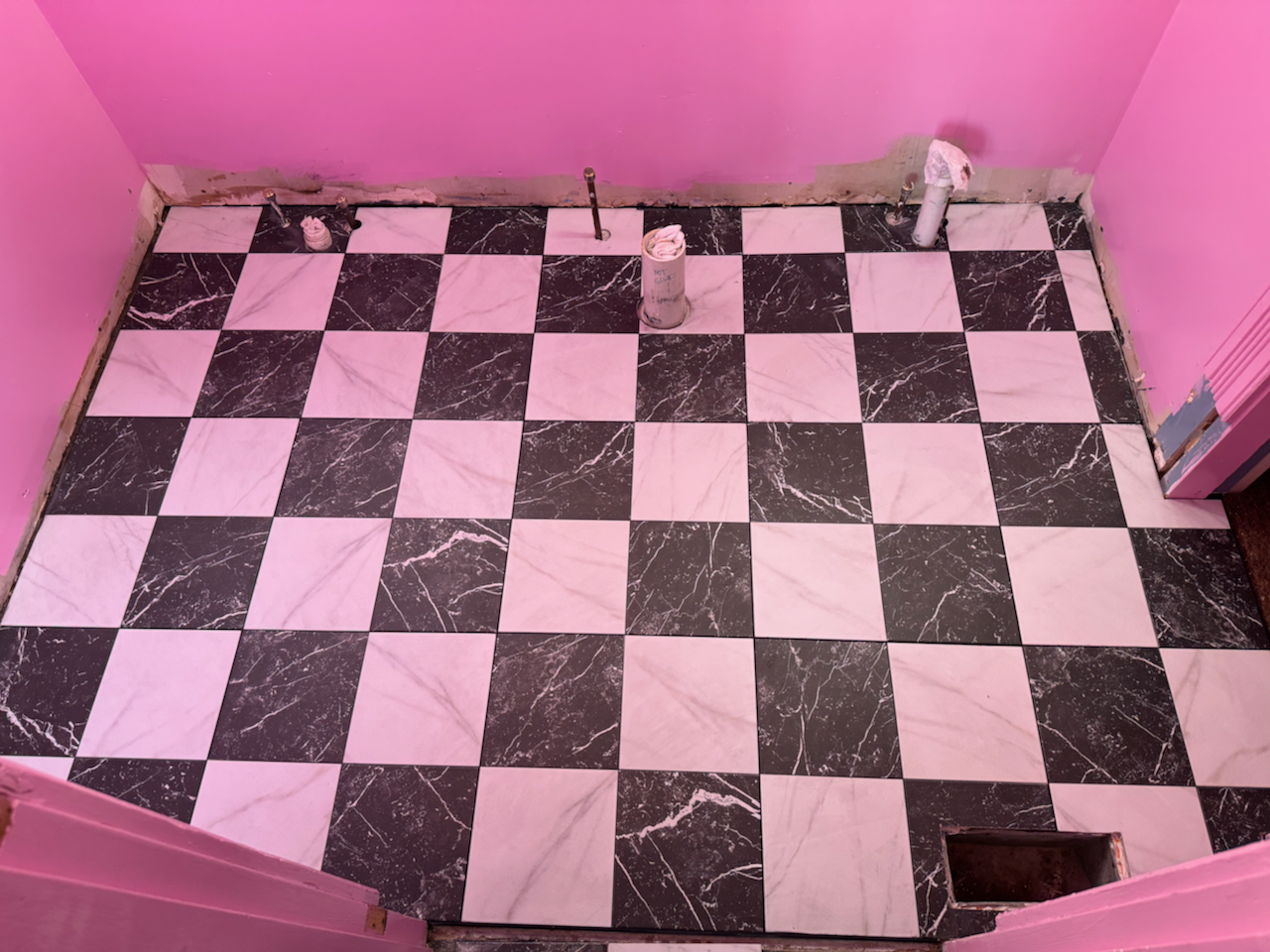
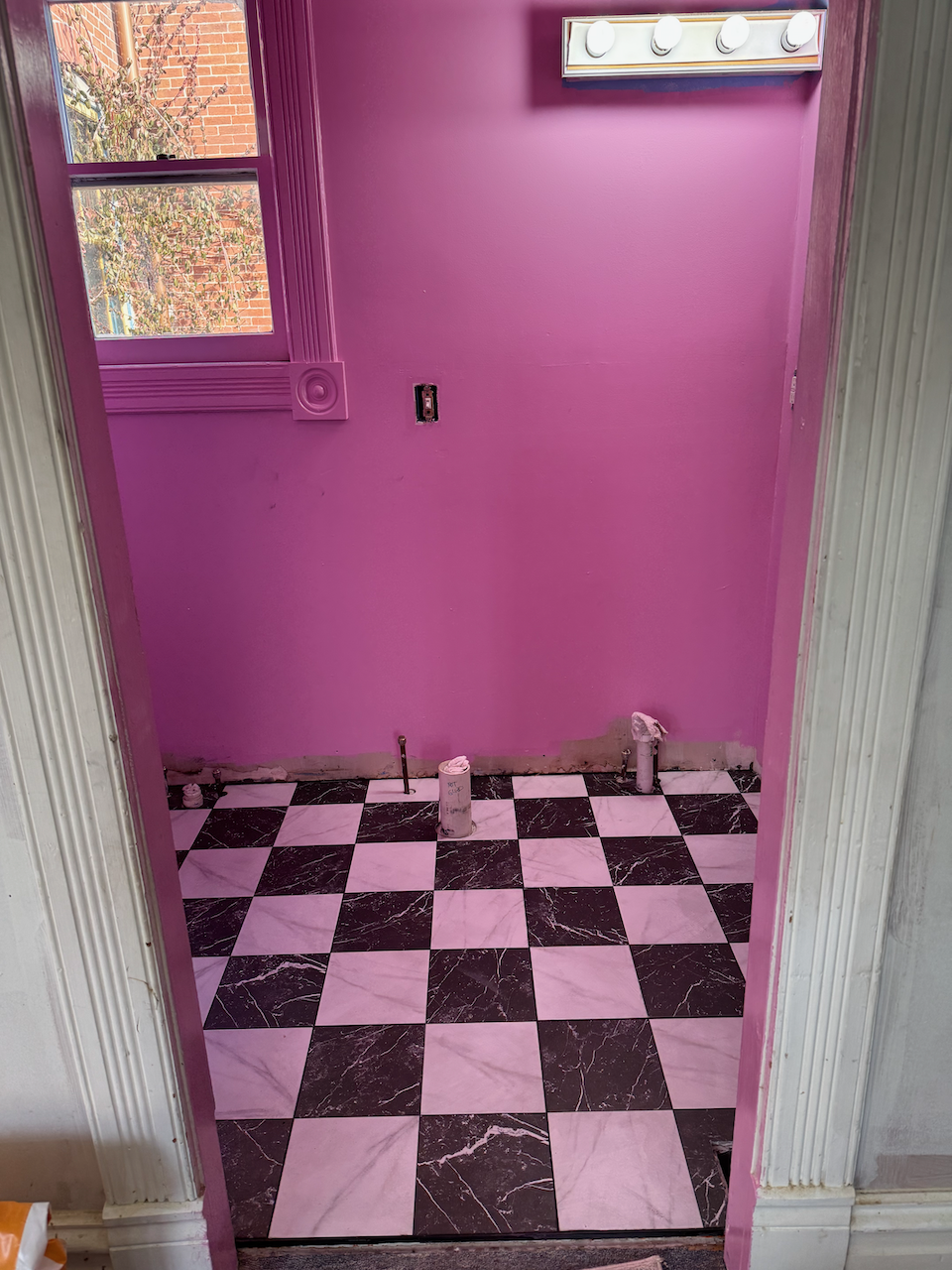
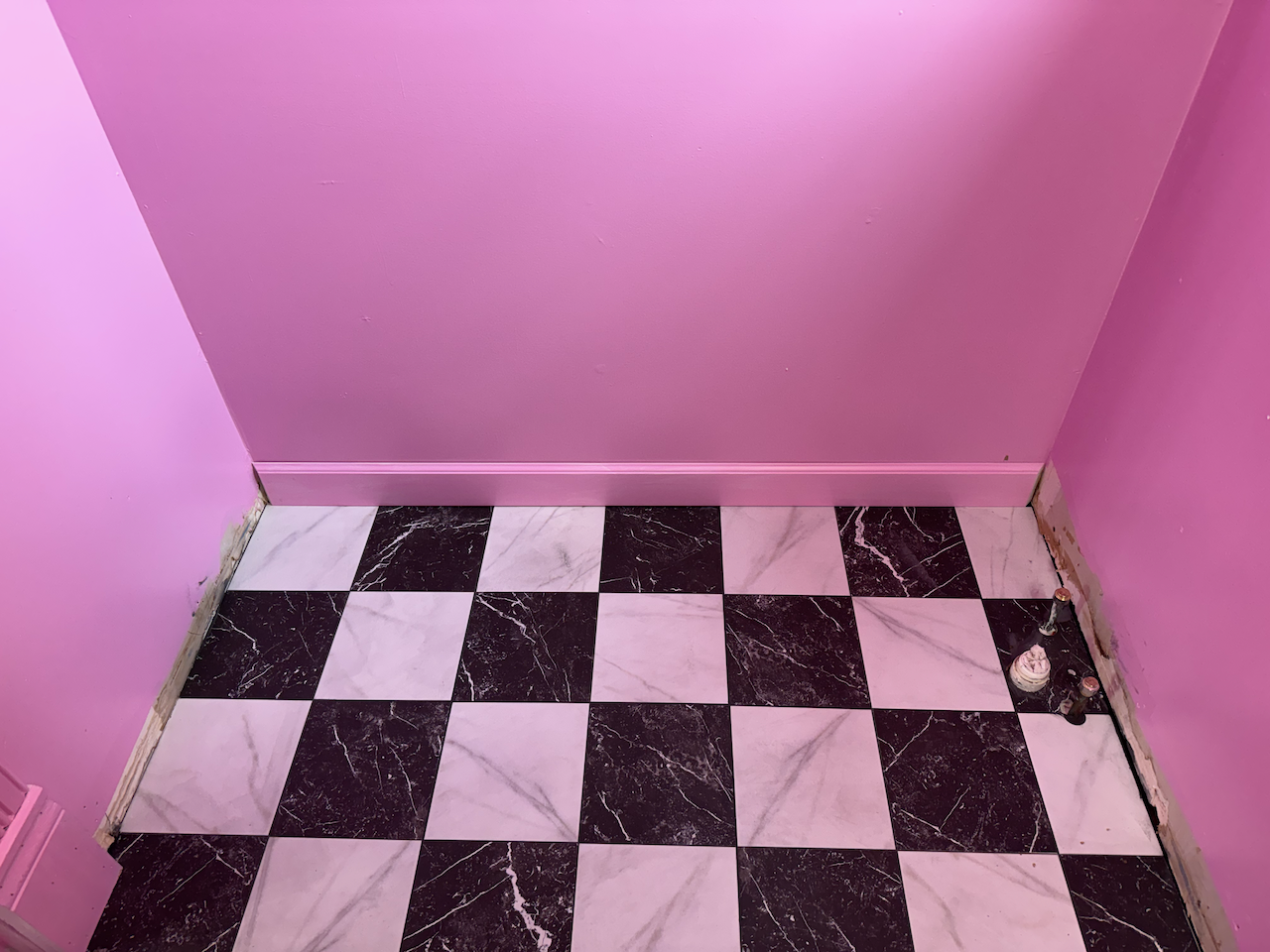
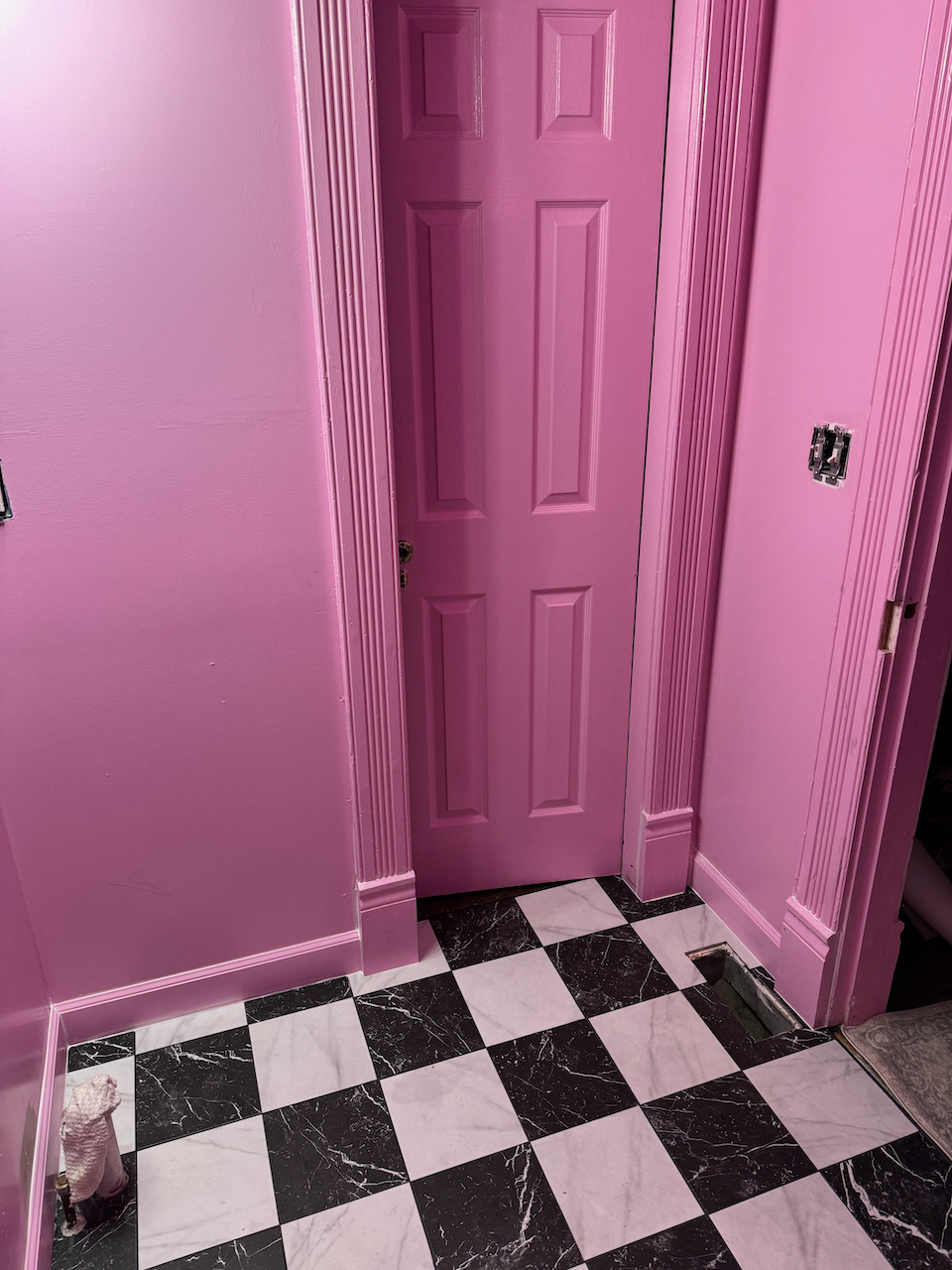
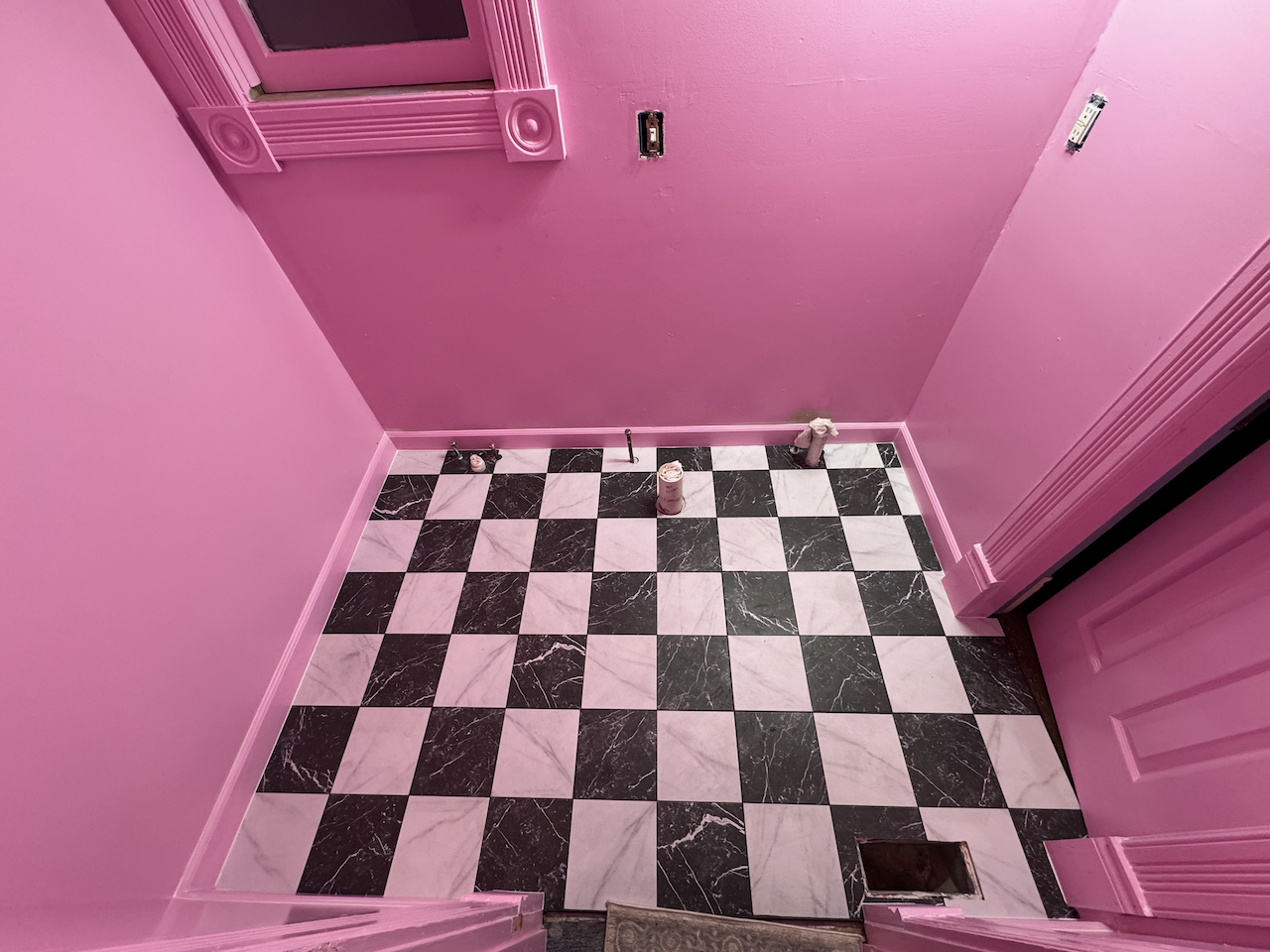
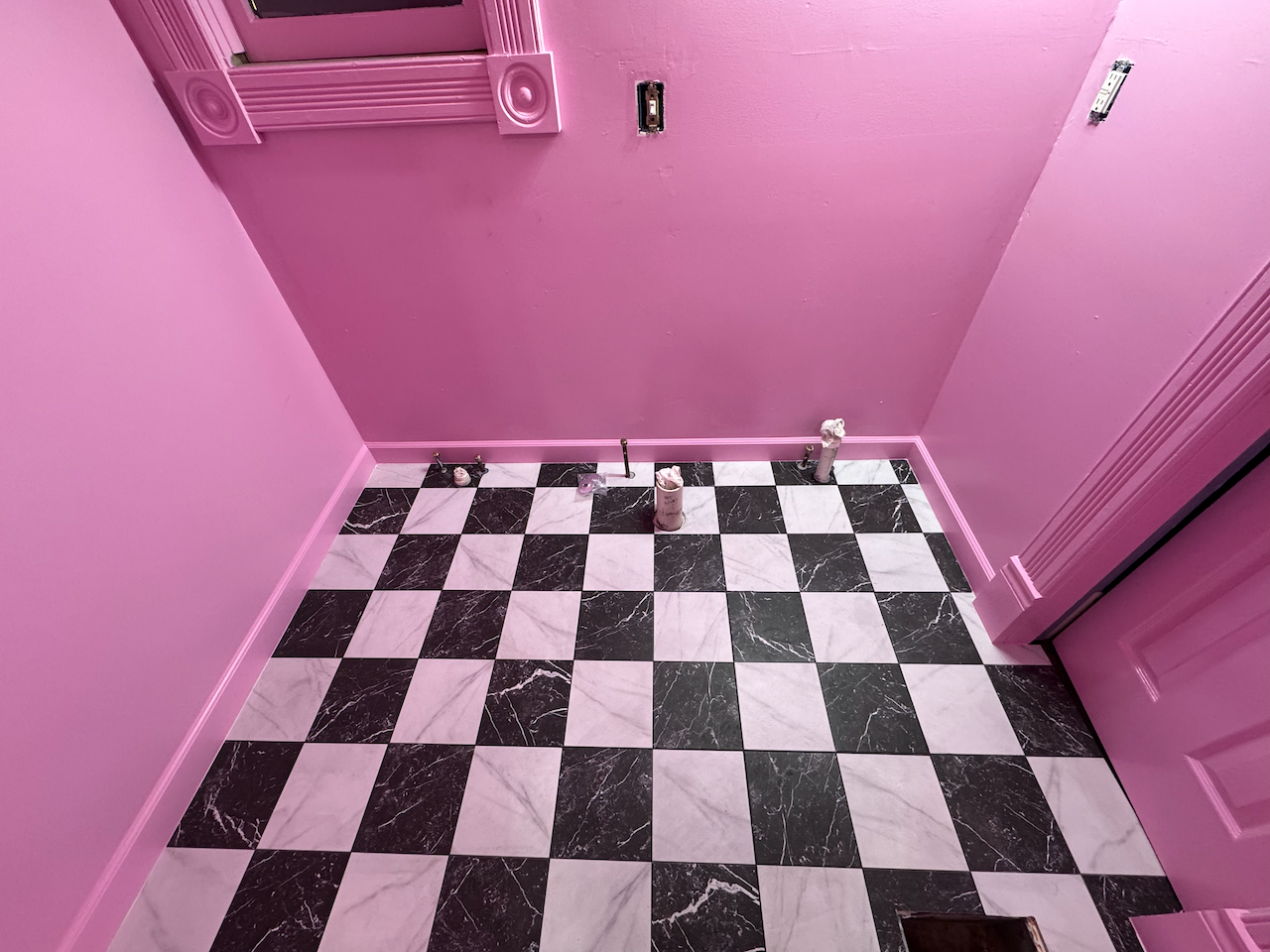
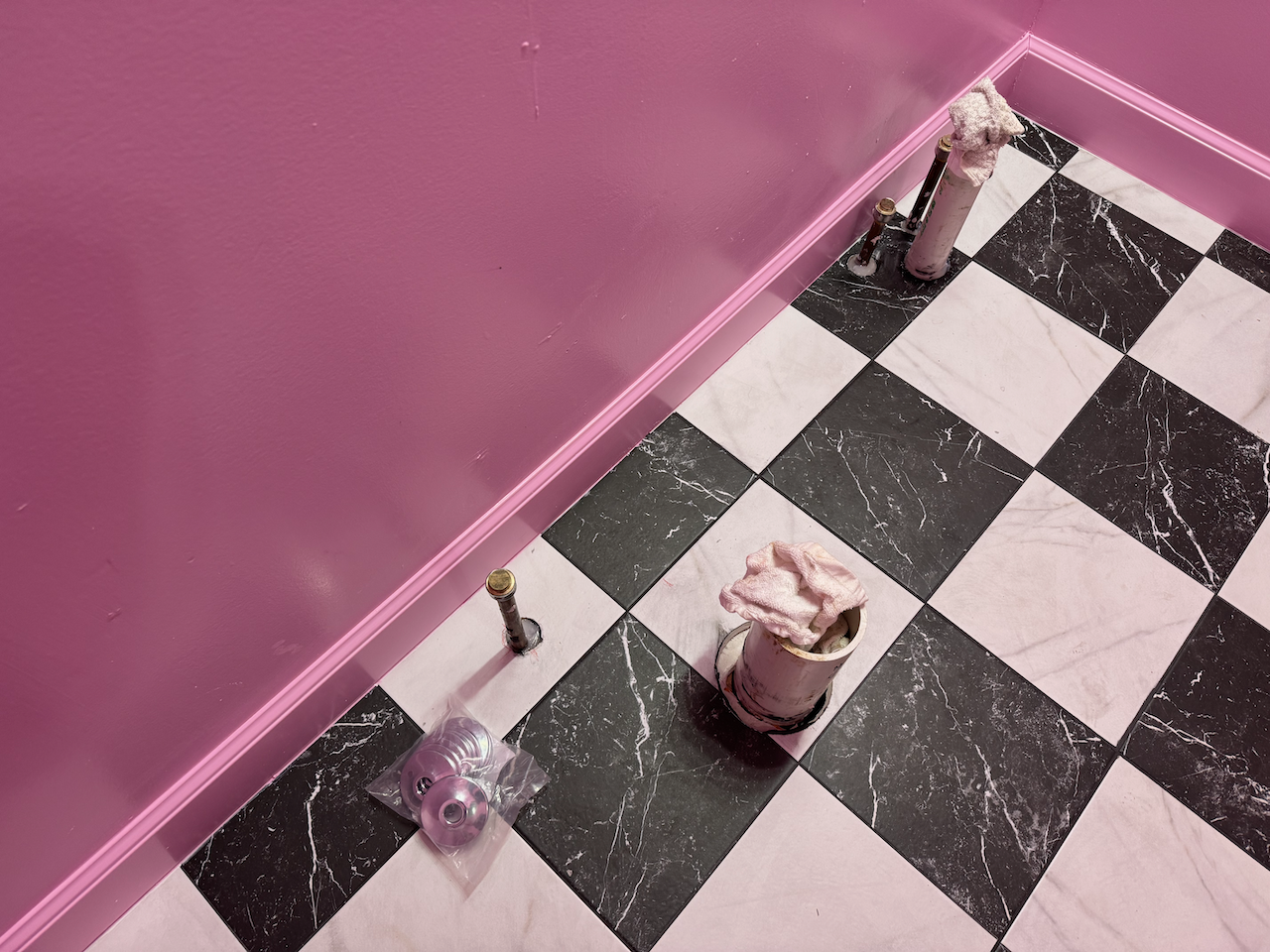
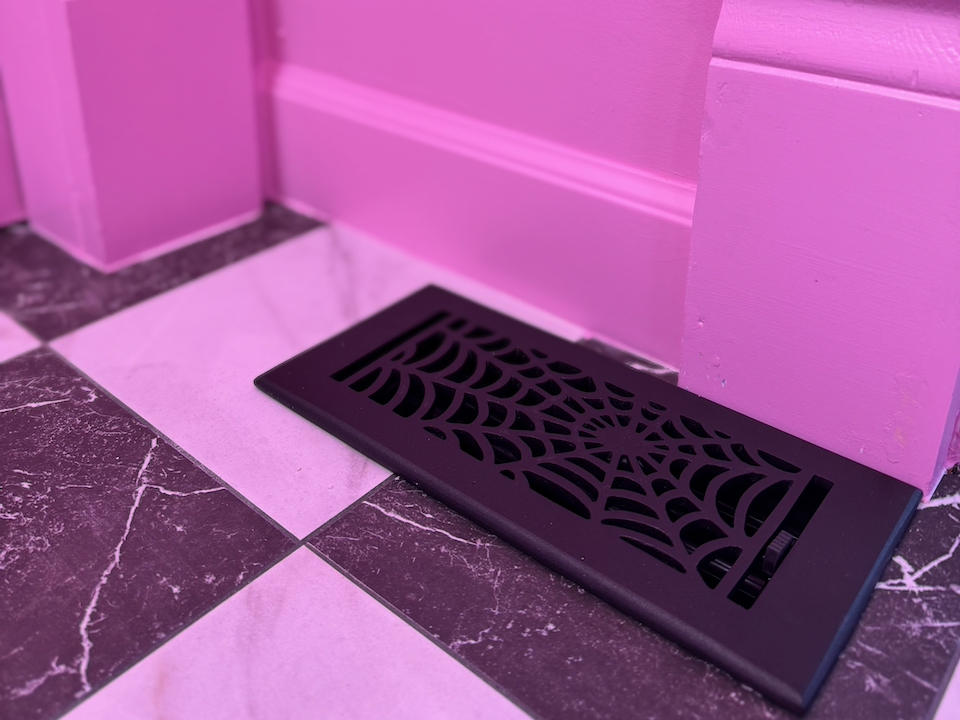
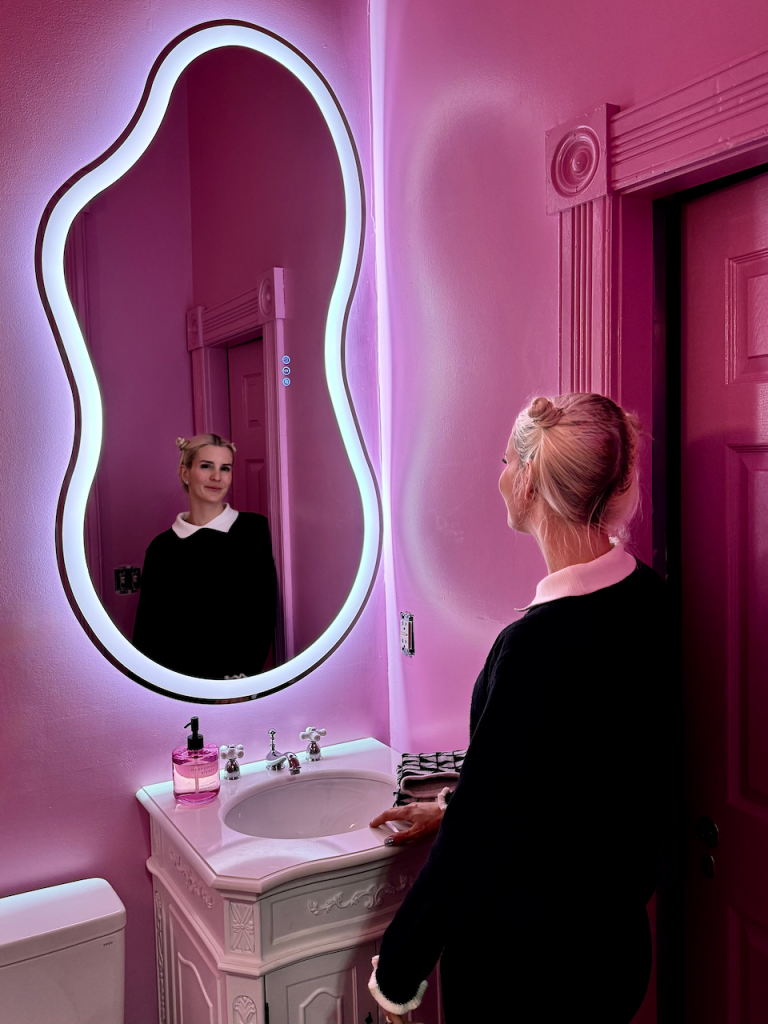
The twins chose the paint color. They wanted their “Pink Barbie” bathroom, and Alexandria designed around it. The new flooring is porcelain tile in a black and white pattern.
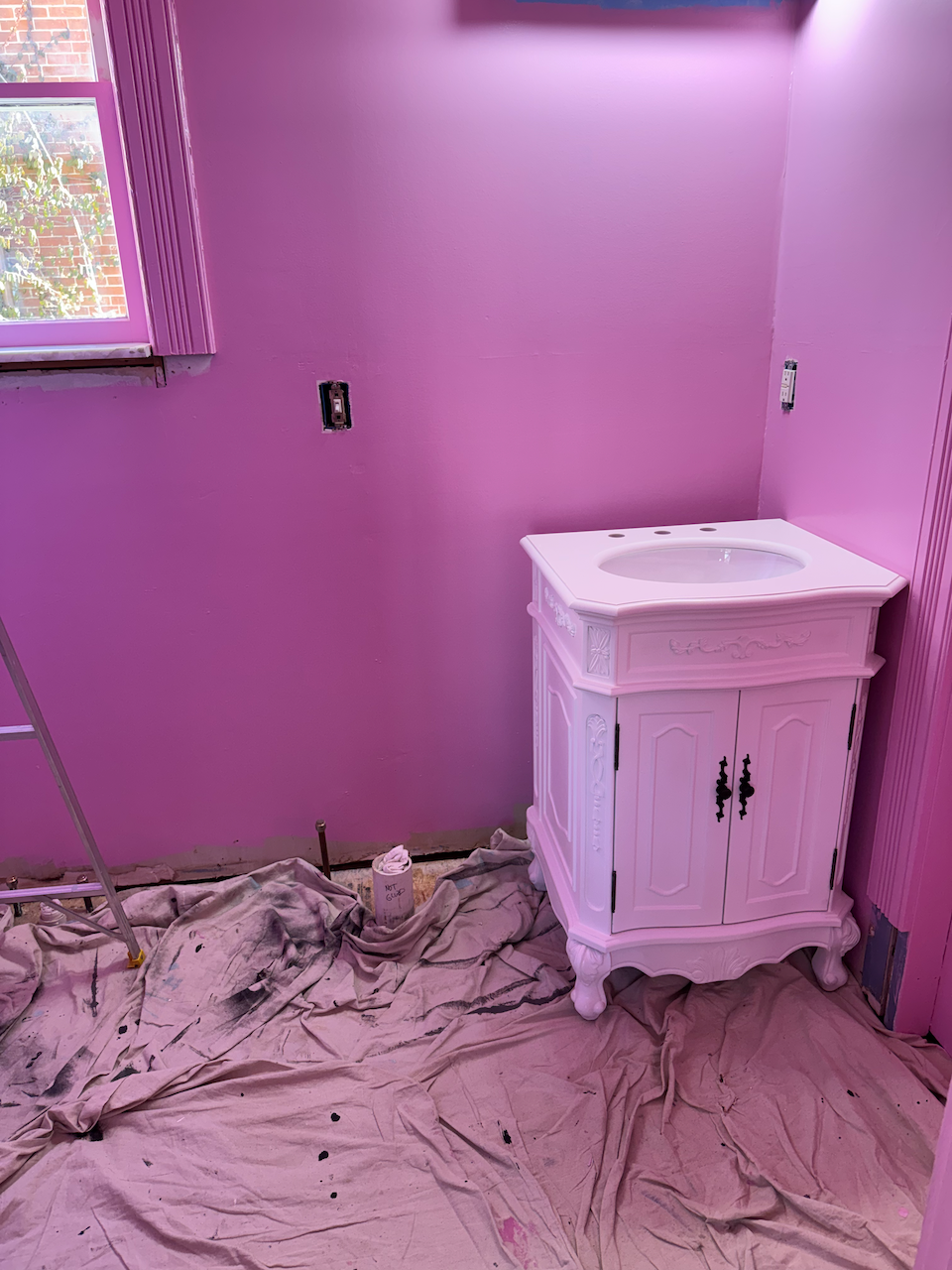
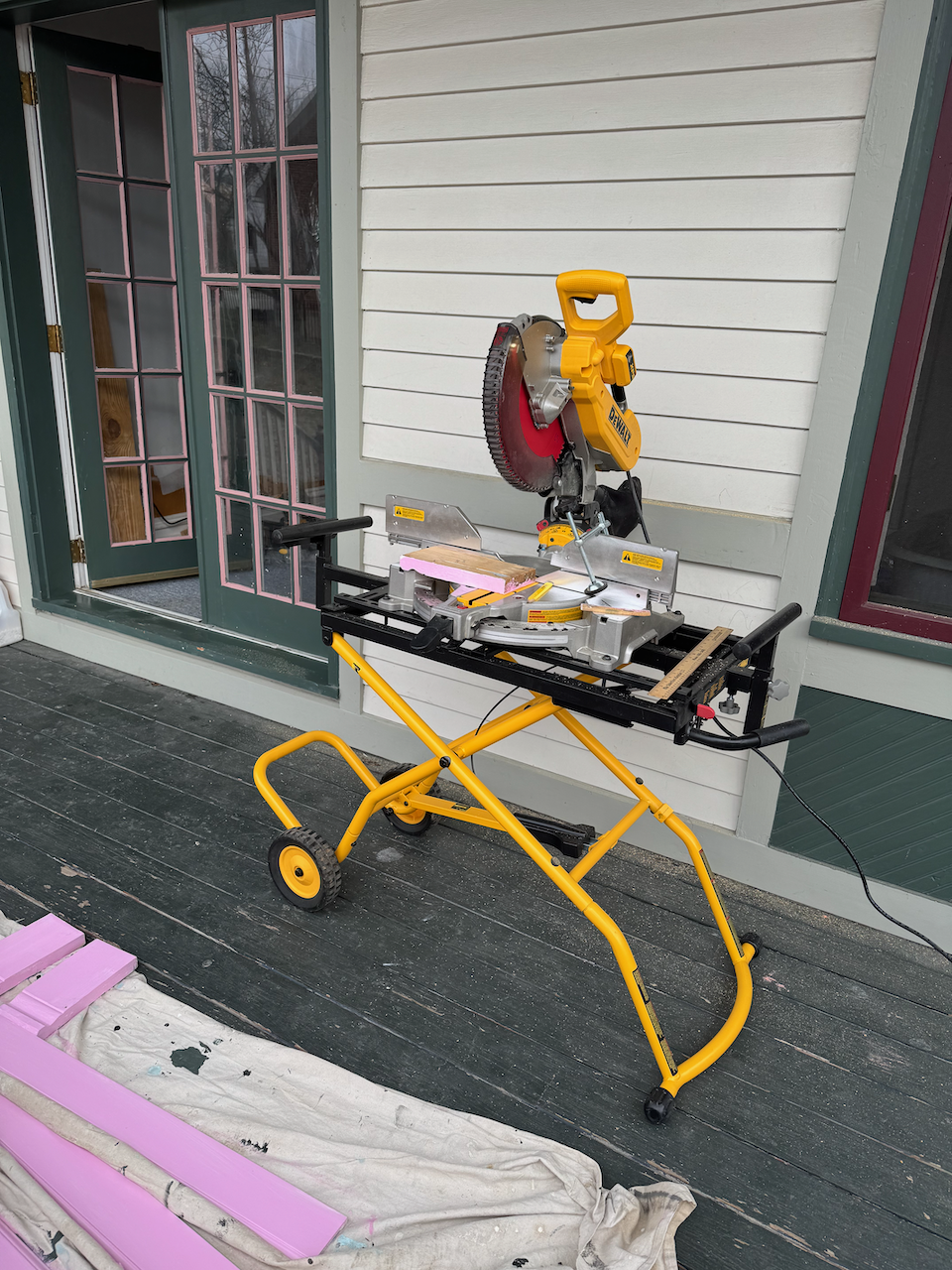
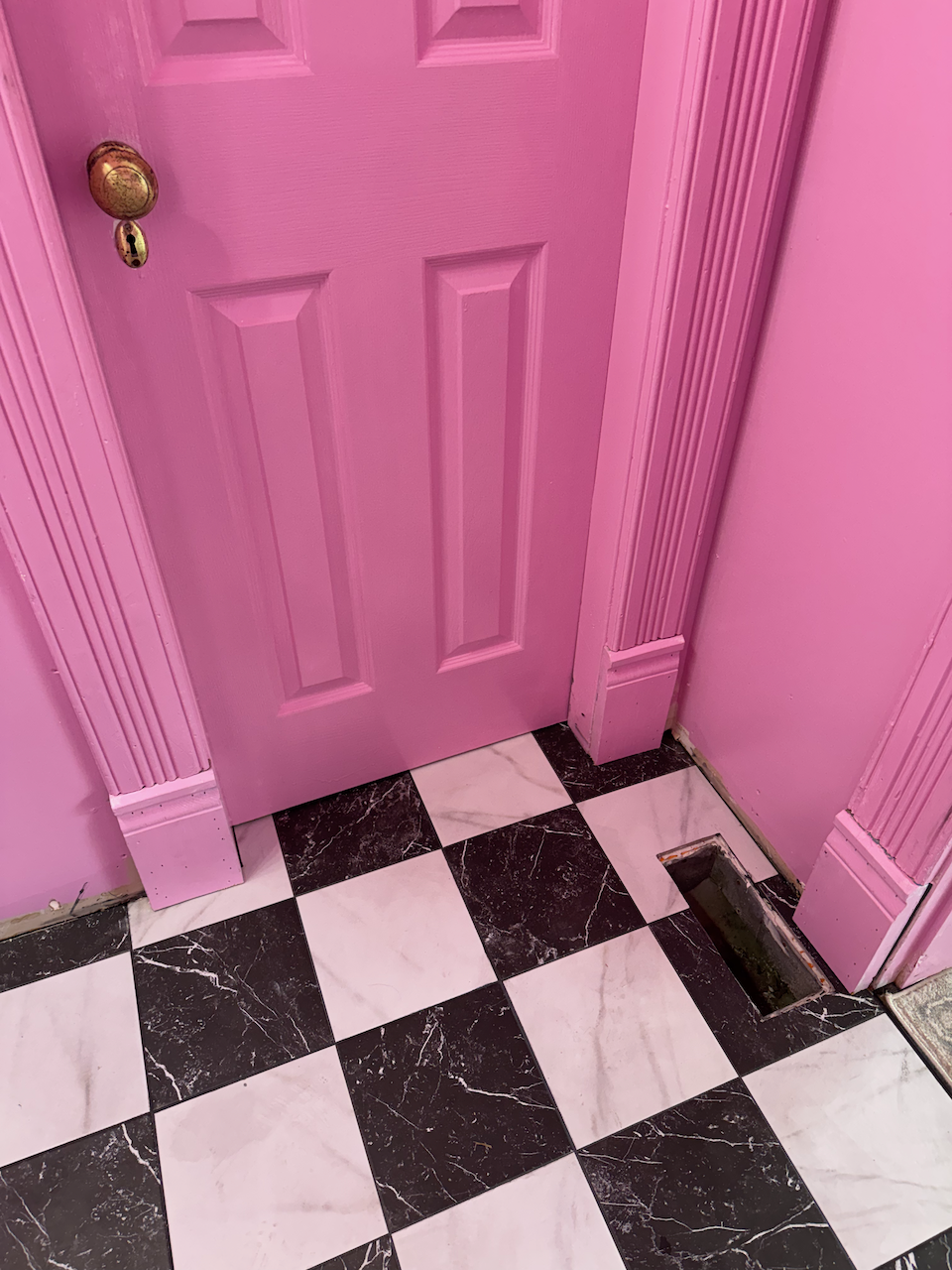
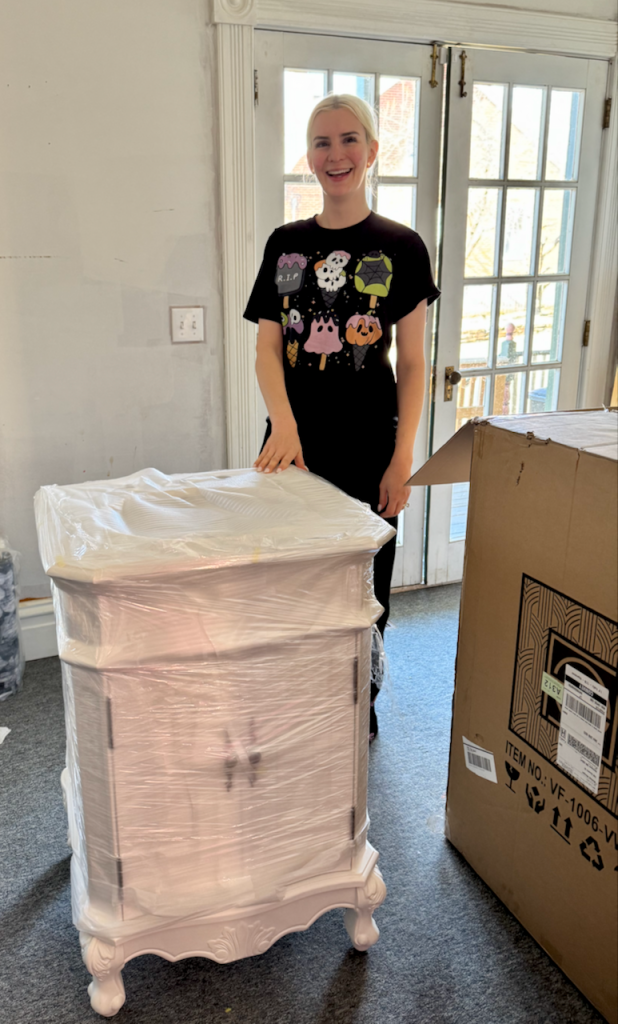
Three very excited little ones to see the paint!Vanity arrived, taking a peek at it in the spaceWe’ve already replaced nine of these MDF laminated window sills, this makes tenBefore installing the casing and rosette bulleyes. There was wainscotting before, requiring some work to reintroduce.Installed, holes filled and caulked, ready to be sanded and two coats of paintTile installed, next up is installing the four plinths and new baseboardsTime to for the plinths and baseboards to go inWith the floor raised, each plinth needed to be cut to sizeThe plinths go in firstDry fit of the new baseboardsPlinths and baseboards installed, caulked and waiting for paintCaulked the baseboards and plinths, along with two coats of paint
Vanity
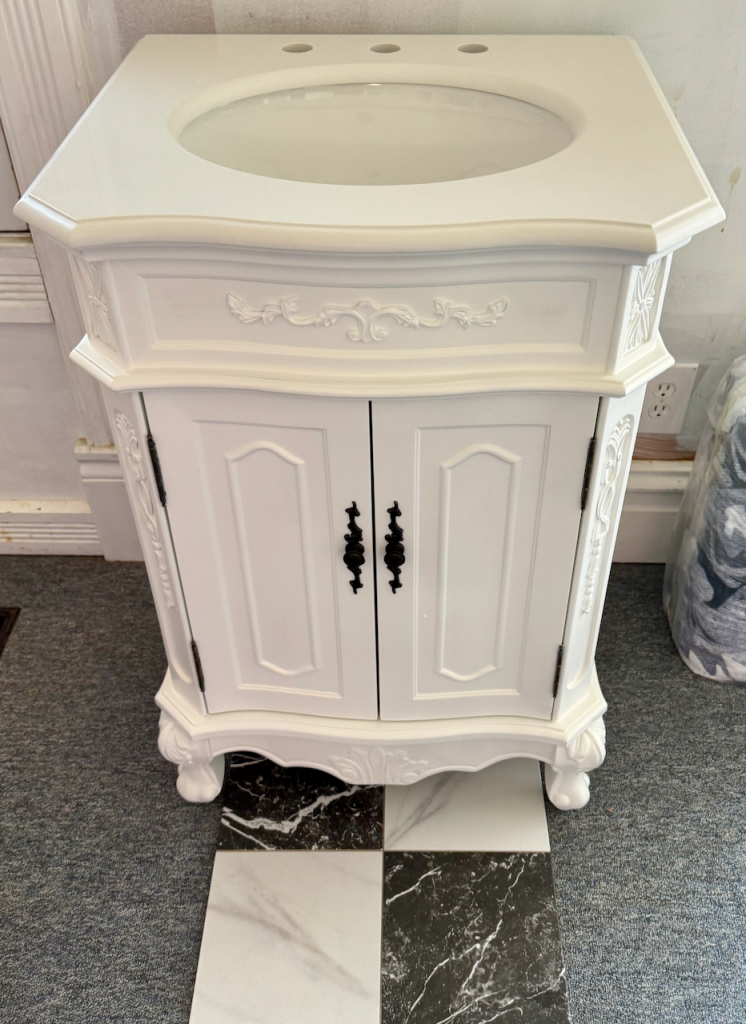
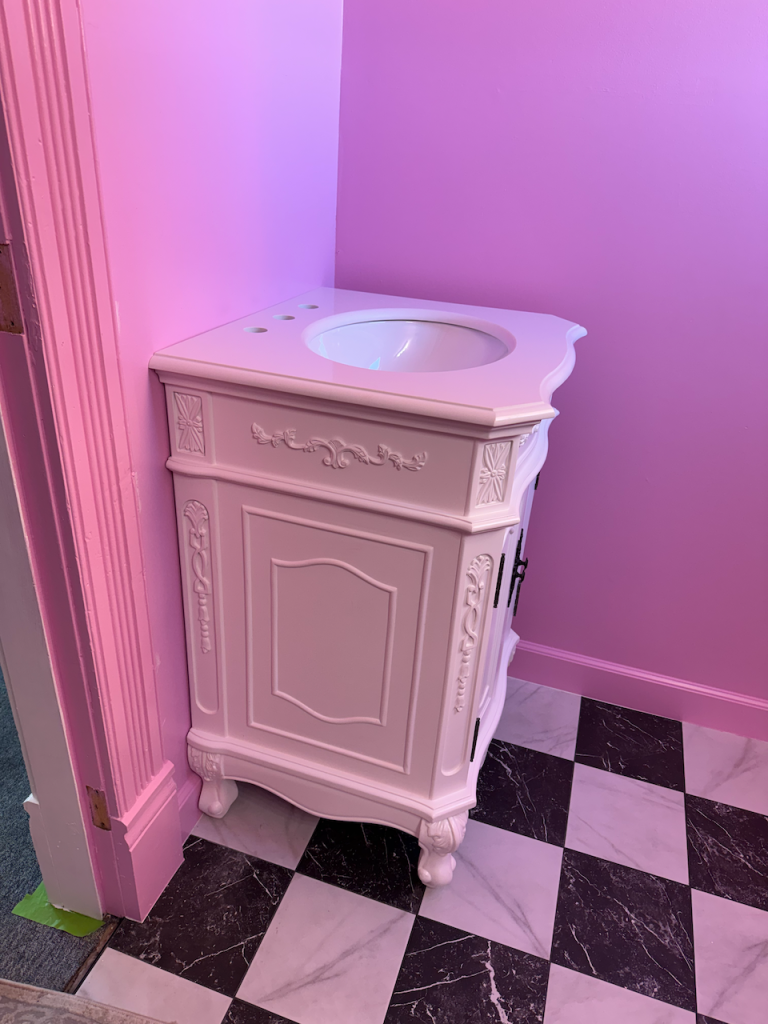
We chose a Victorian-inspired vanity. Above is a quick mockup of the vanity and porcelain tile.
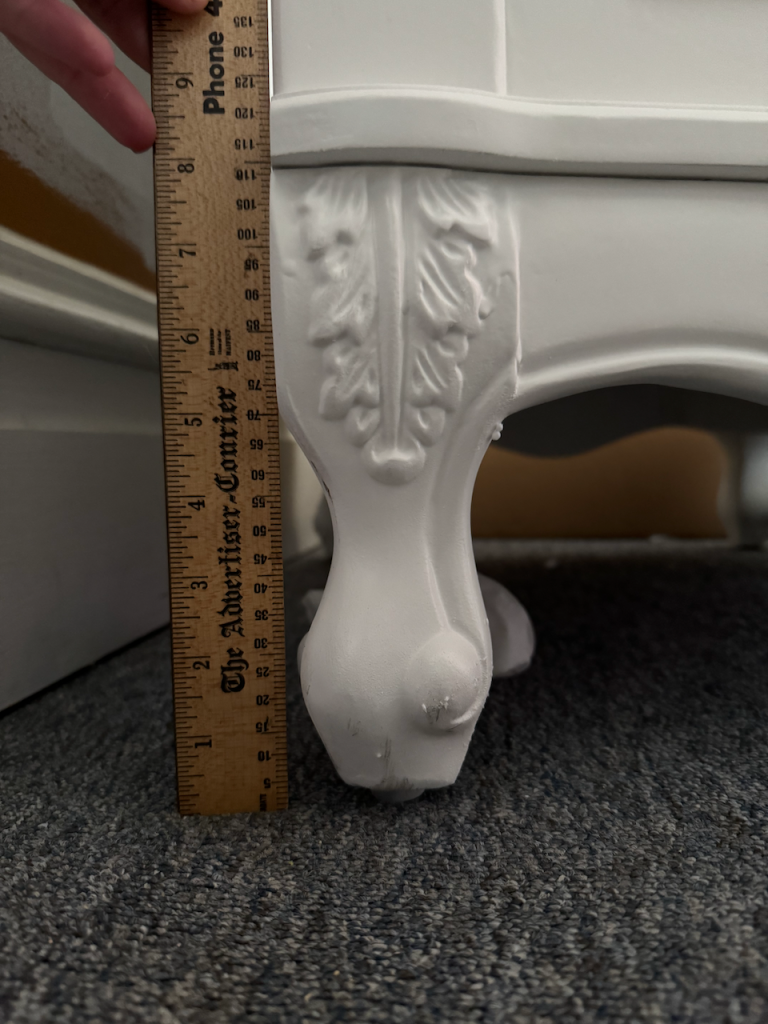
From an install standpoint, the vanity was tricky. It has claw feet, which, when placed against the baseboard, would create a 1/2 inch gap. We labored over how to solve this.
We did a lot of research, and everything pointed to removing the baseboard behind the vanity, which we did not want to do for various reasons, including: 1) A continuous look, 2) Sealing. Our argument is that the vanity represents “furniture”; why would you disrupt the baseboard to install furniture?
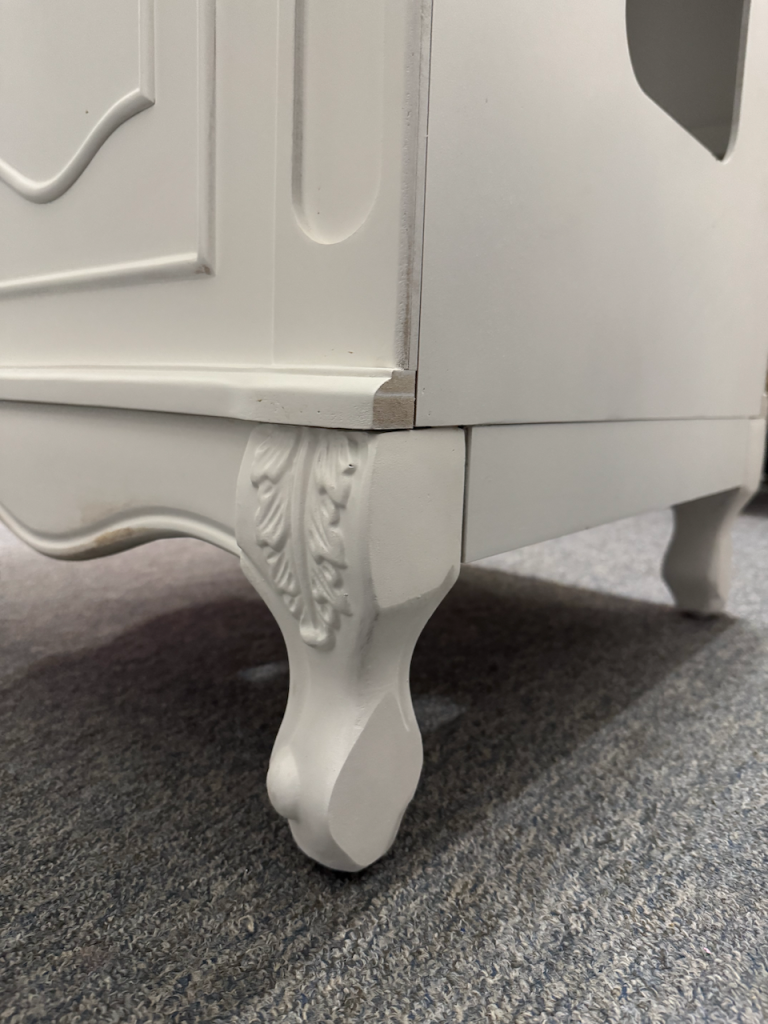
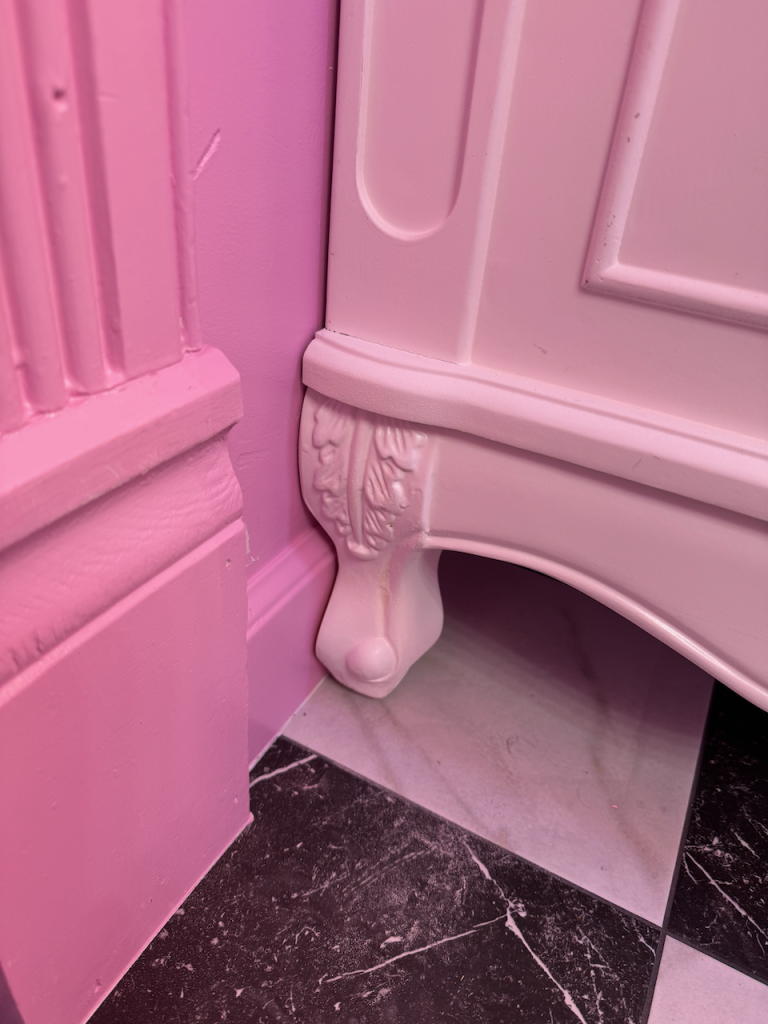
The final decision was to retrofit the clawfeet to provide enough clearance to allow the baseboard to run continuously around the vanity. We accomplished this by carefully removing a 1/2 inch of the back of the clawfoot.
The result is a flush and seamless install. It helps that we bought a baseboard that fits right under the clawfoot’s curve. Planning for the win! By the way, not that anybody is going to be looking at the backside of the feet, but look at that perfect paint match!
Clawfoot Tub
One of the few items to return to the remodeled bathroom was this gorgeous Victorian clawfoot tub. We have seven clawfoot tubs throughout the house, and it’s our understanding that we have the Birk’s to thank for them.
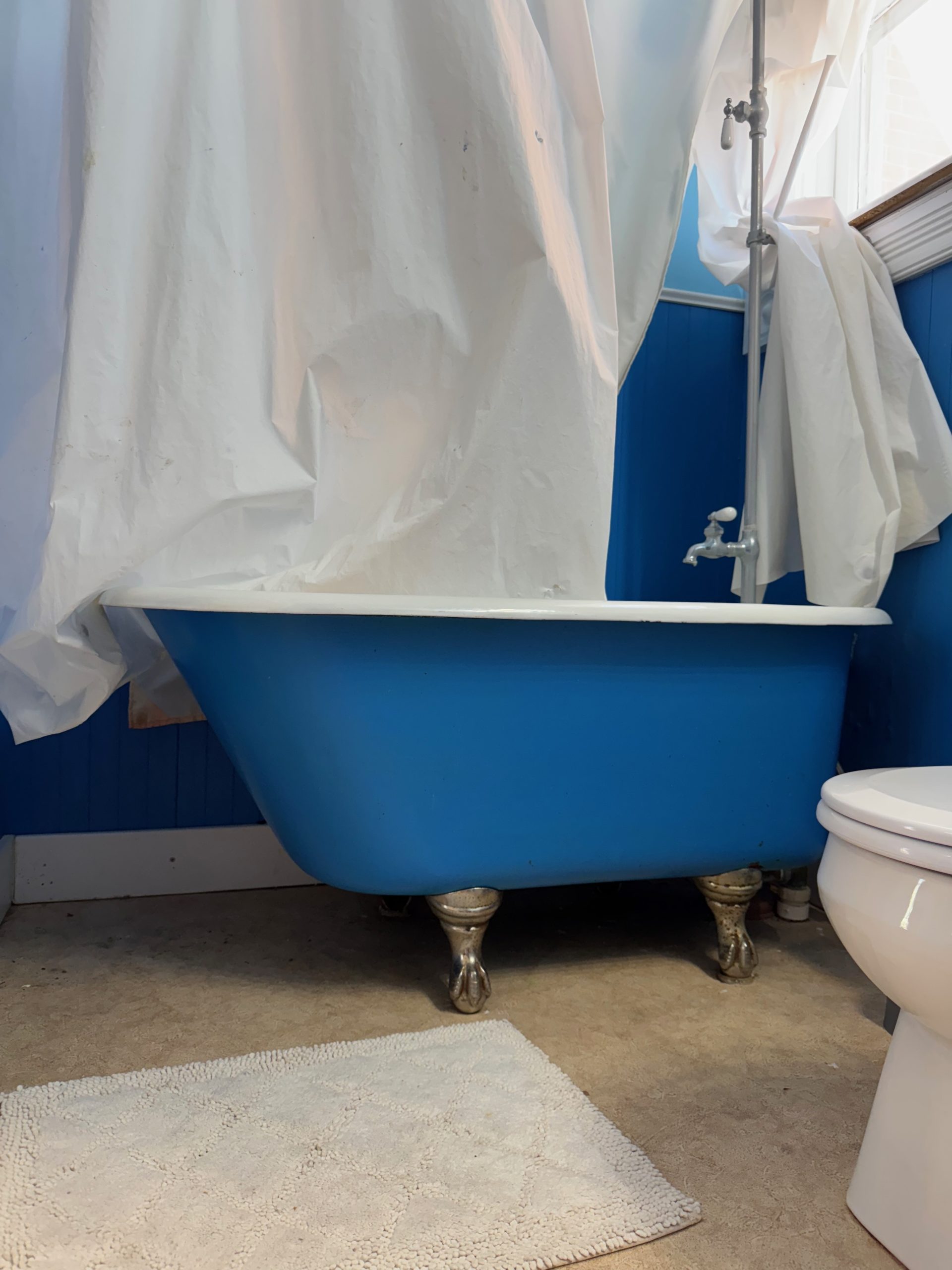
It’s hard to beat the beauty of an original clawfoot tub. The challenge in this space was the configuration. It was set up as a shower, and the curtain dominated the space (blocked a lovely window, too). We decided to do away with the shower curtain, which opens up the space. We replaced the fixture with a beautiful Victorian telephone faucet.
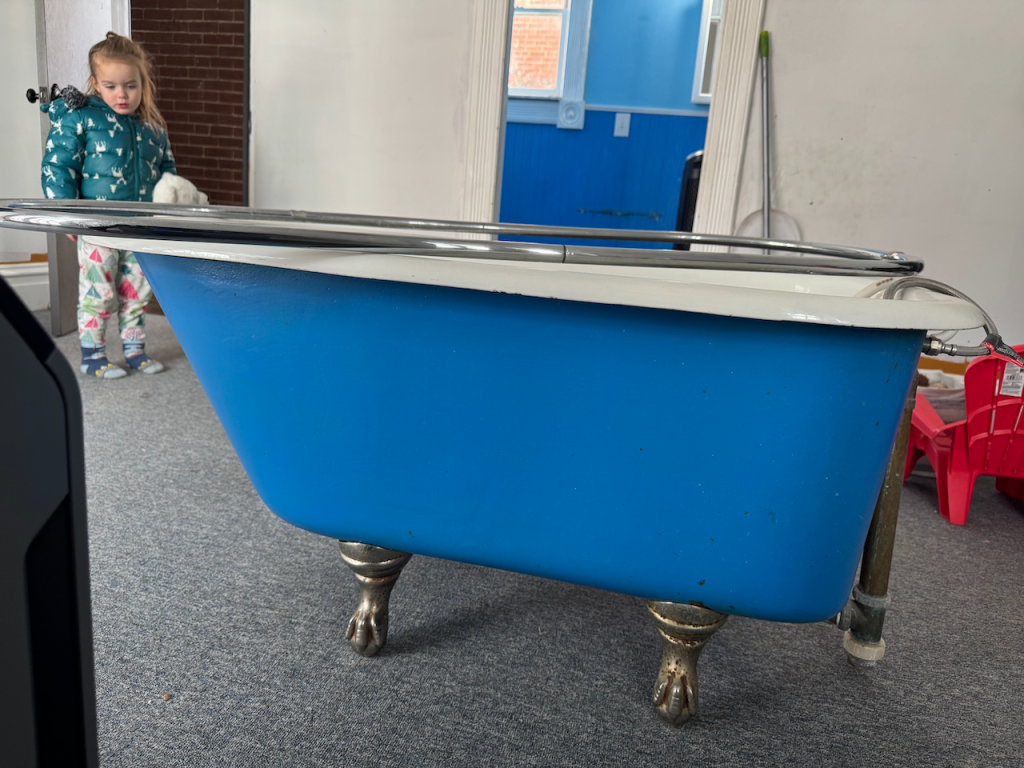
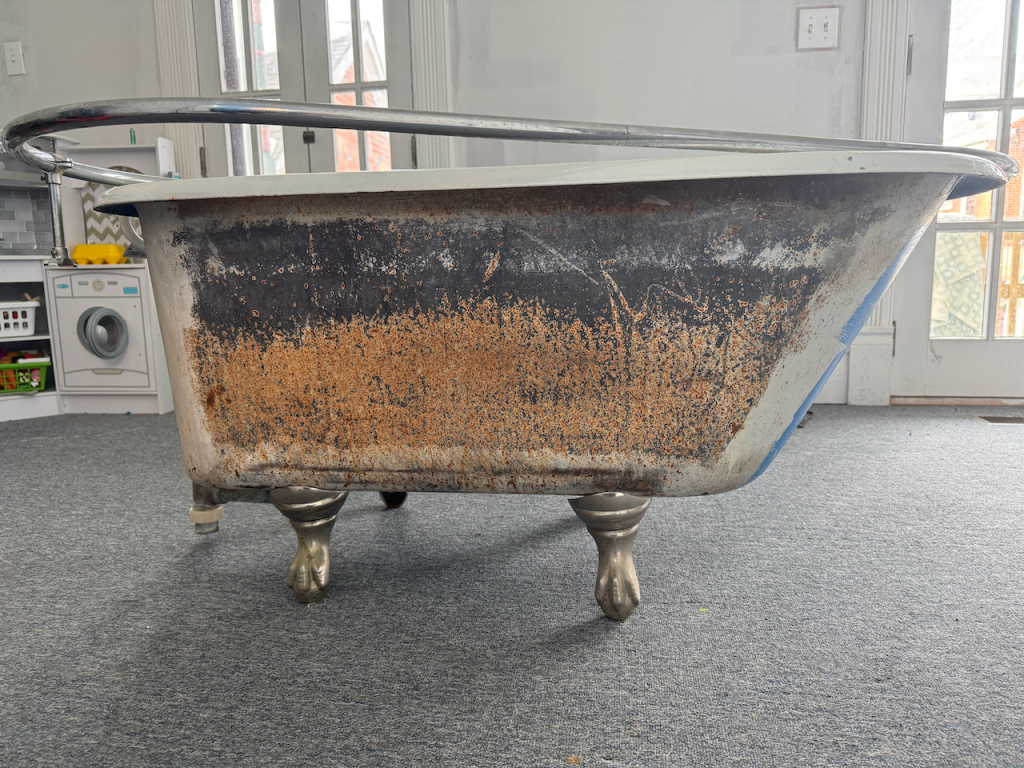
Alexandria took on the project of restoring the tub. The blue was out! We decided to go back to a classic white. We also cleaned up the clawfeet and copper drain pipe.
Summary
Nearly every facet of this bathroom was touched. It’s easier to list what wasn’t replaced: the casing, Victorian bullseye, and plinths, sheetrock, and tub. Everything else was replaced or refreshed, including the subfloor, new flooring, vanity, lighting, faucets, a TOTO toilet, light switches, outlets, etc. A new bathroom!
A common question we get is how many of these projects we do ourselves versus how many we contract out. There are several areas/domains we feel pretty confident in these days: finish carpentry, painting, restoration, plaster work, and electrical. When it was all said and done, the two areas we hired out were: plumbing and tile installation; we did the rest.
Stay tuned for part 2 of this bathroom remodel for all of the final touches! We also have a number of other projects coming to an end that we’re excited to share.
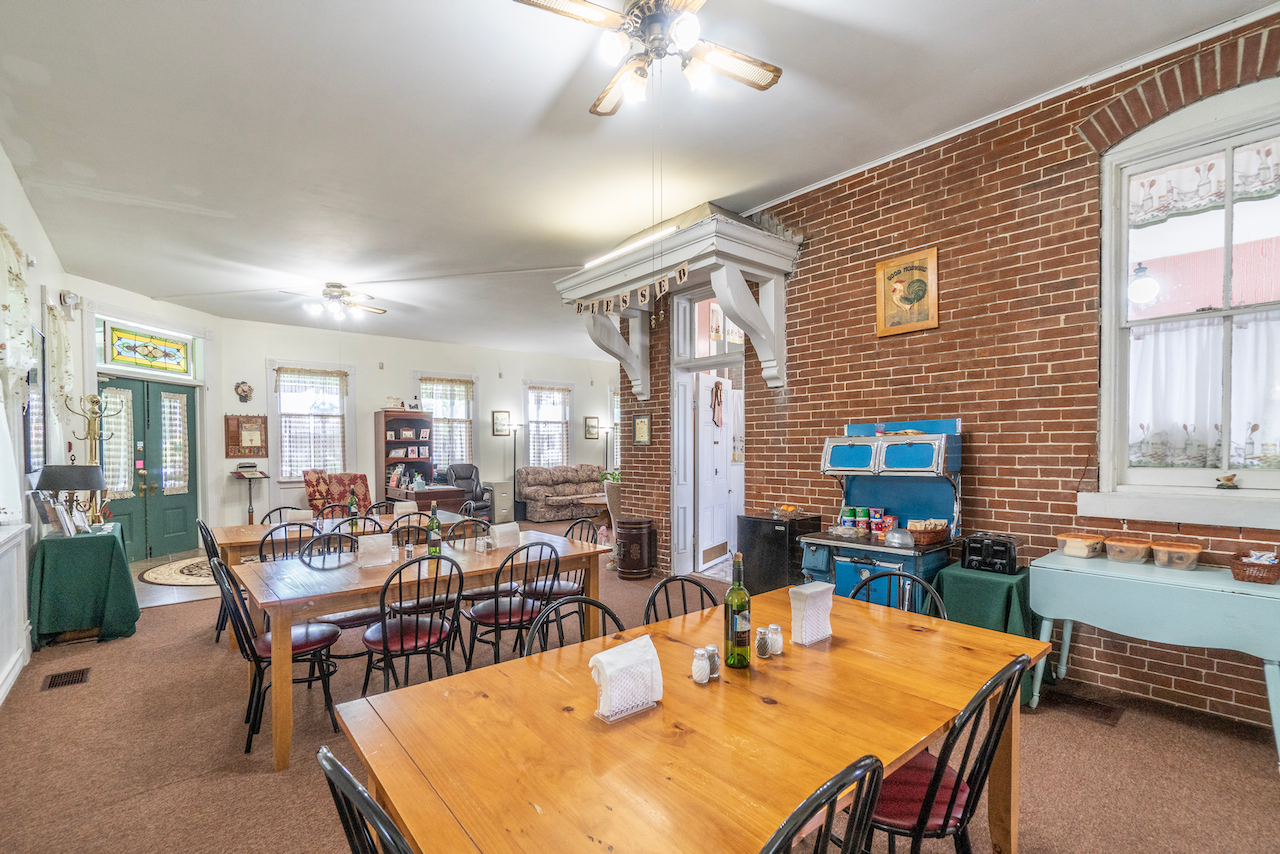
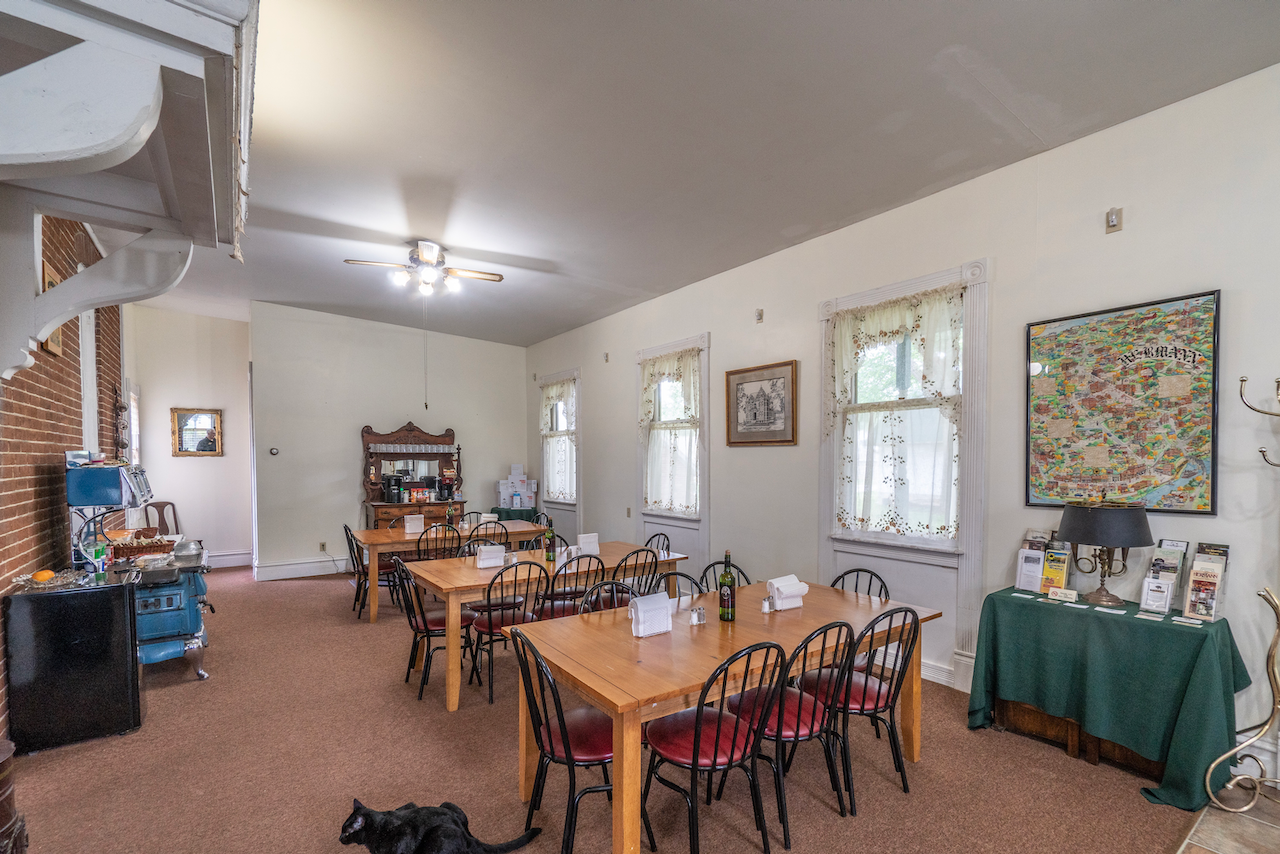
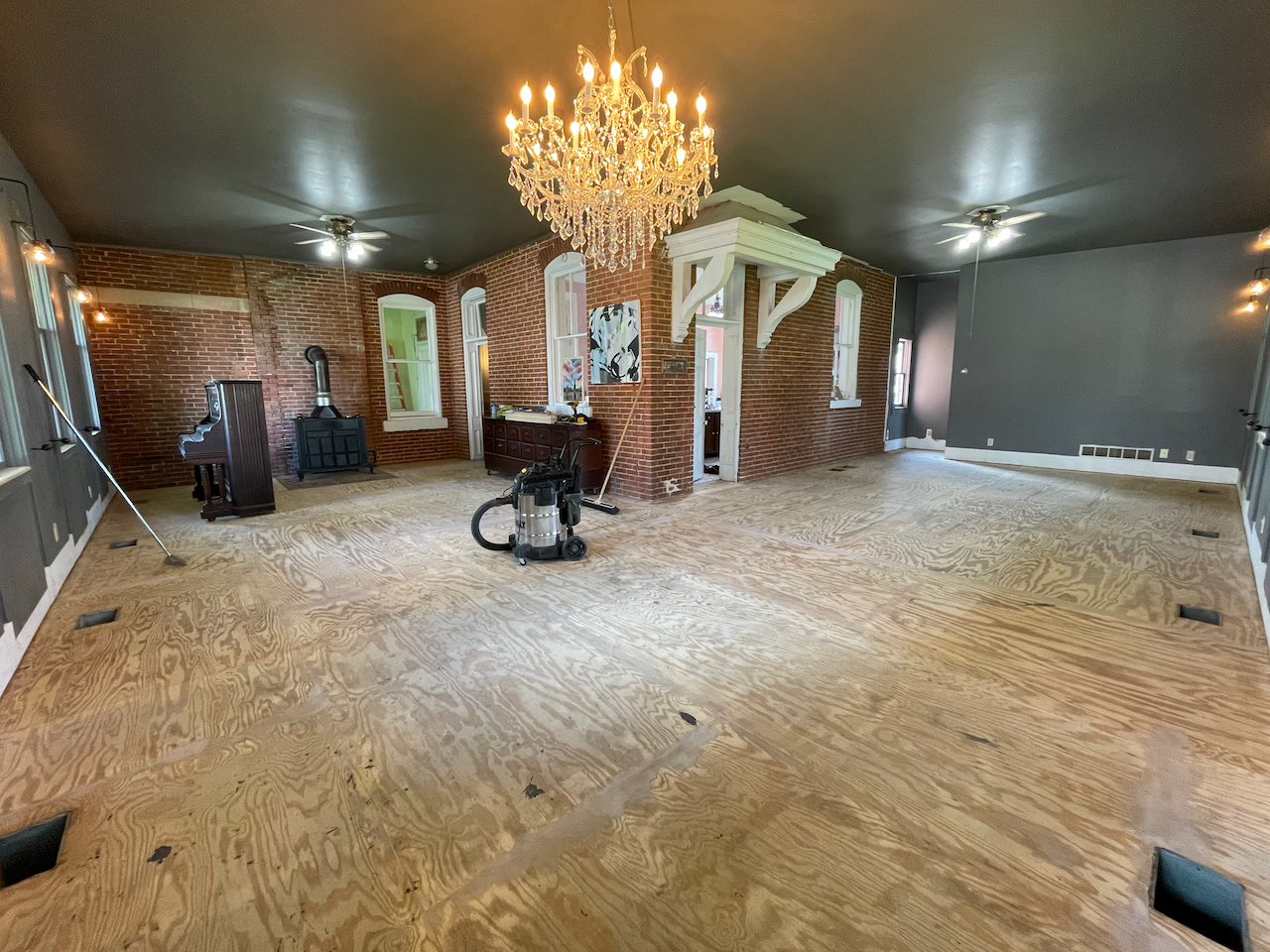
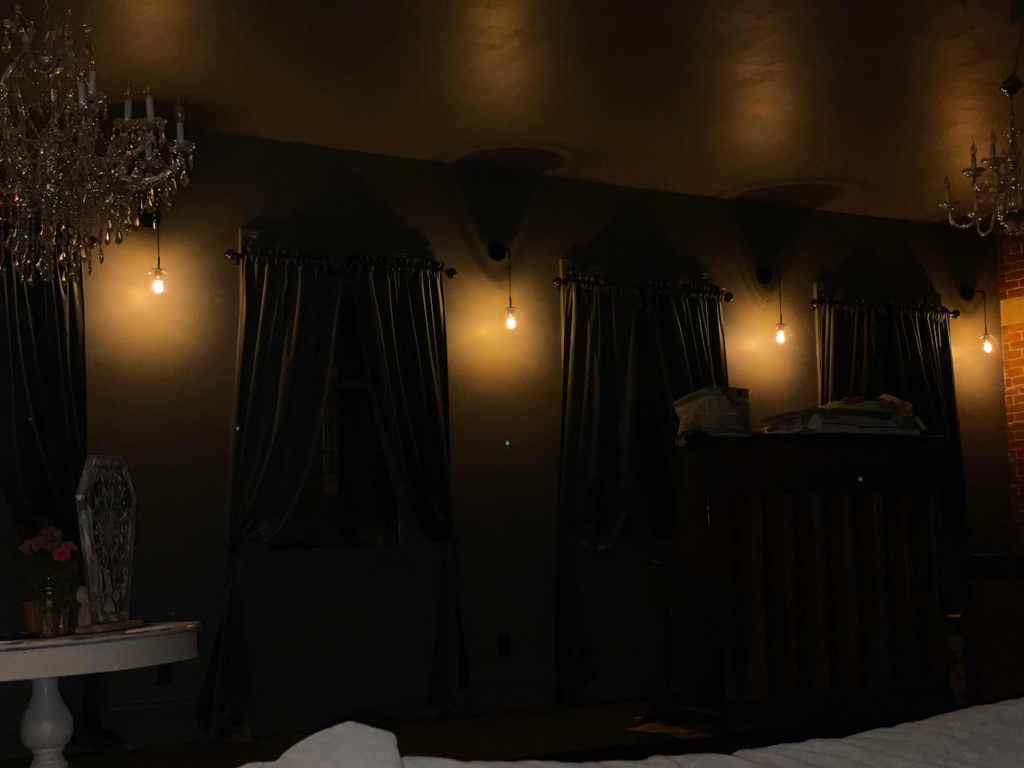
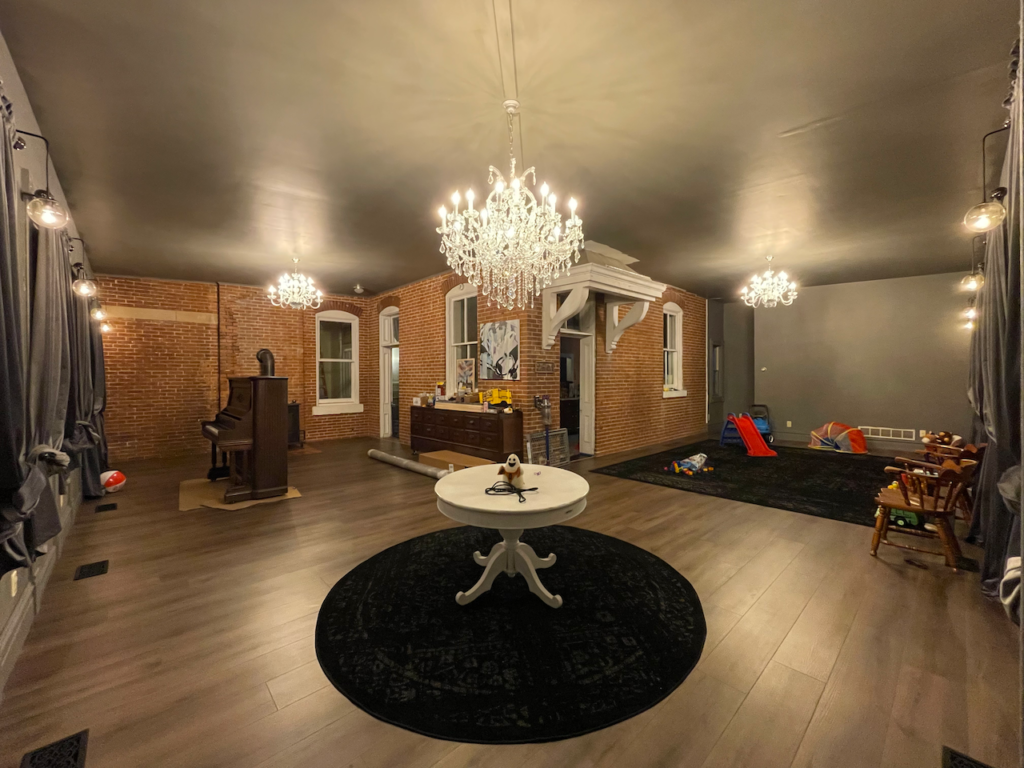
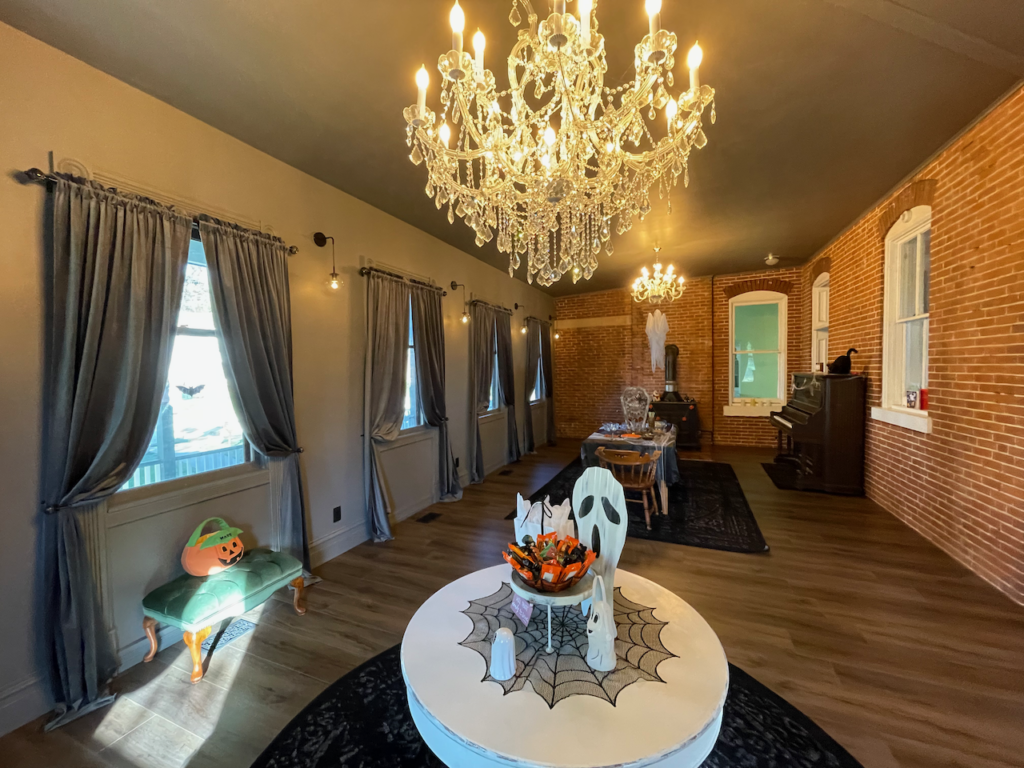
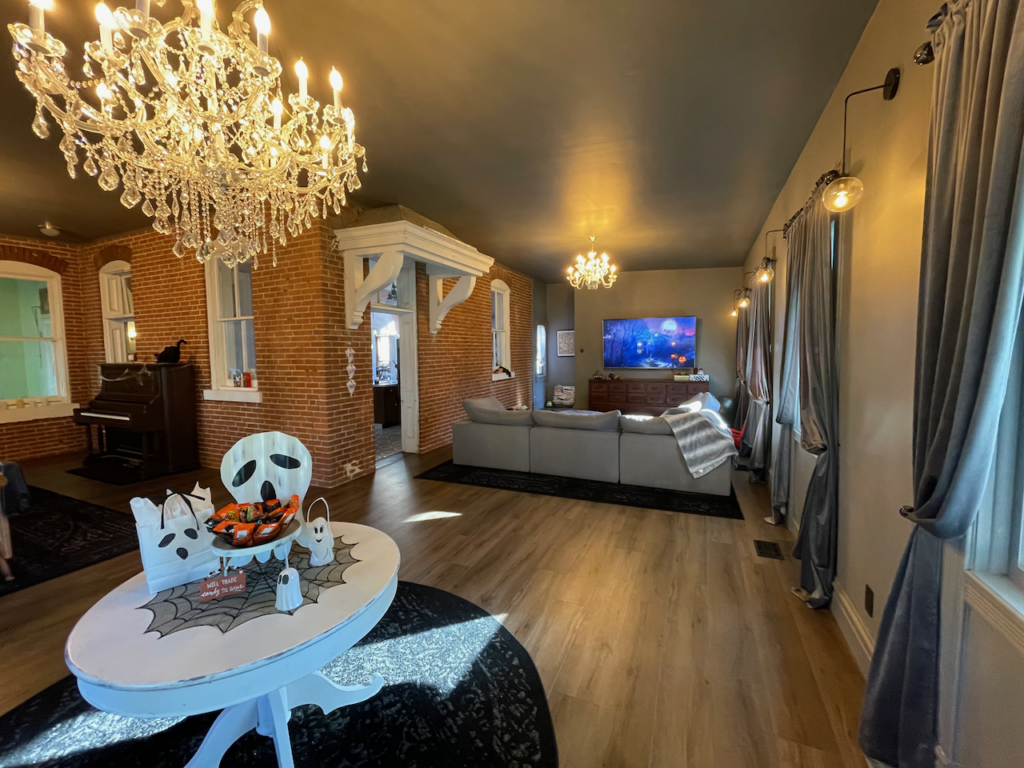
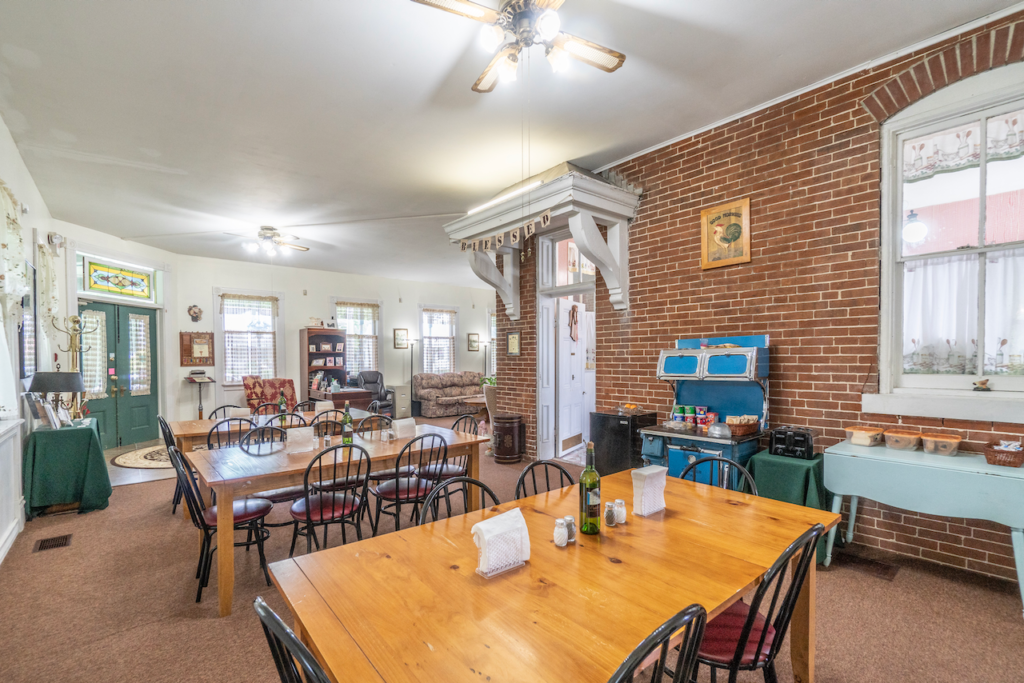
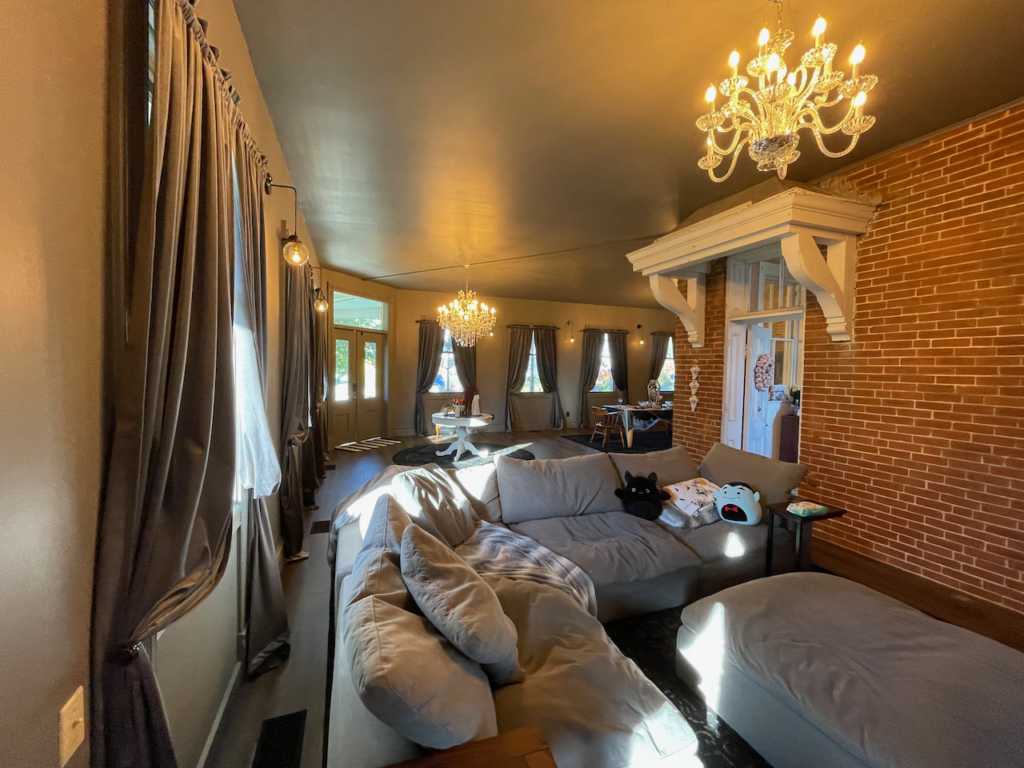
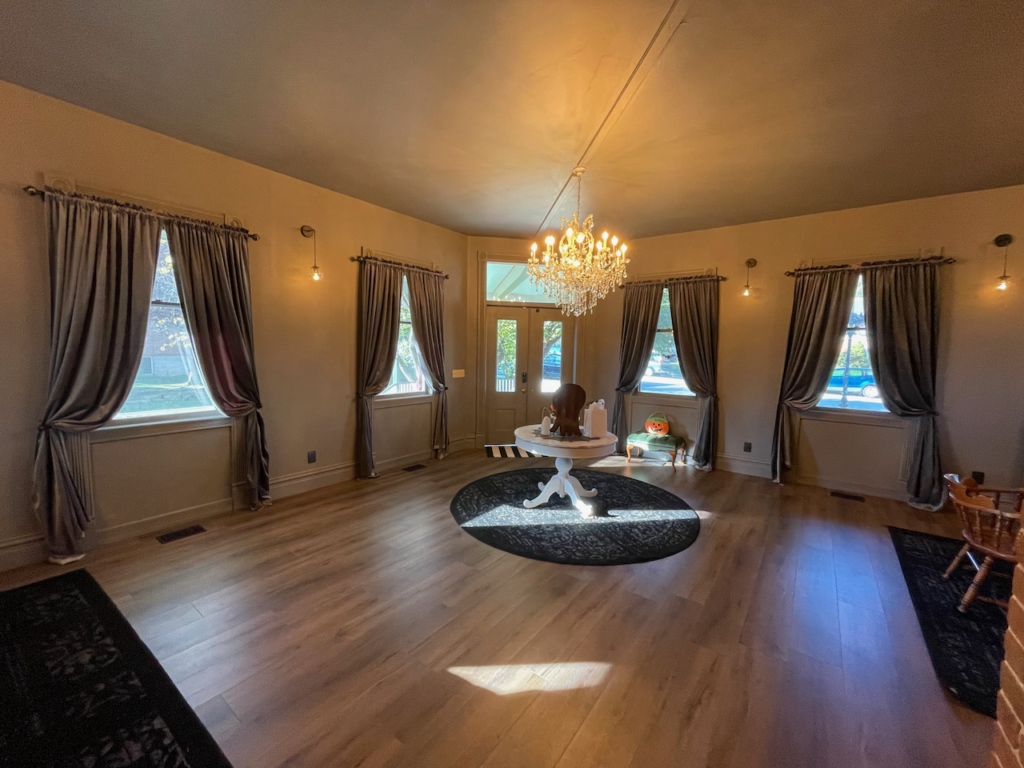
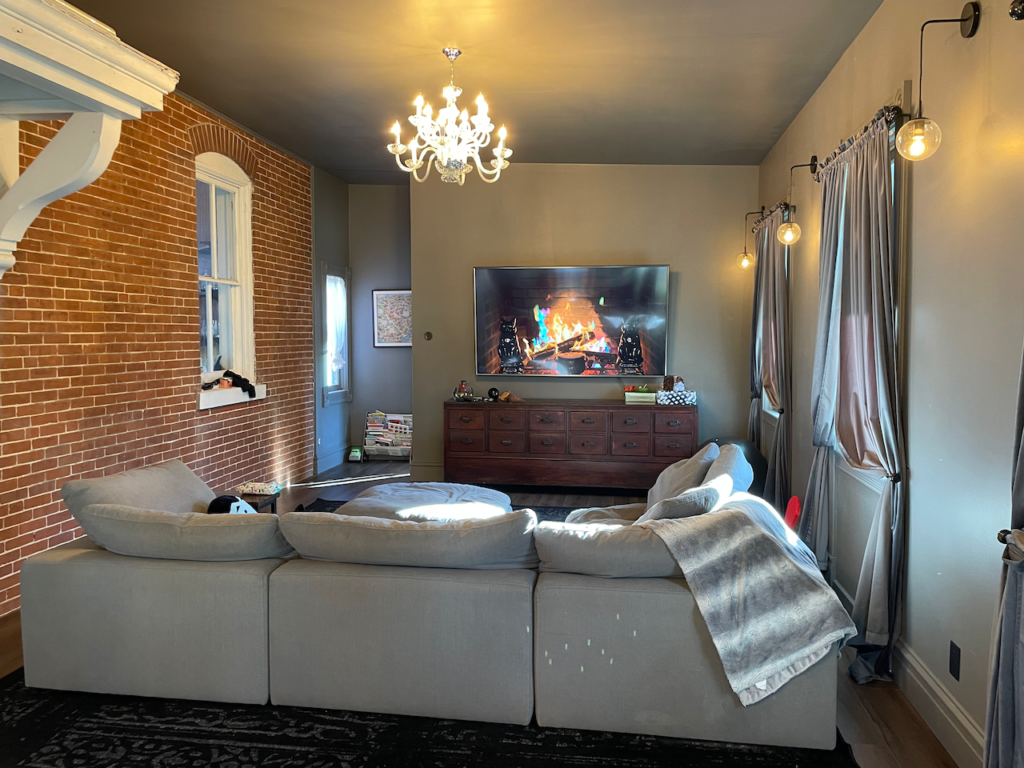
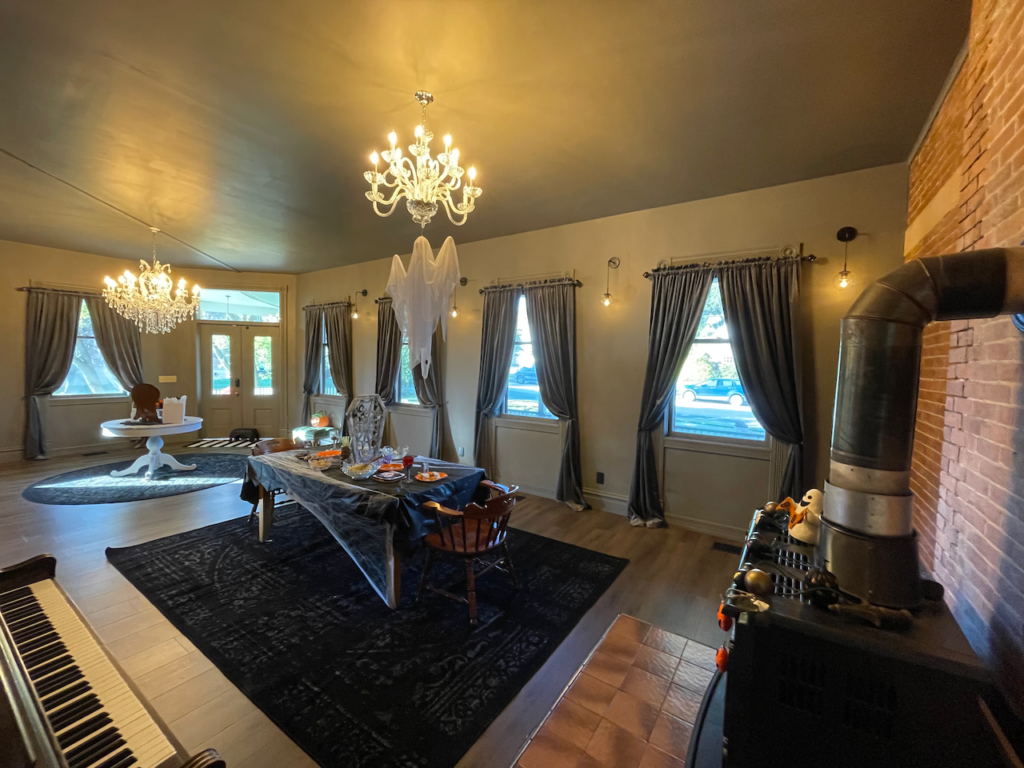
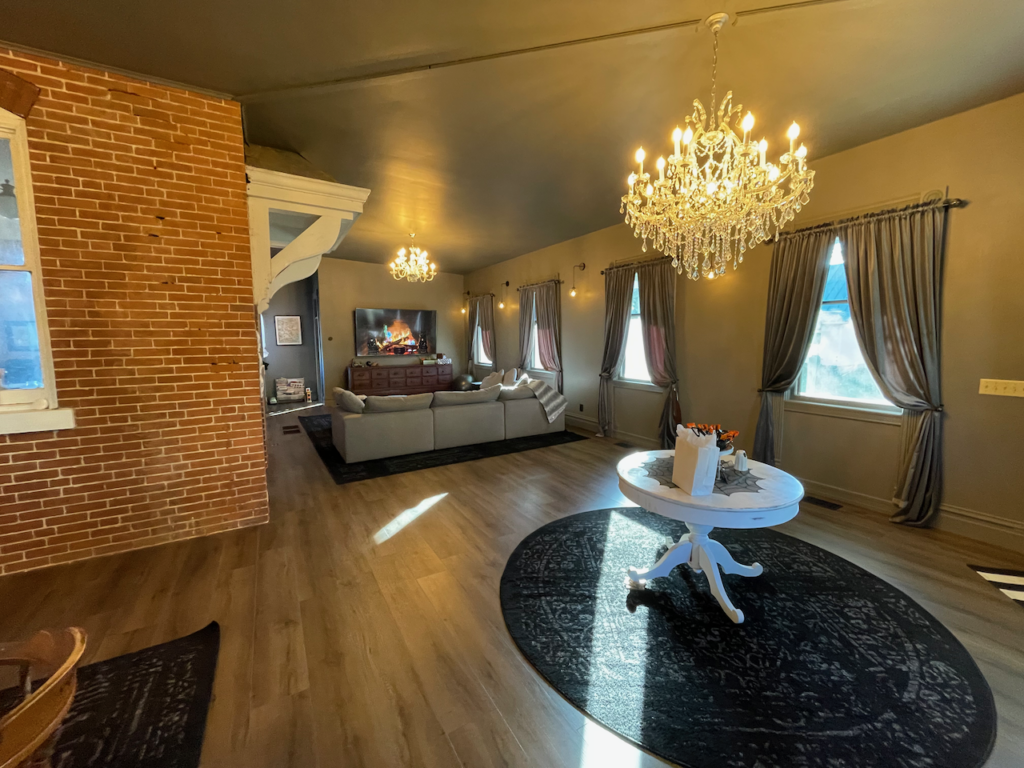
Our largest interior project we have taken on yet. The family room was added in the 1980s and is around 900 square feet. It was used as the reception and breakfast space for the B&B. As a result, it was by far the most in need of a refreshing. Since it’s our primary living room, it also sees the most action. Since this space was an addition, it is the only space we plan on using modern design.
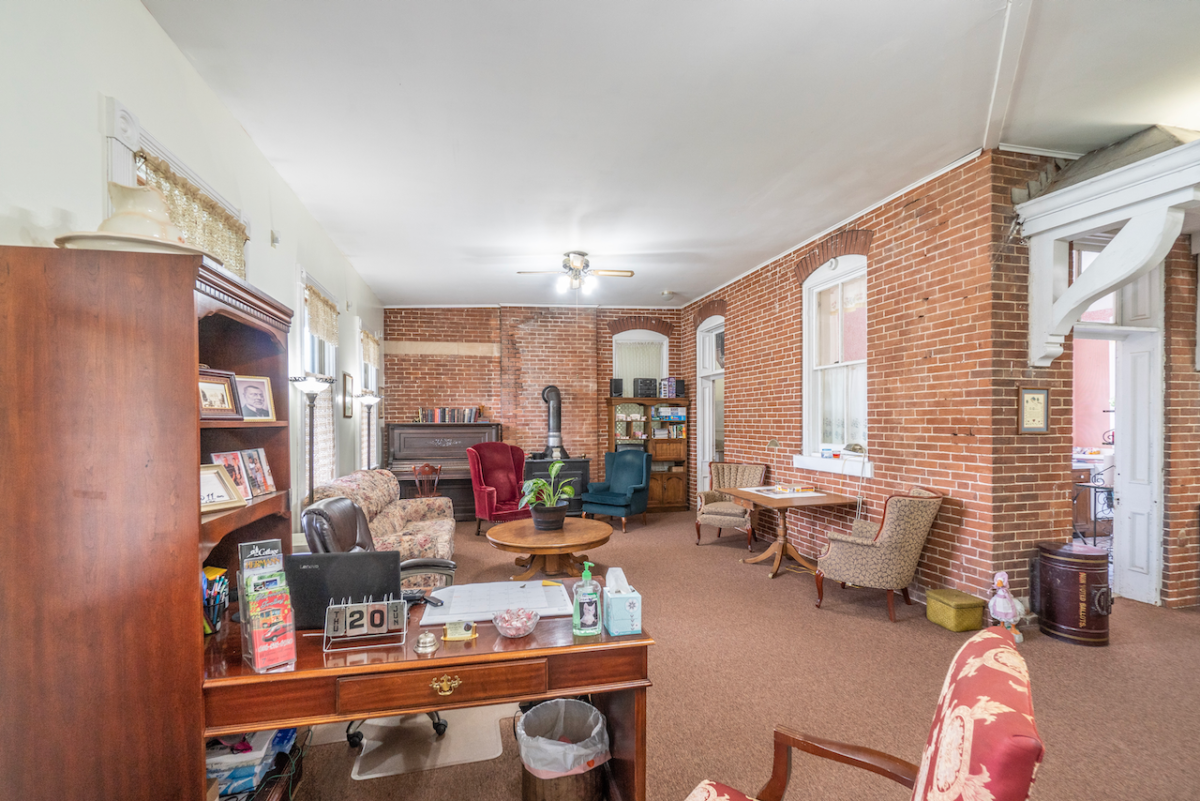
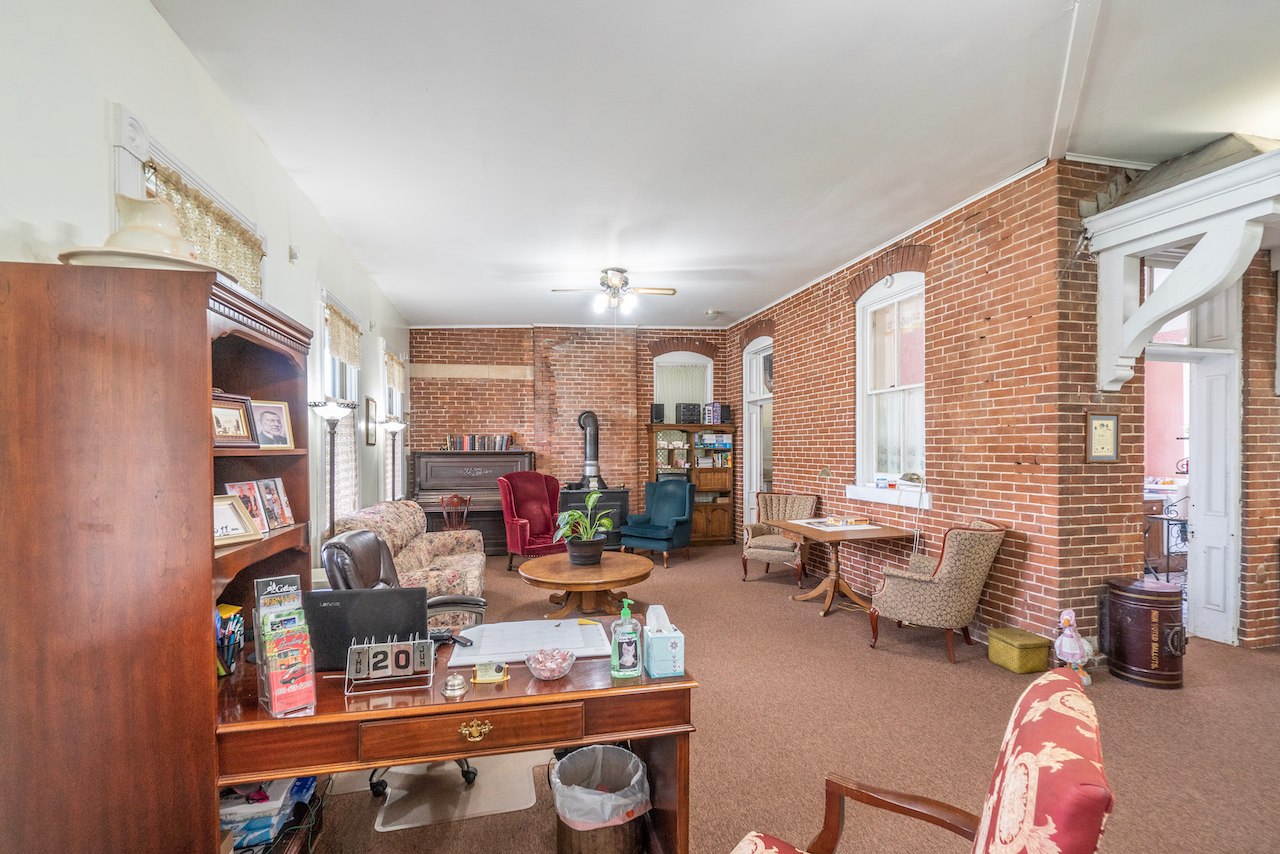
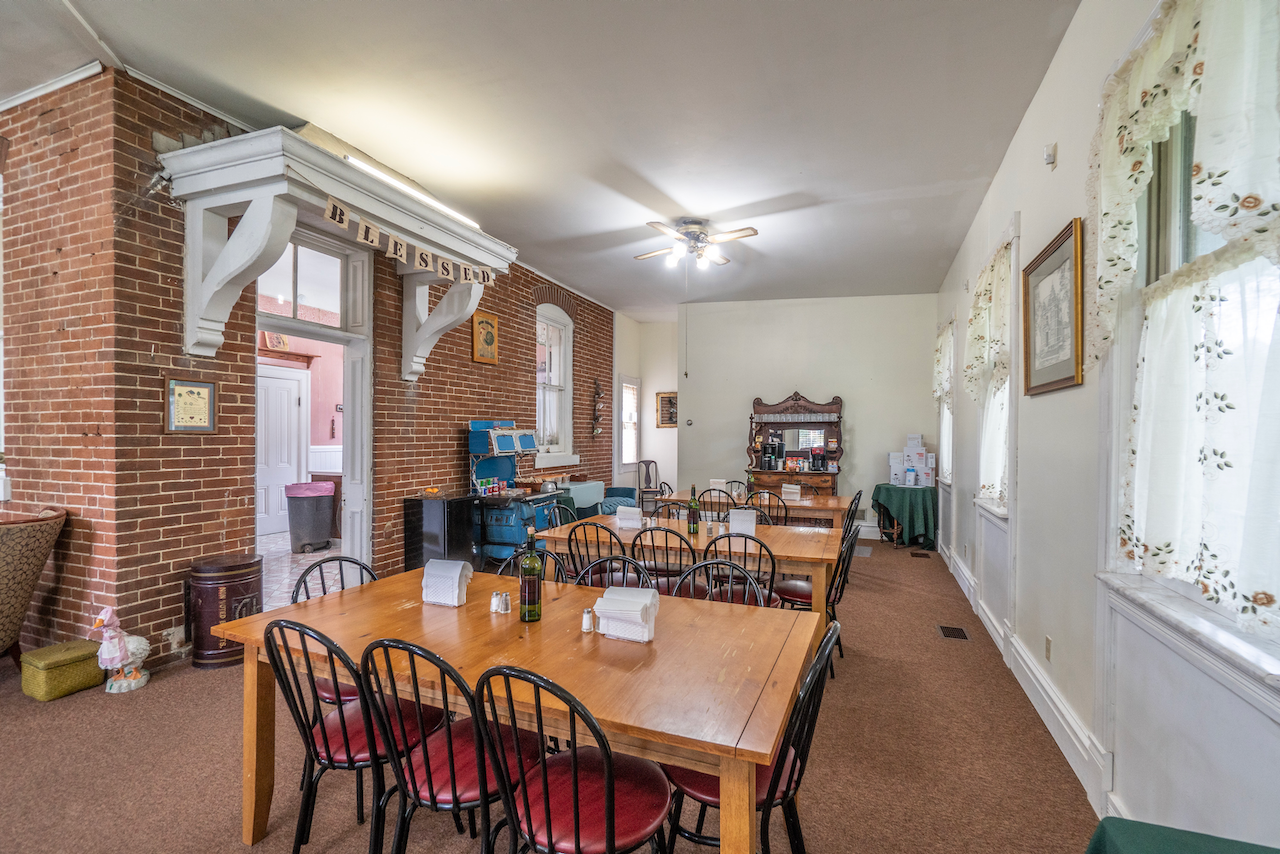
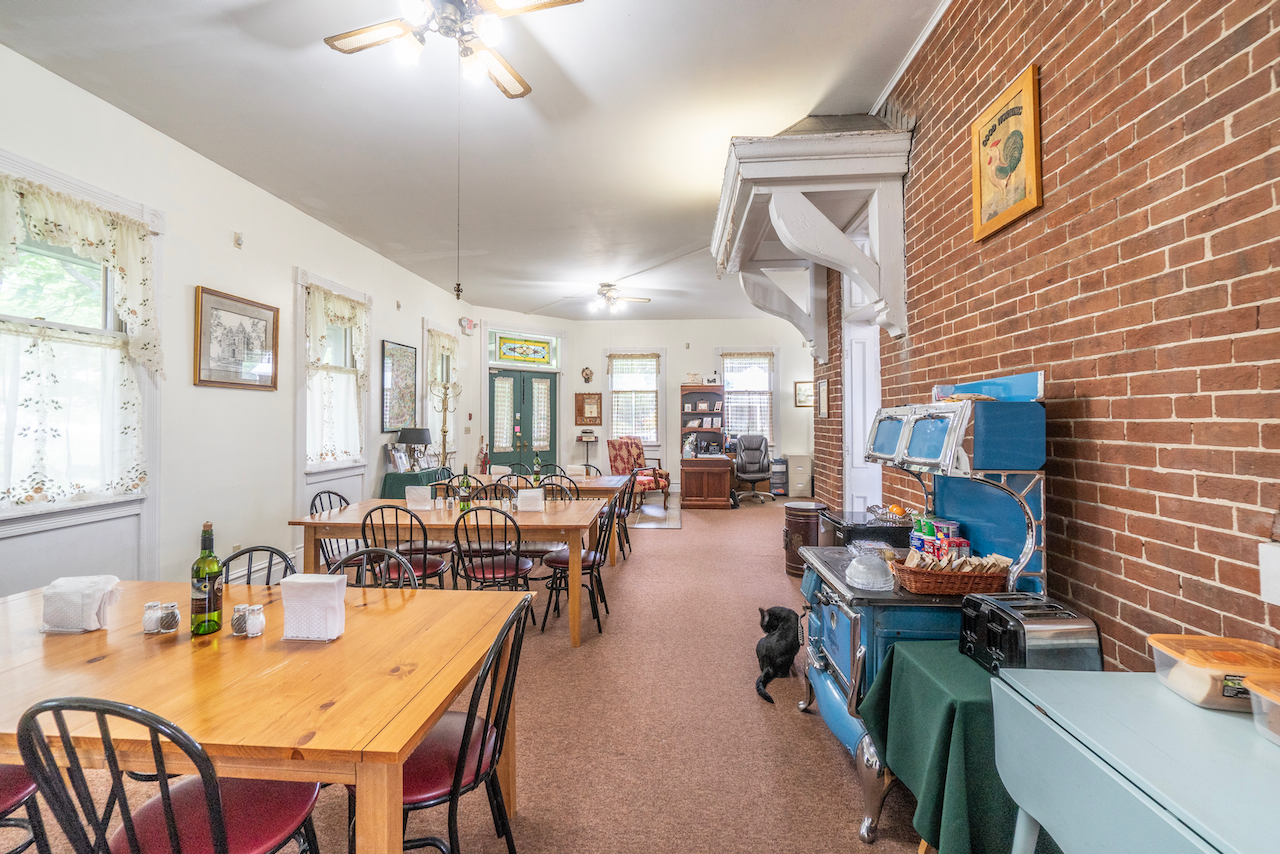
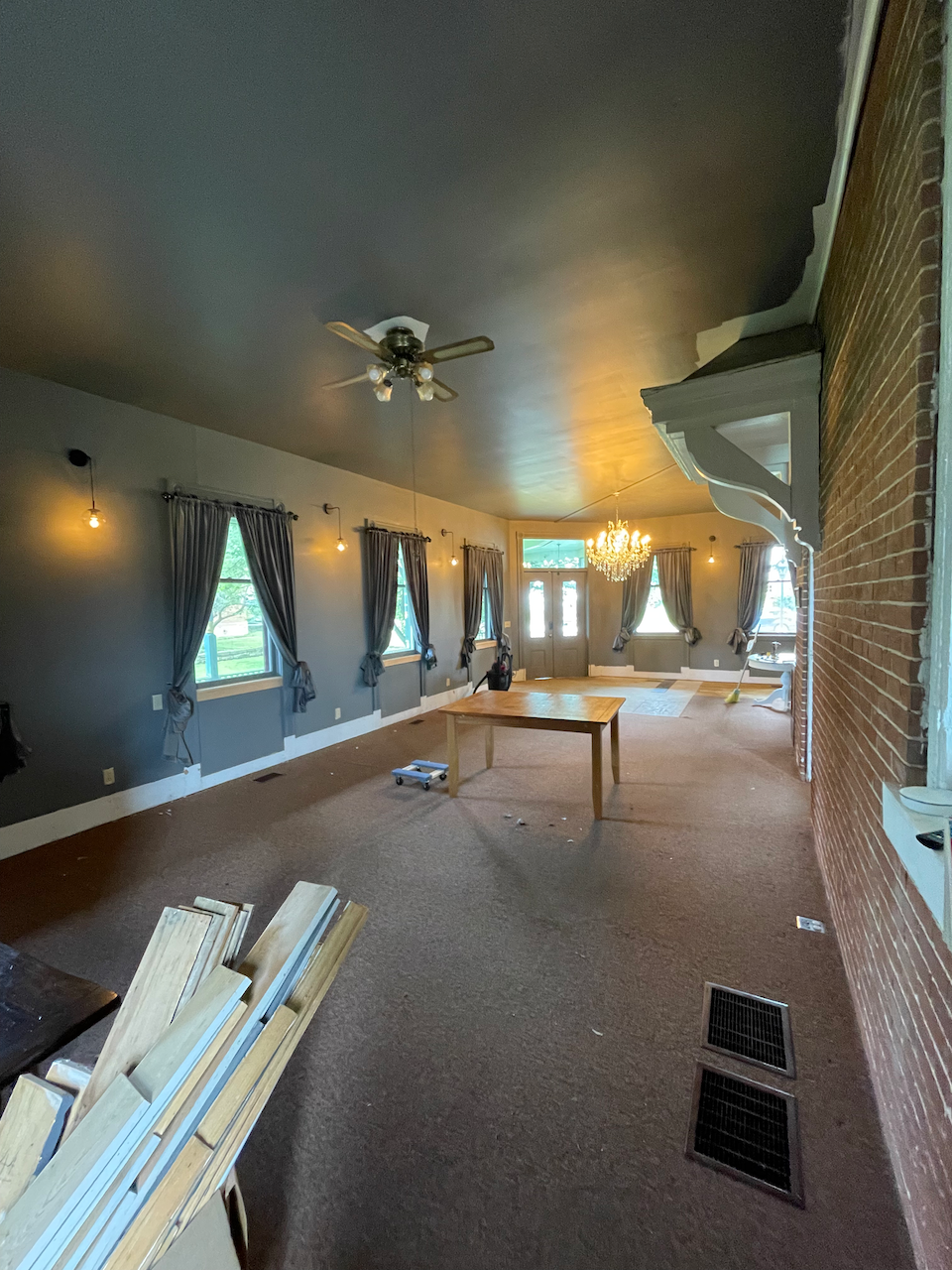
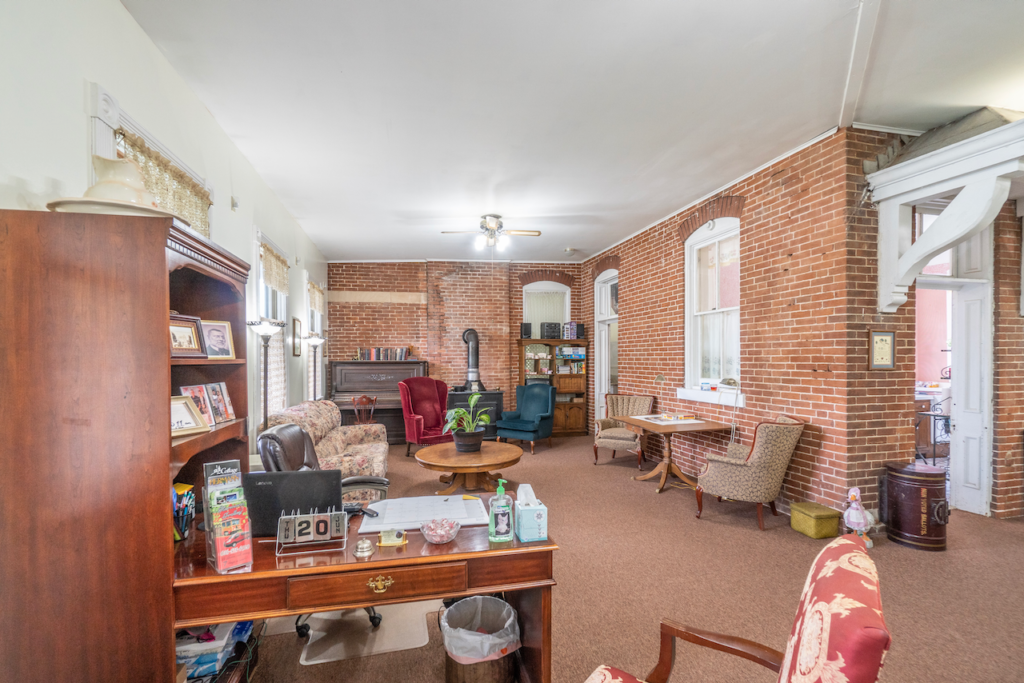
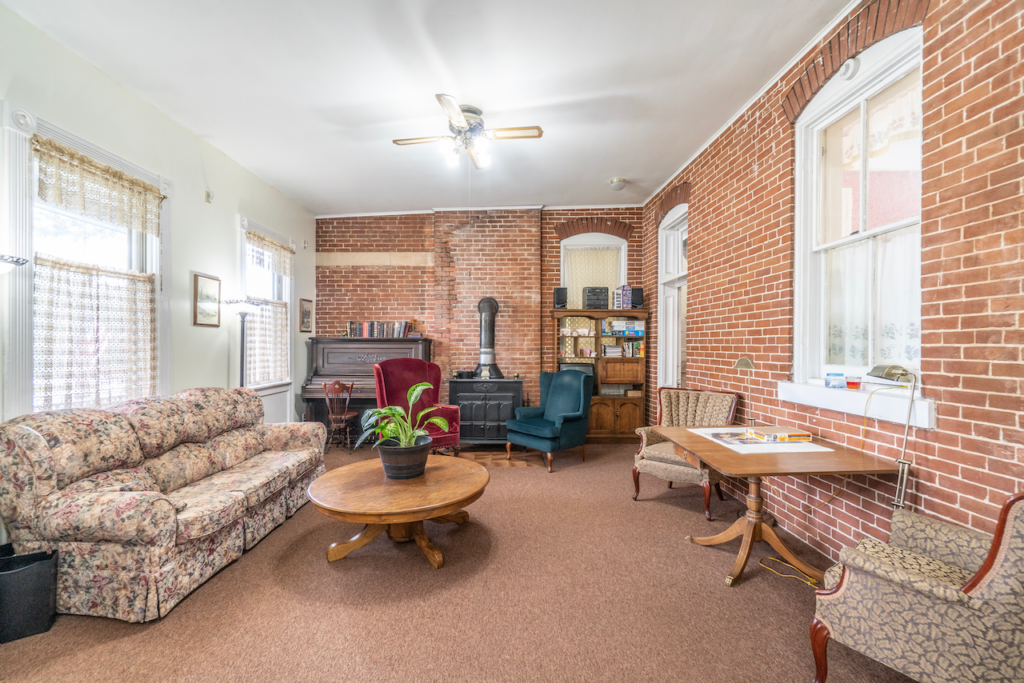
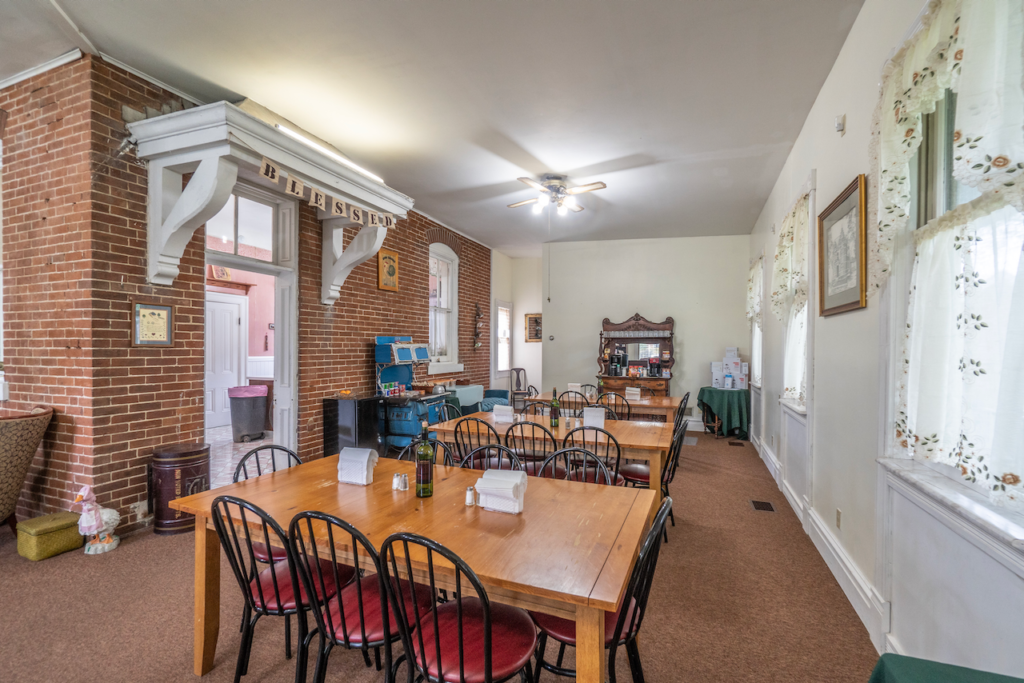
When we moved in, this room was still very much a B&B community room. There was a reception desk, three dining tables, and a sitting area. Over our first year, this space naturally turned into our family room–especially an ideal space for a toddler.
The original community room for the bed and breakfast.
Casing, Aprons & Sills
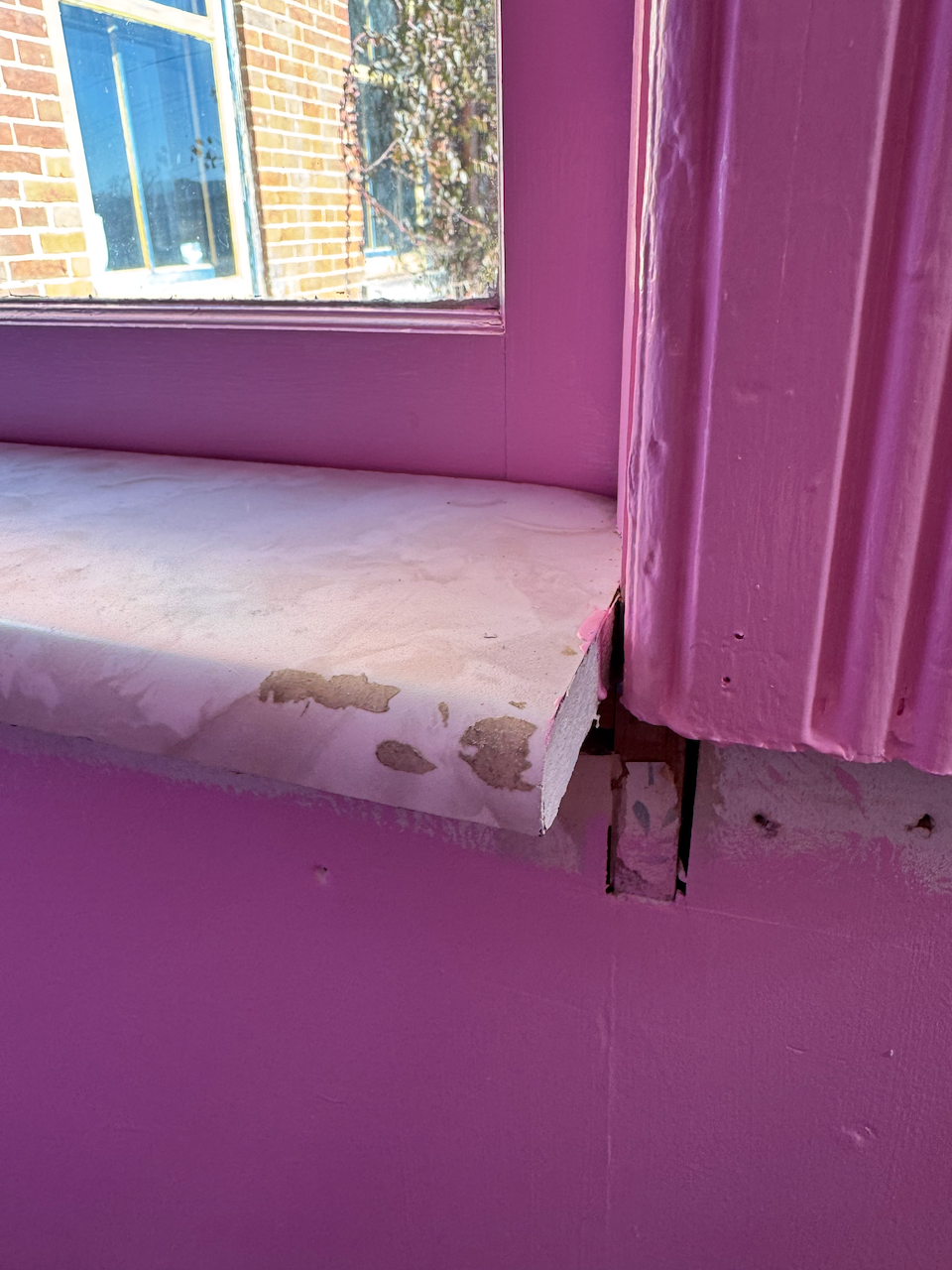
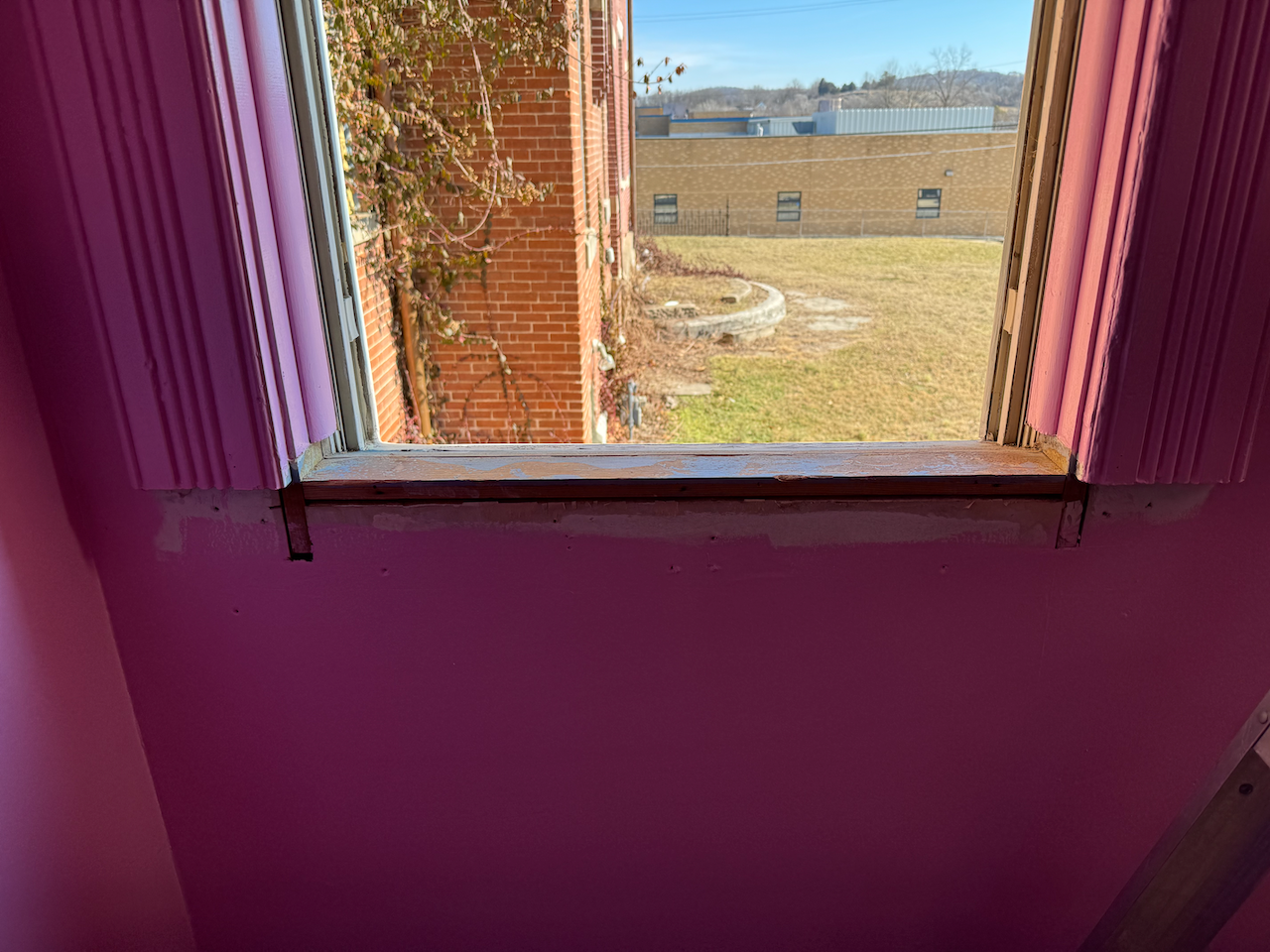
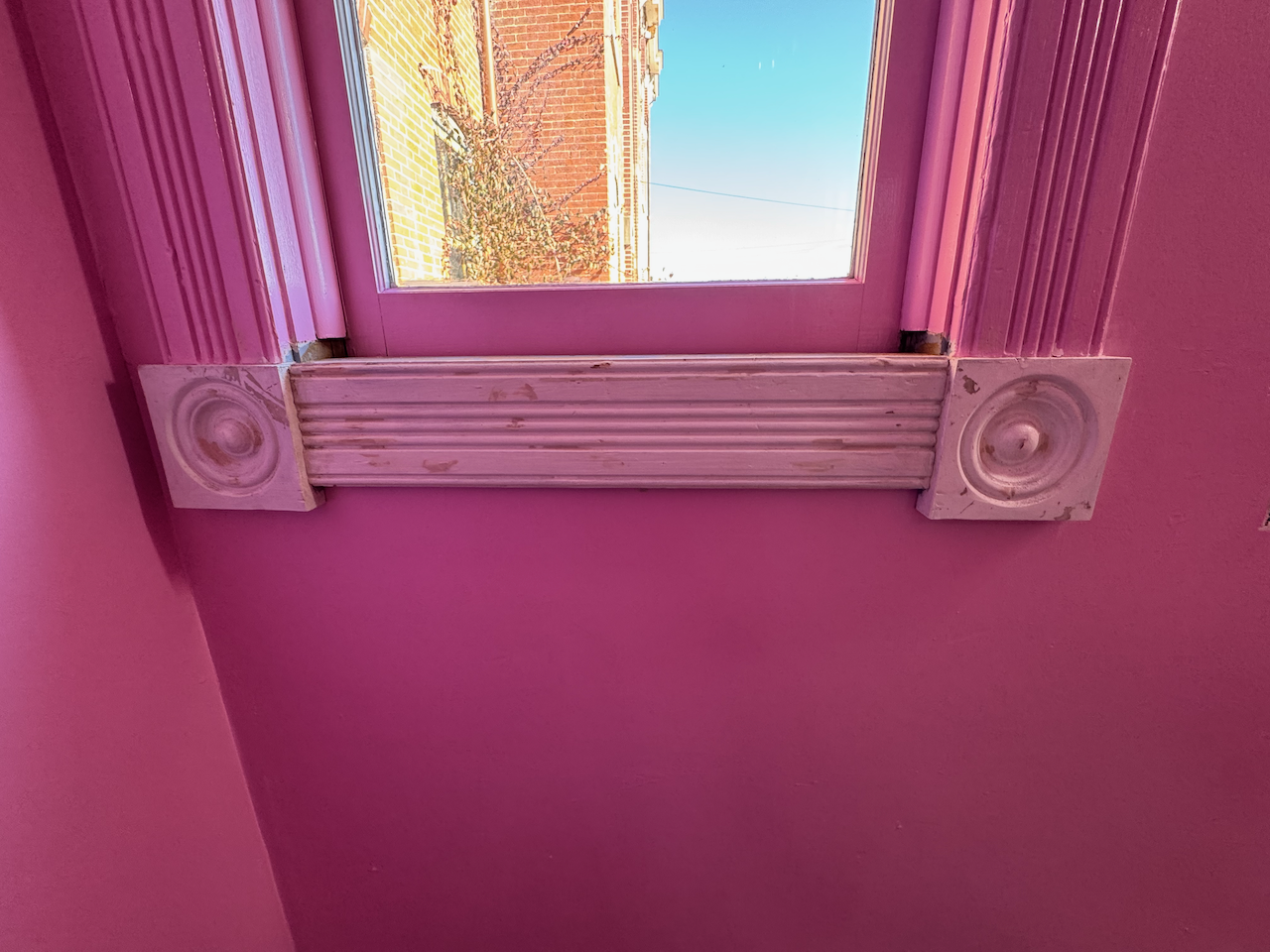
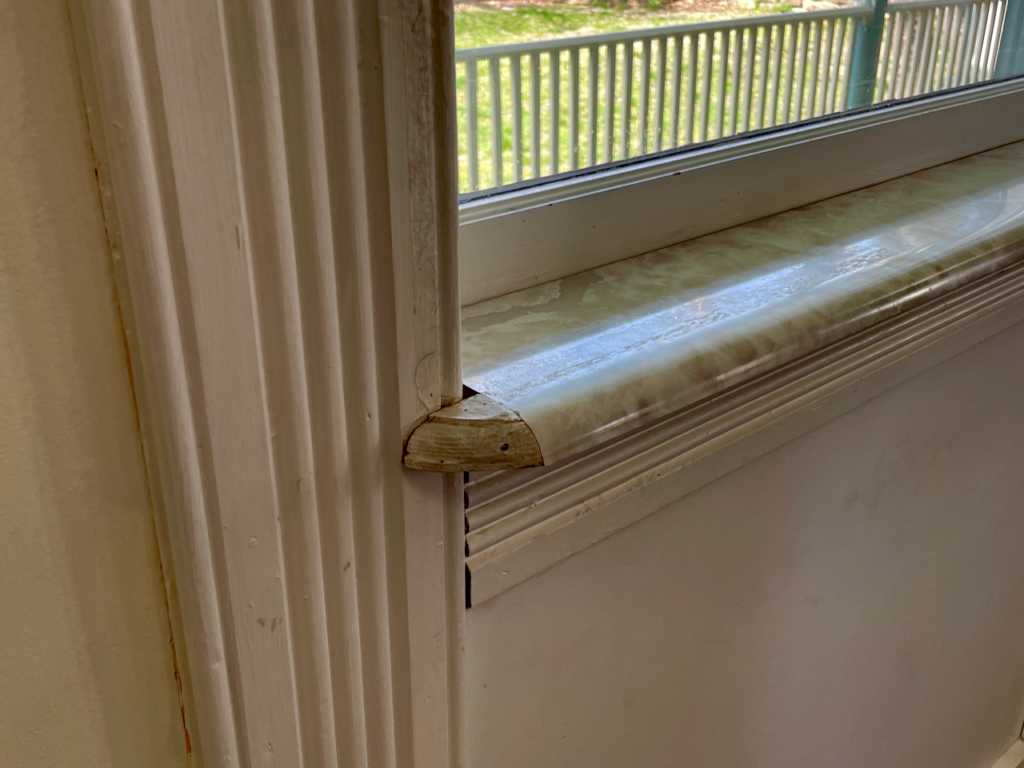
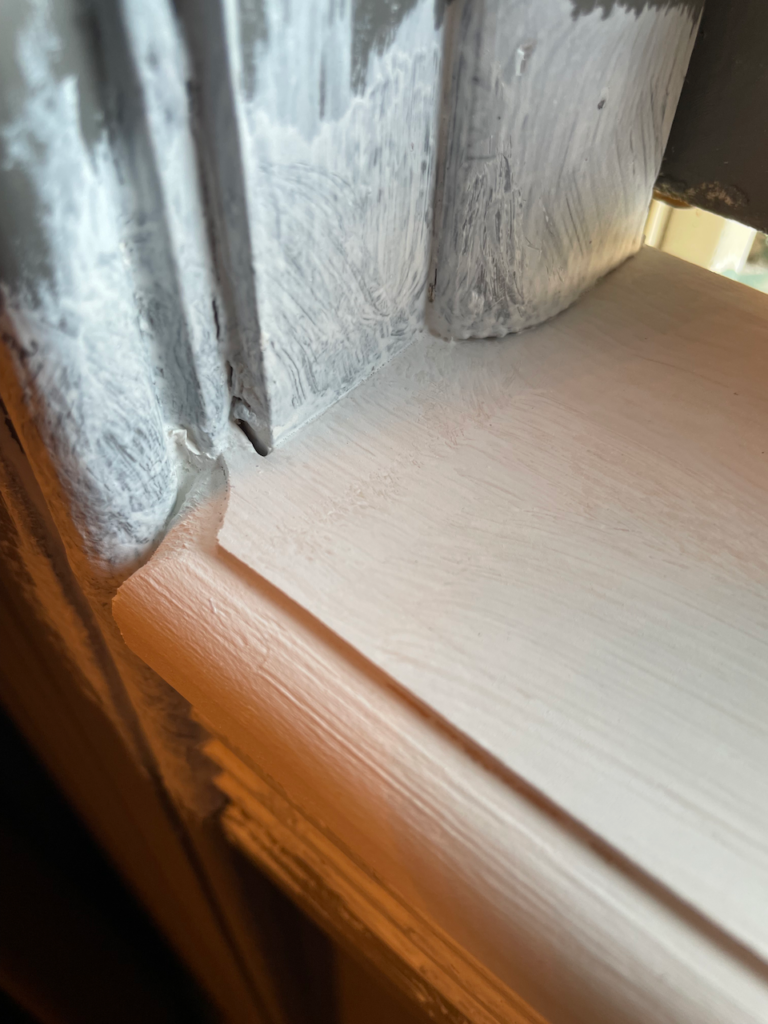
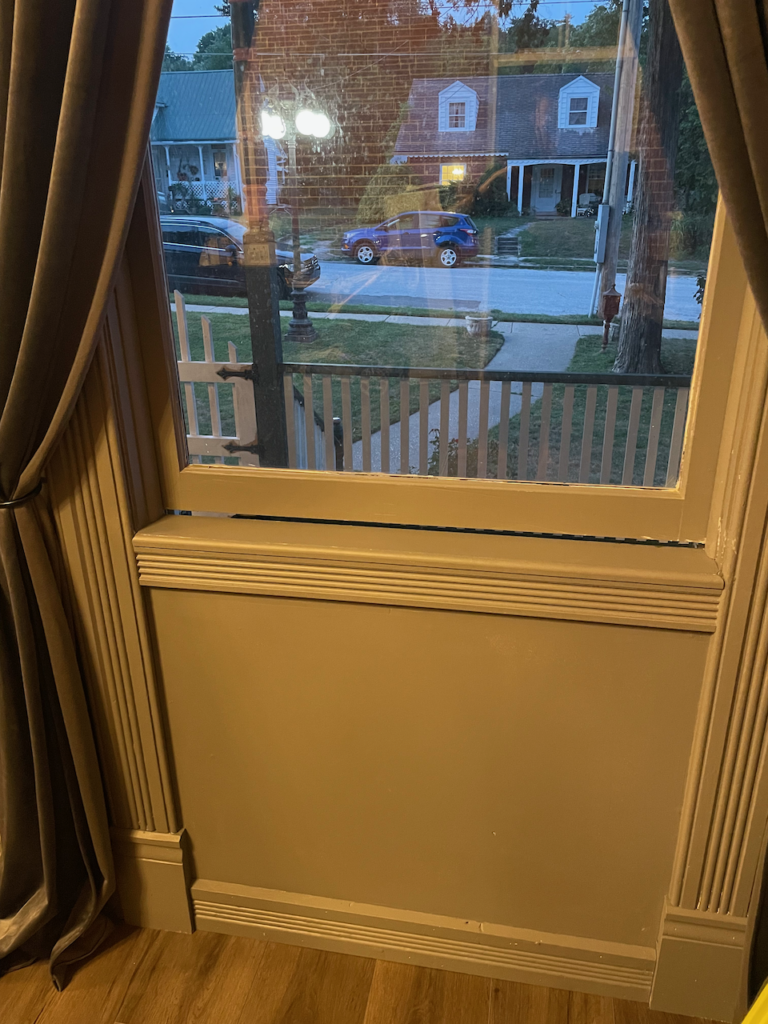
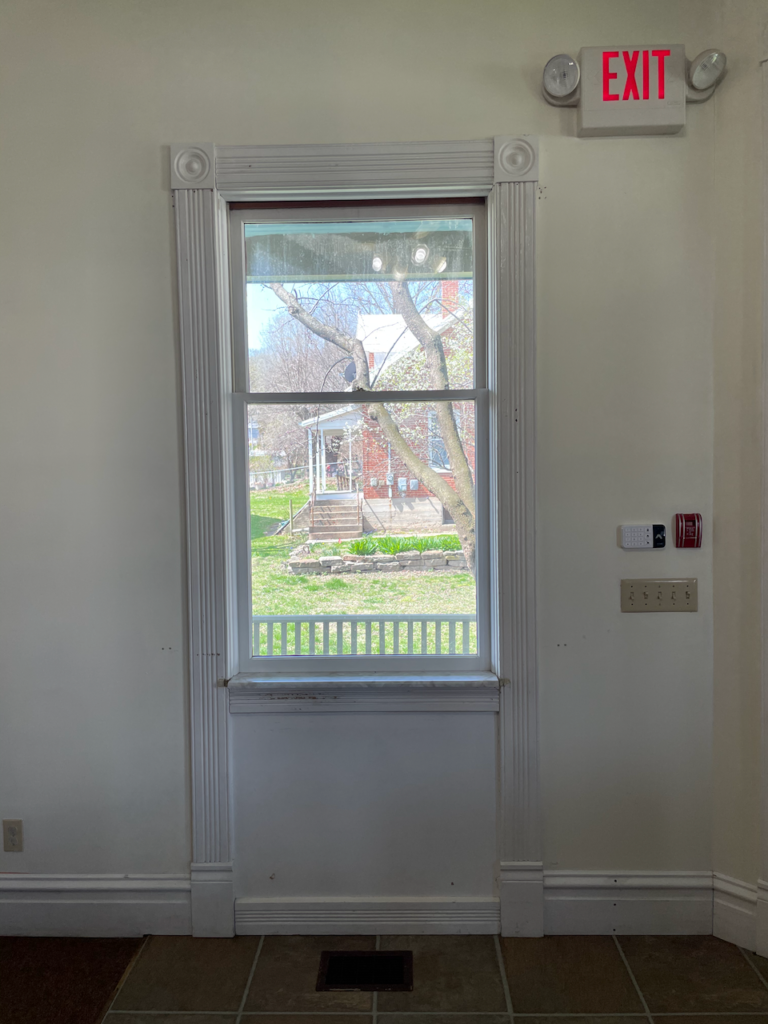
Before embarking on the prep work for painting, we took inventory of the windows. The room has nine windows total and needs updates. The window aprons that were originally chosen were too thick and protruded beyond the casing. The window sills were laminated MDF with a marble pattern.
The window sills were laminated MDF and the window apron protruded beyond the casing.
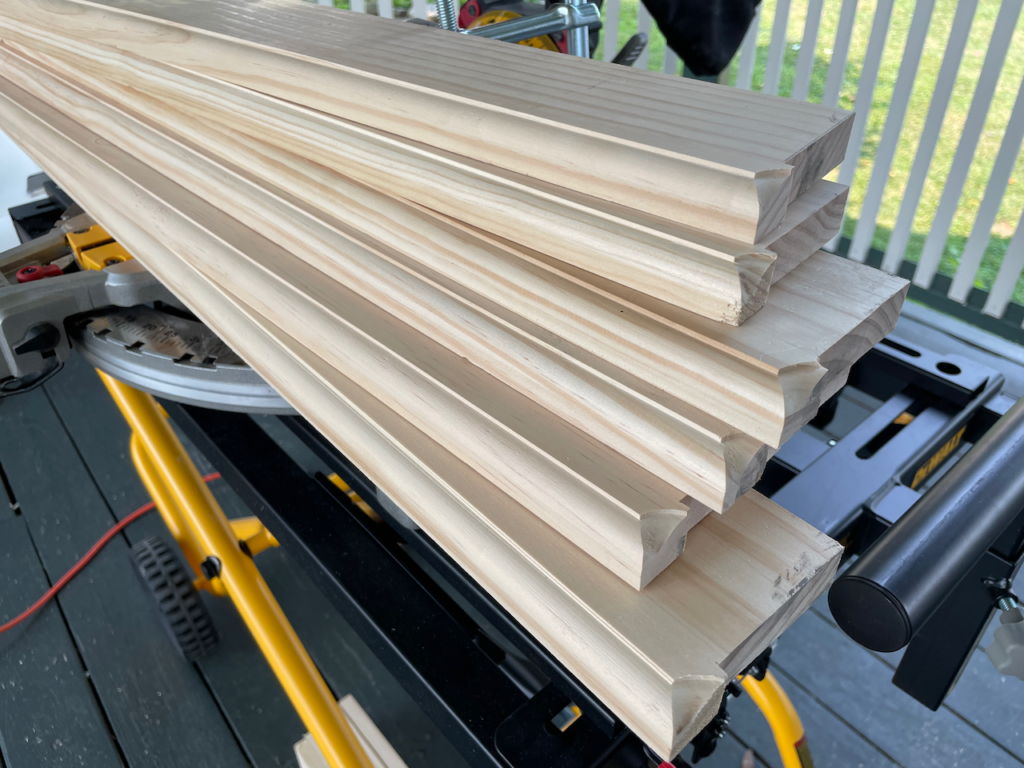
Needless to say, everything about this configuration needed to change. We fabricated custom window sills that better matched the style of the windows and replaced the window aprons with the proper thickness.
Painting
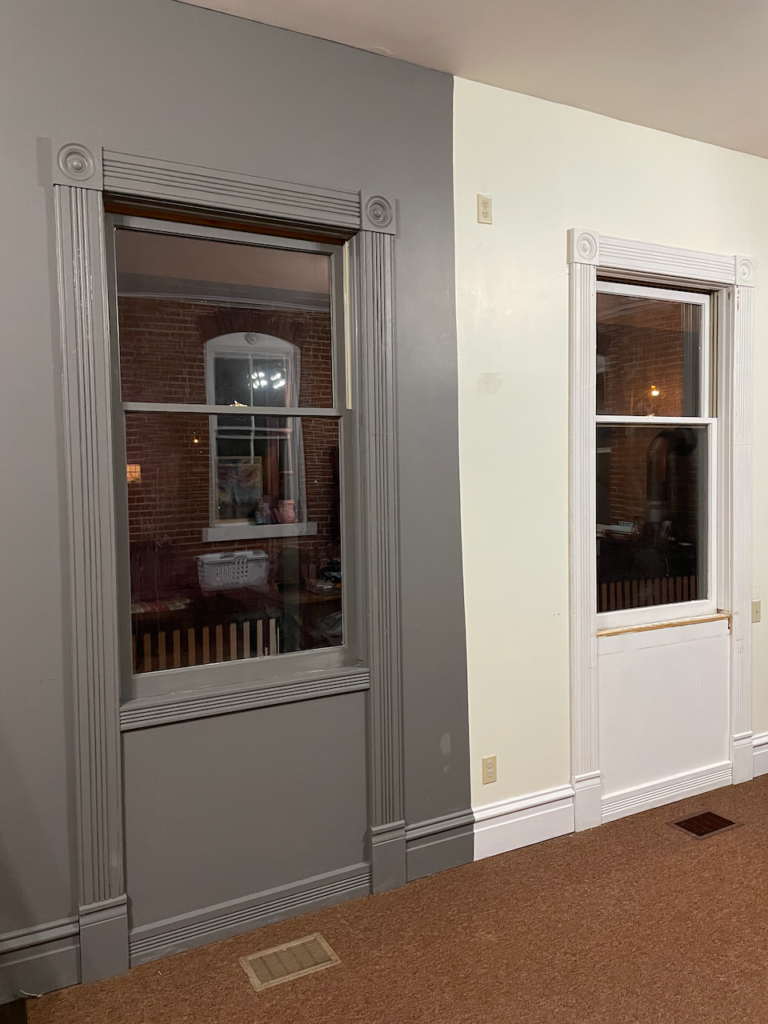
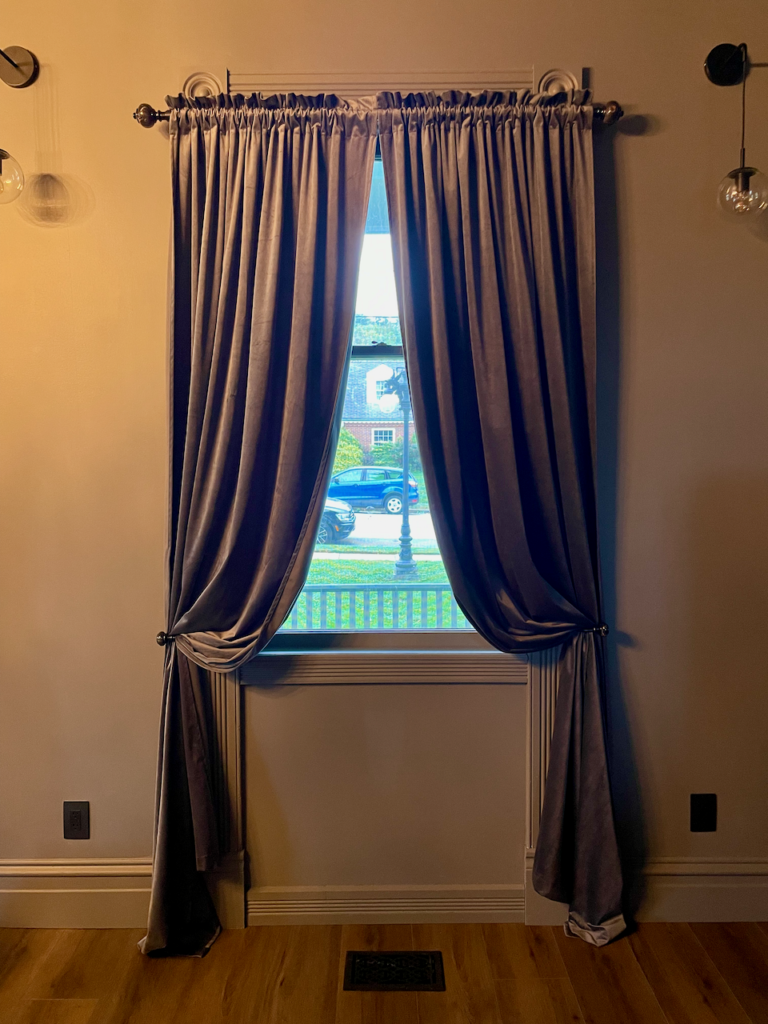
The room has nine windows, and we quickly learned about a winter tradition previously common, taping up over the windows. We spent more time removing goo from the casing and windows than painting.
A mockup of the paint selection and new window apron, including wet paint.BeforeAfter
Double Doors
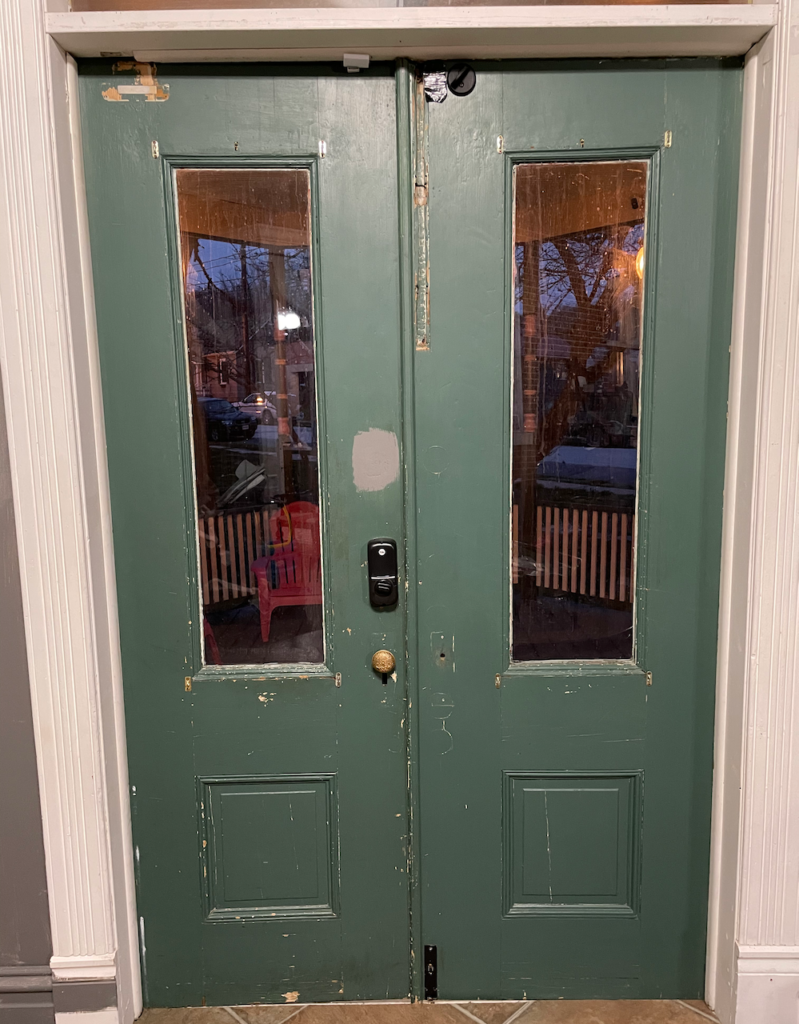
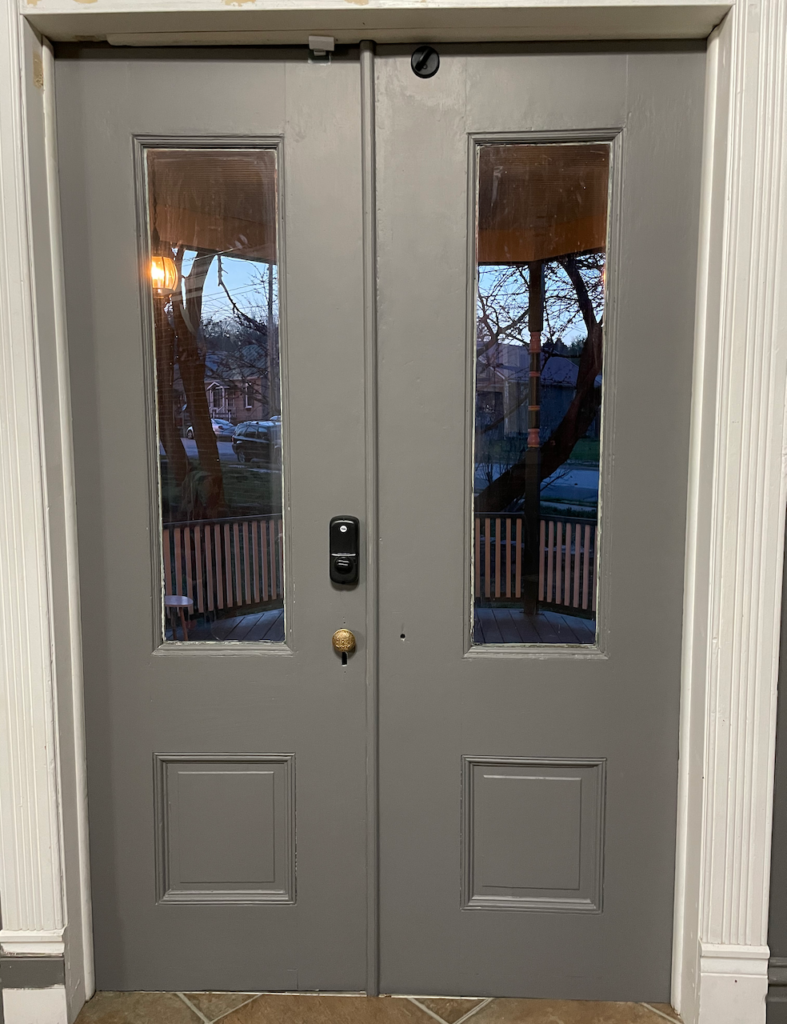
The main entry doors into the room has seen a lot of action over the years.
BeforeAfter
Flooring
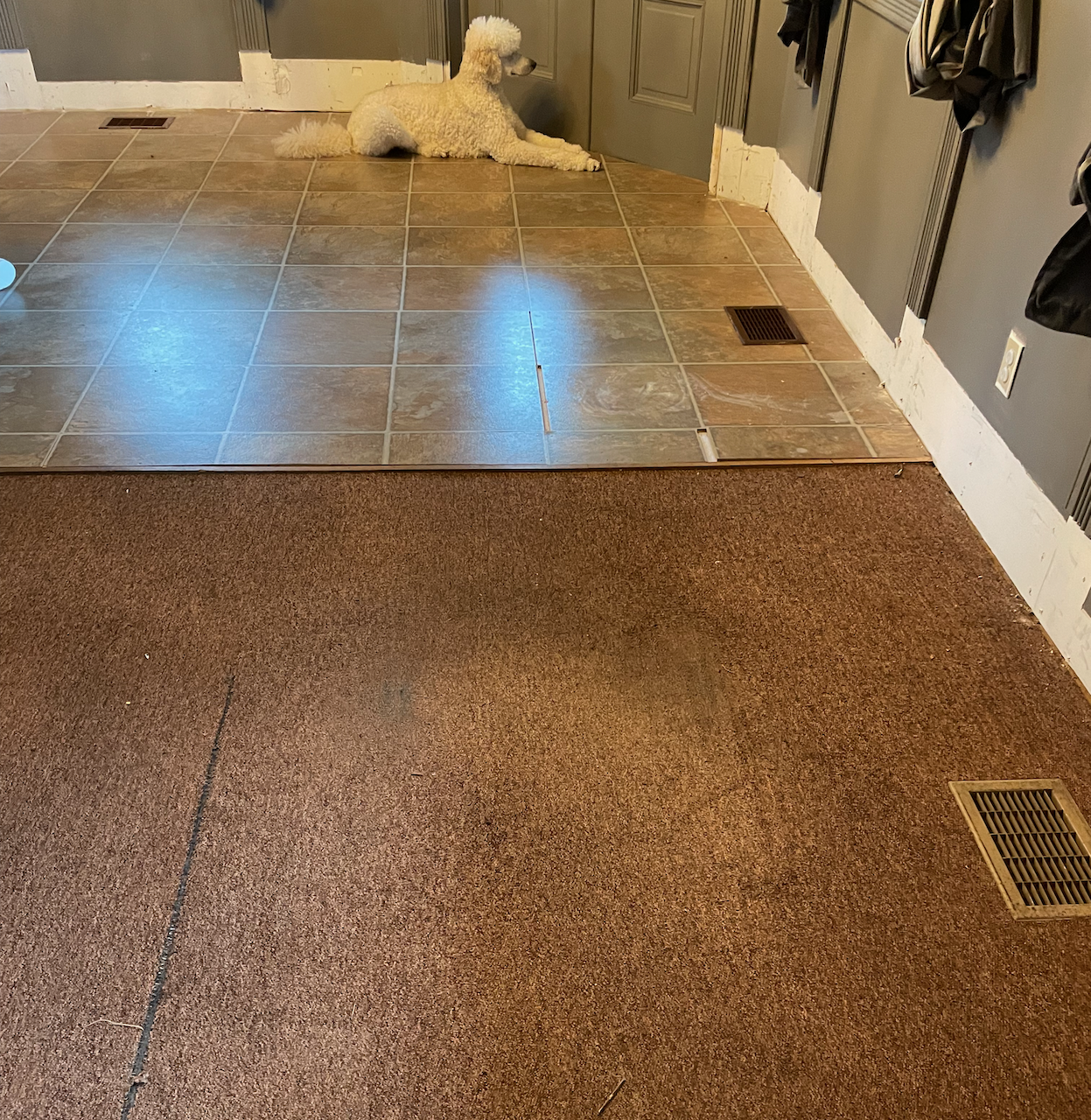
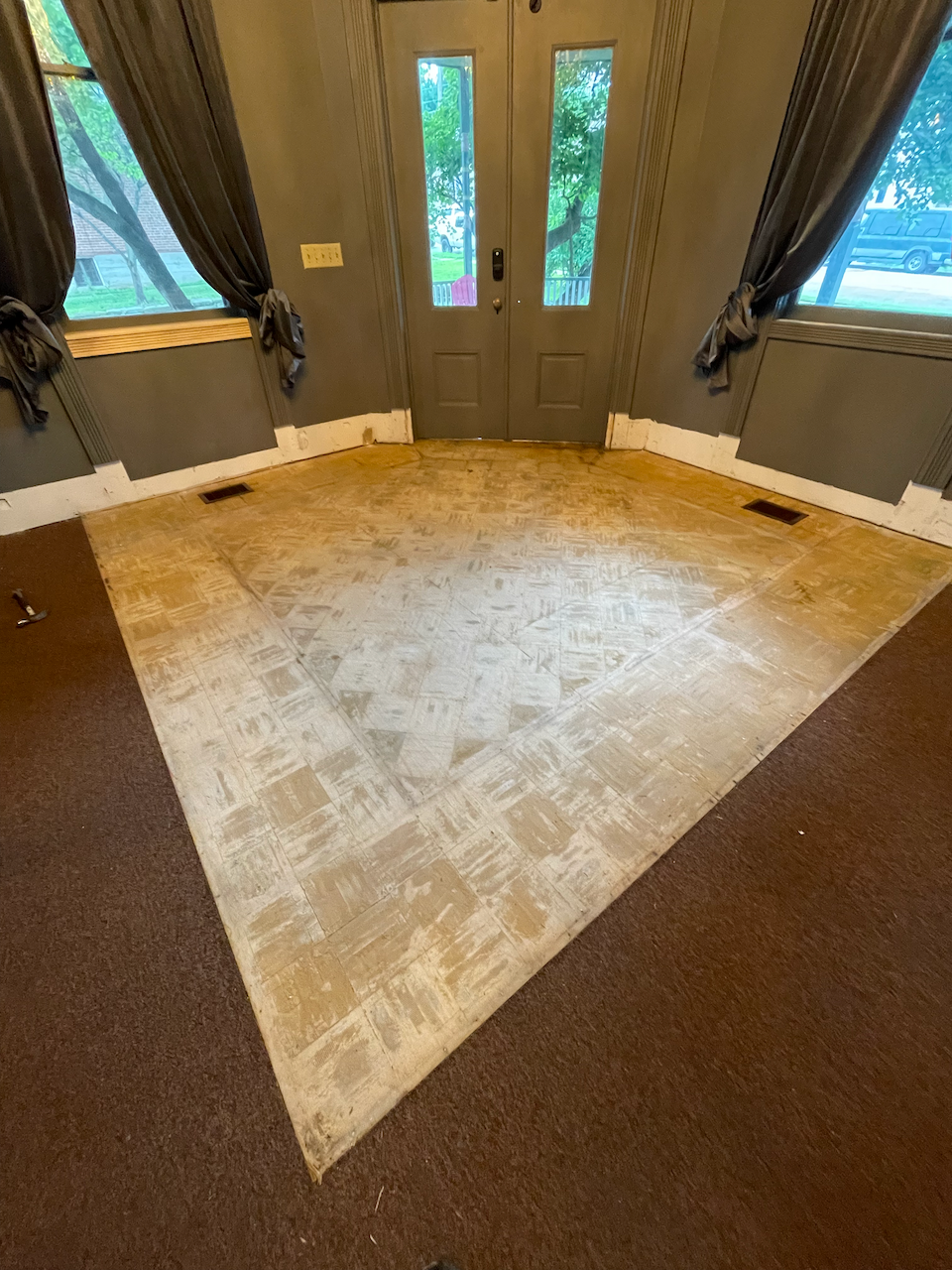
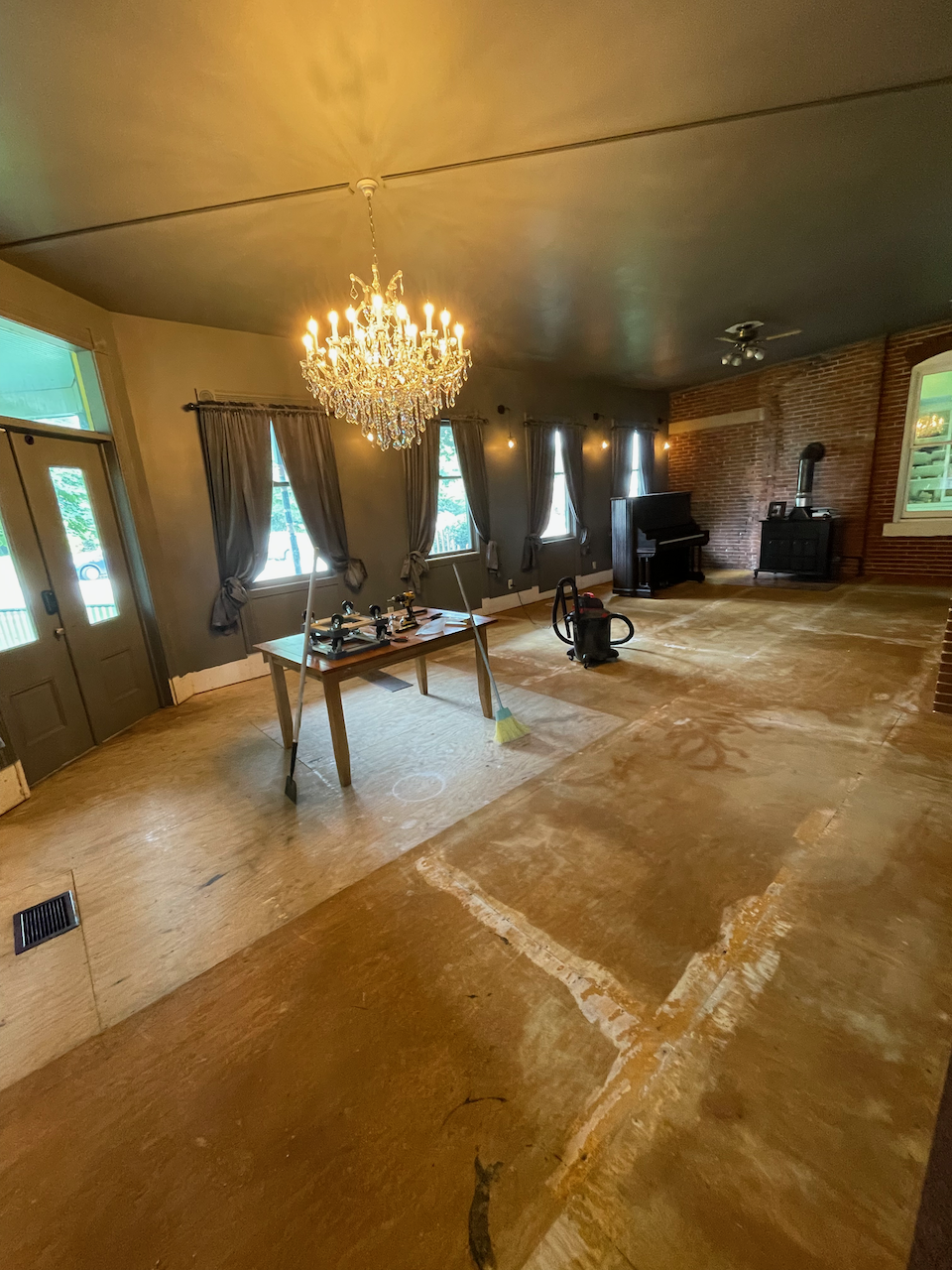
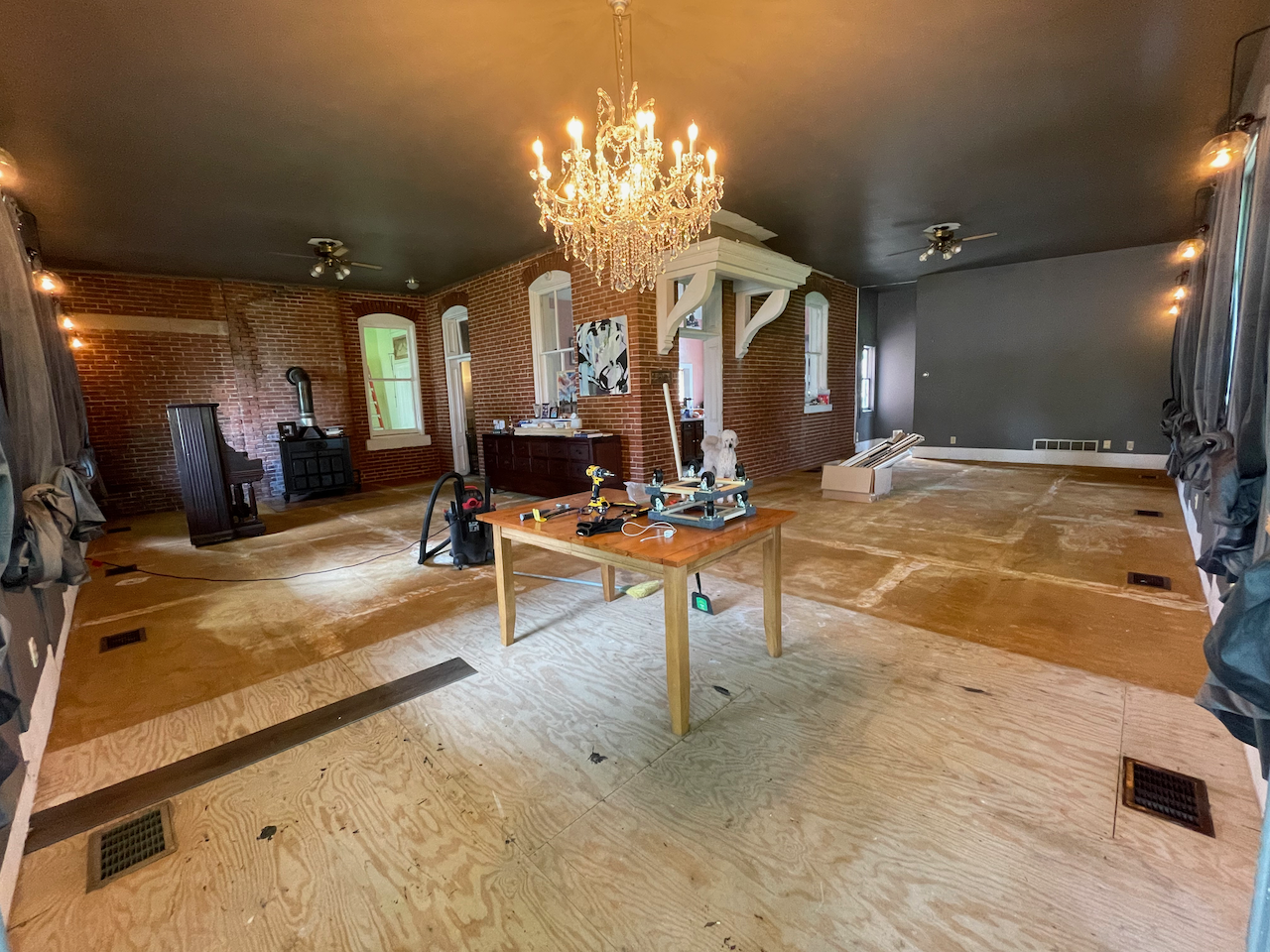
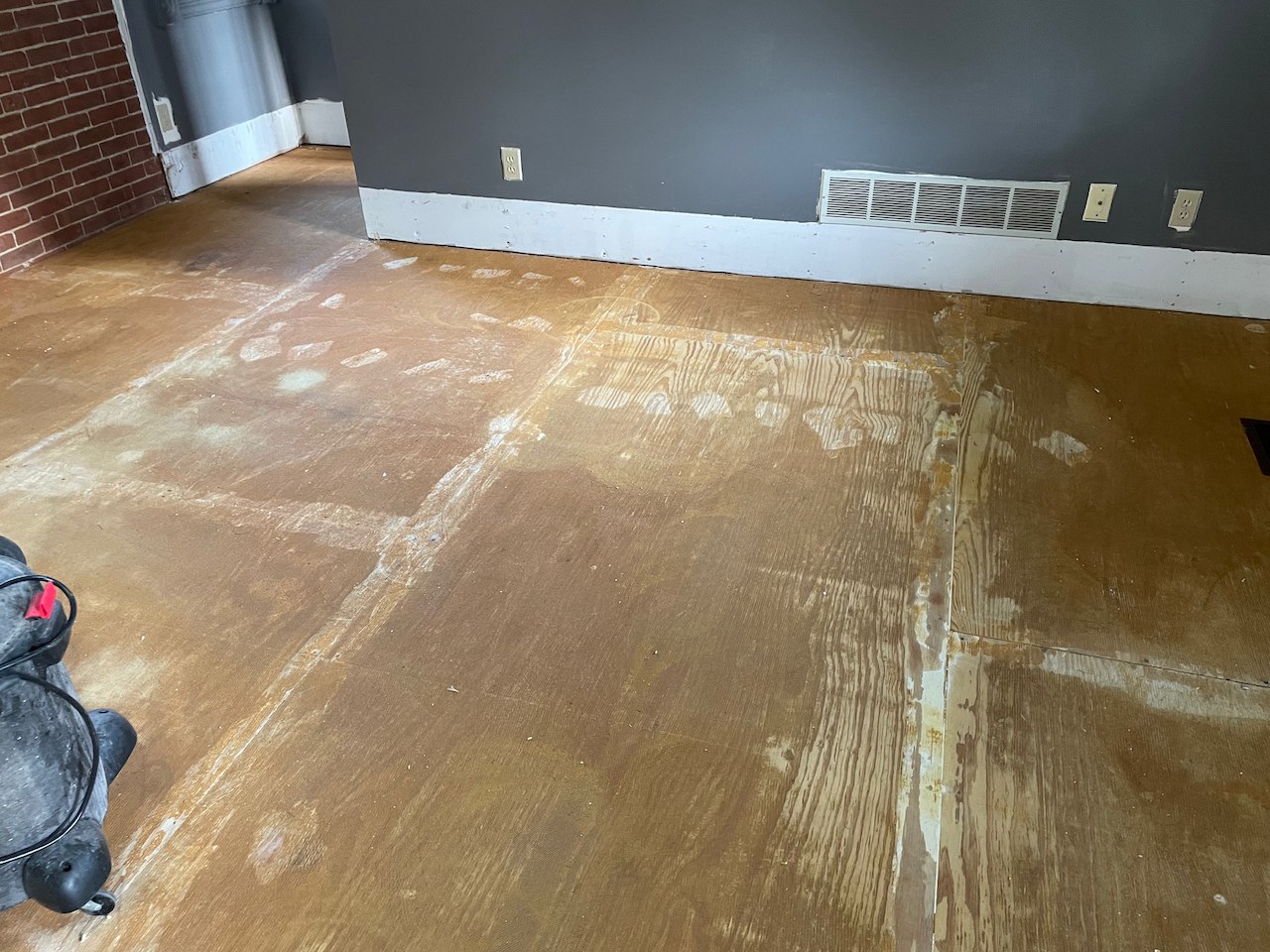
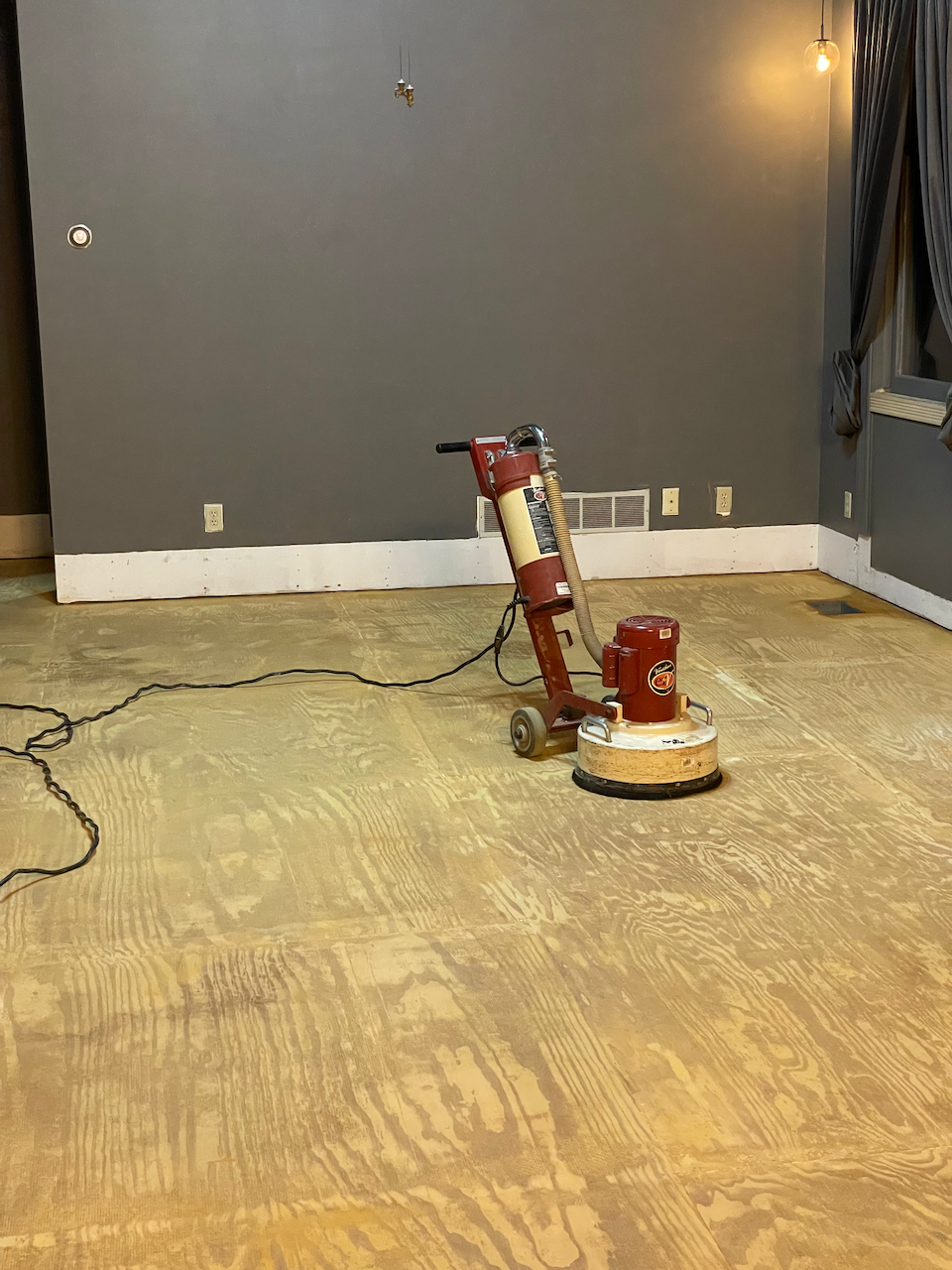
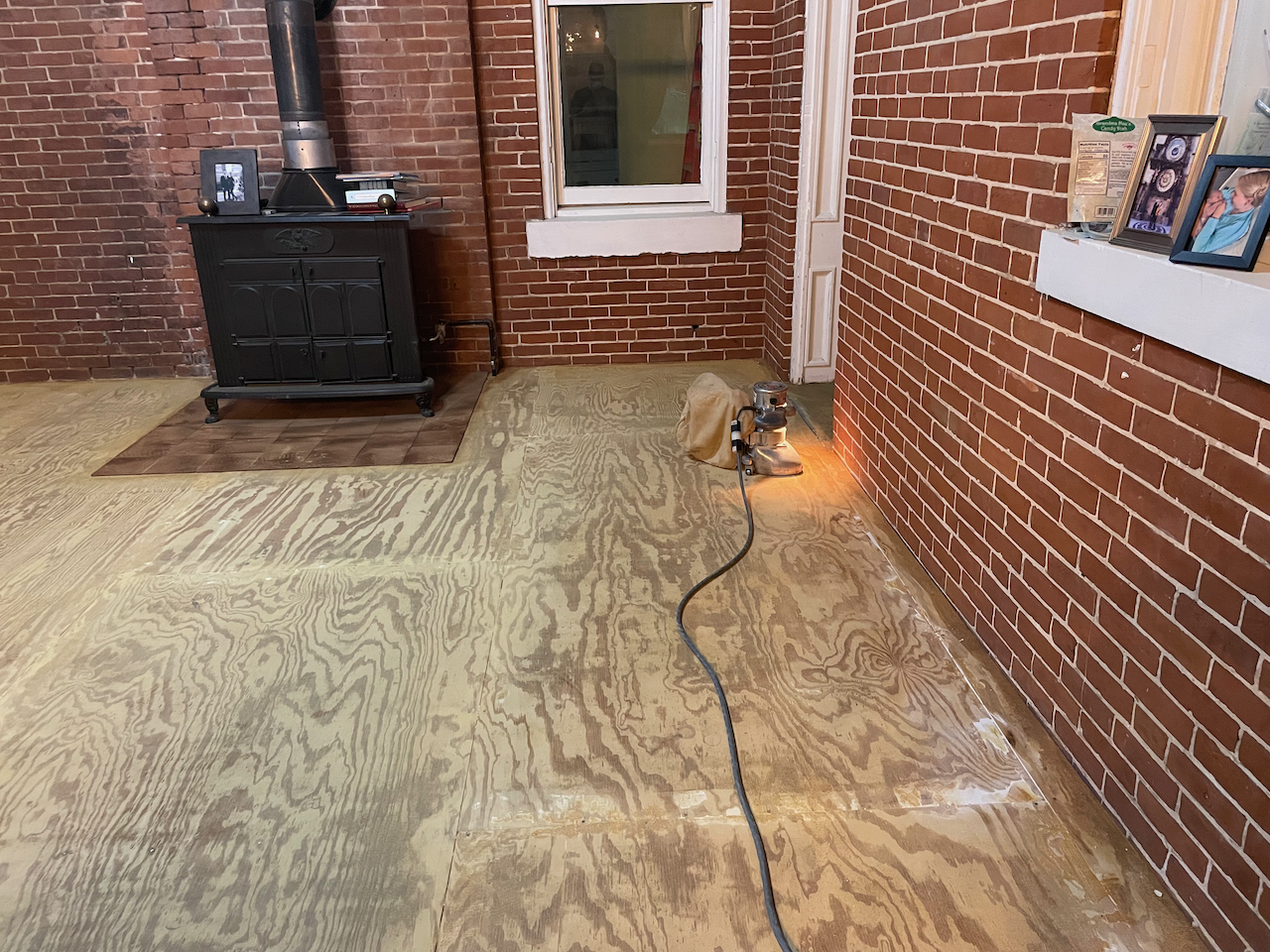
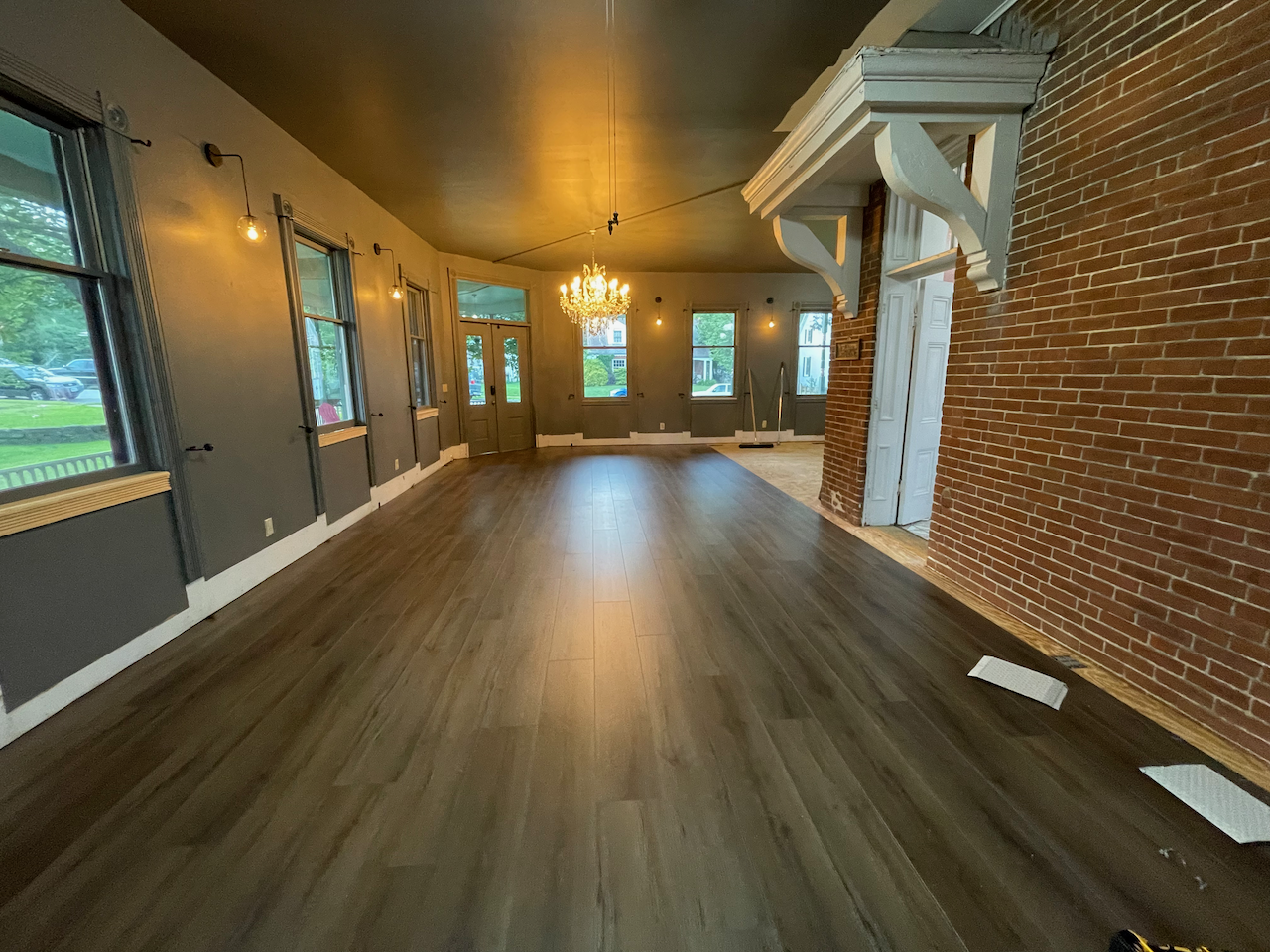
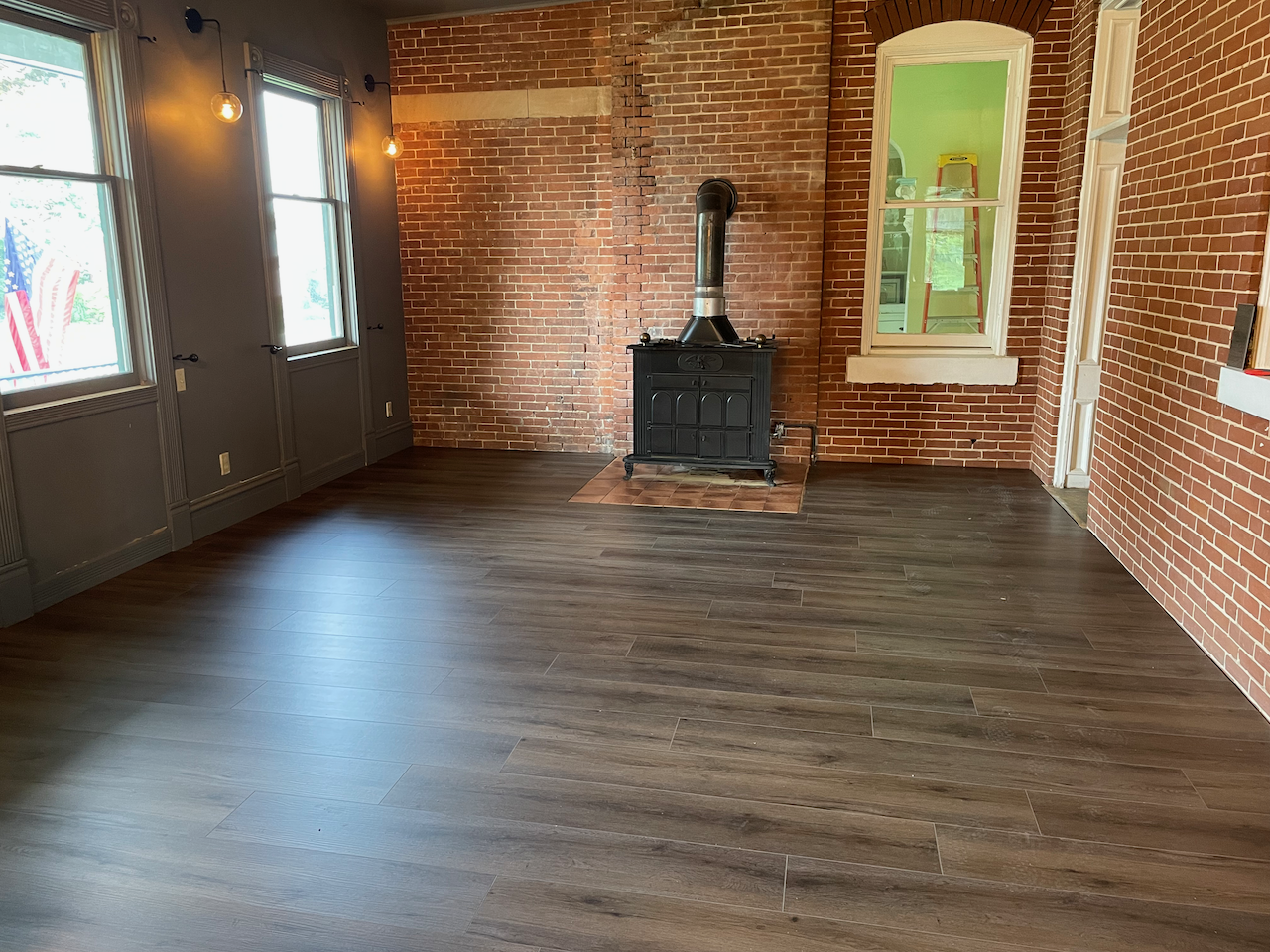
The biggest part of this project was the floors. When you first entered the room, there was an elevated floor, and the remainder of the room was carpeted. It turns out that the commercial carpet is original to when the room was added. We knew we wanted to do away with the elevated entry, but we wrestled choosing the right flooring. Our goal has been hardwood throughout, but this is the main space for toddlers and a large dog. We ordered countless samples of everything under the sun, from engineered to rigid core. It’s amazing how few passed the “toddler-proof” test.
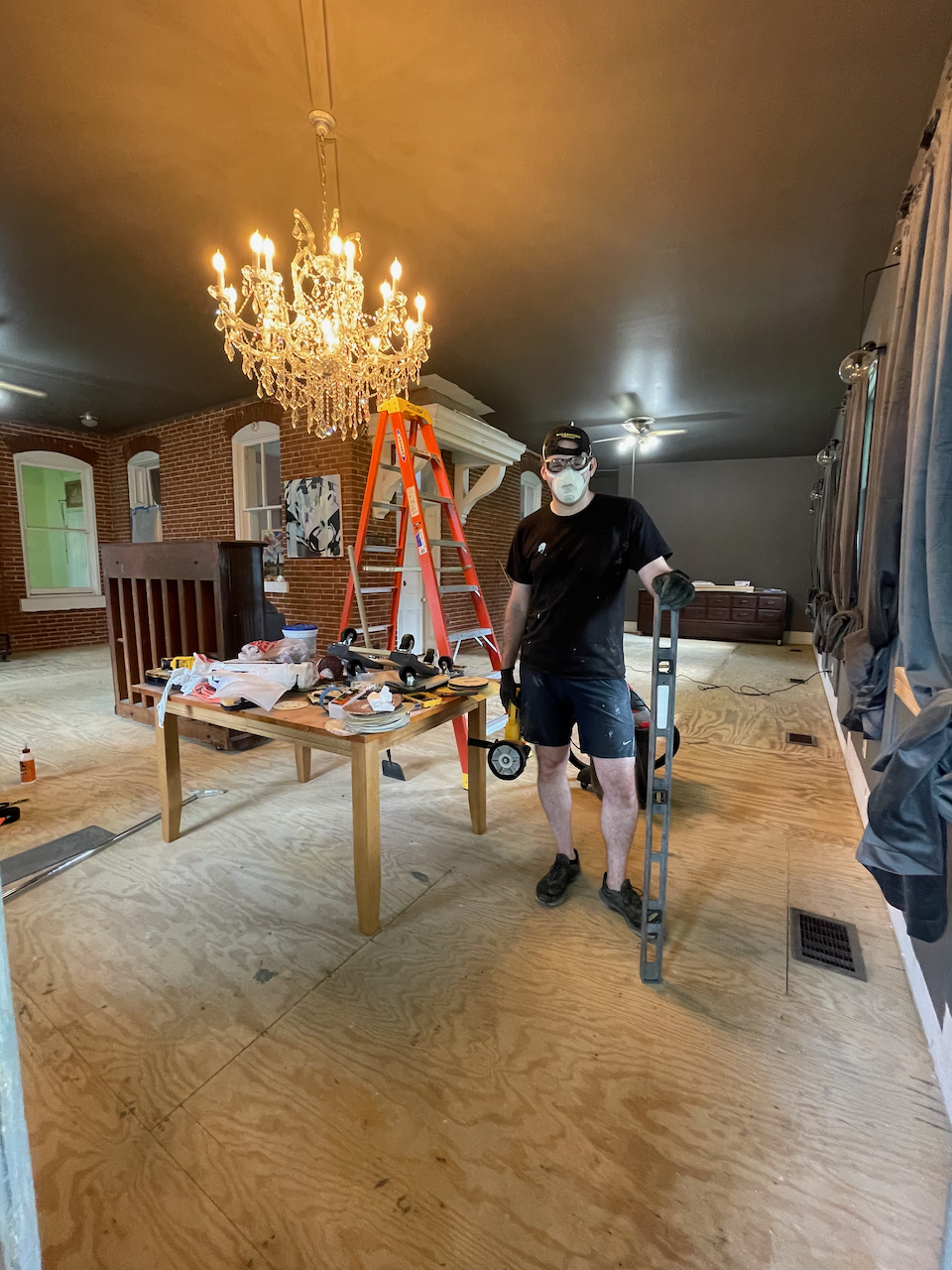
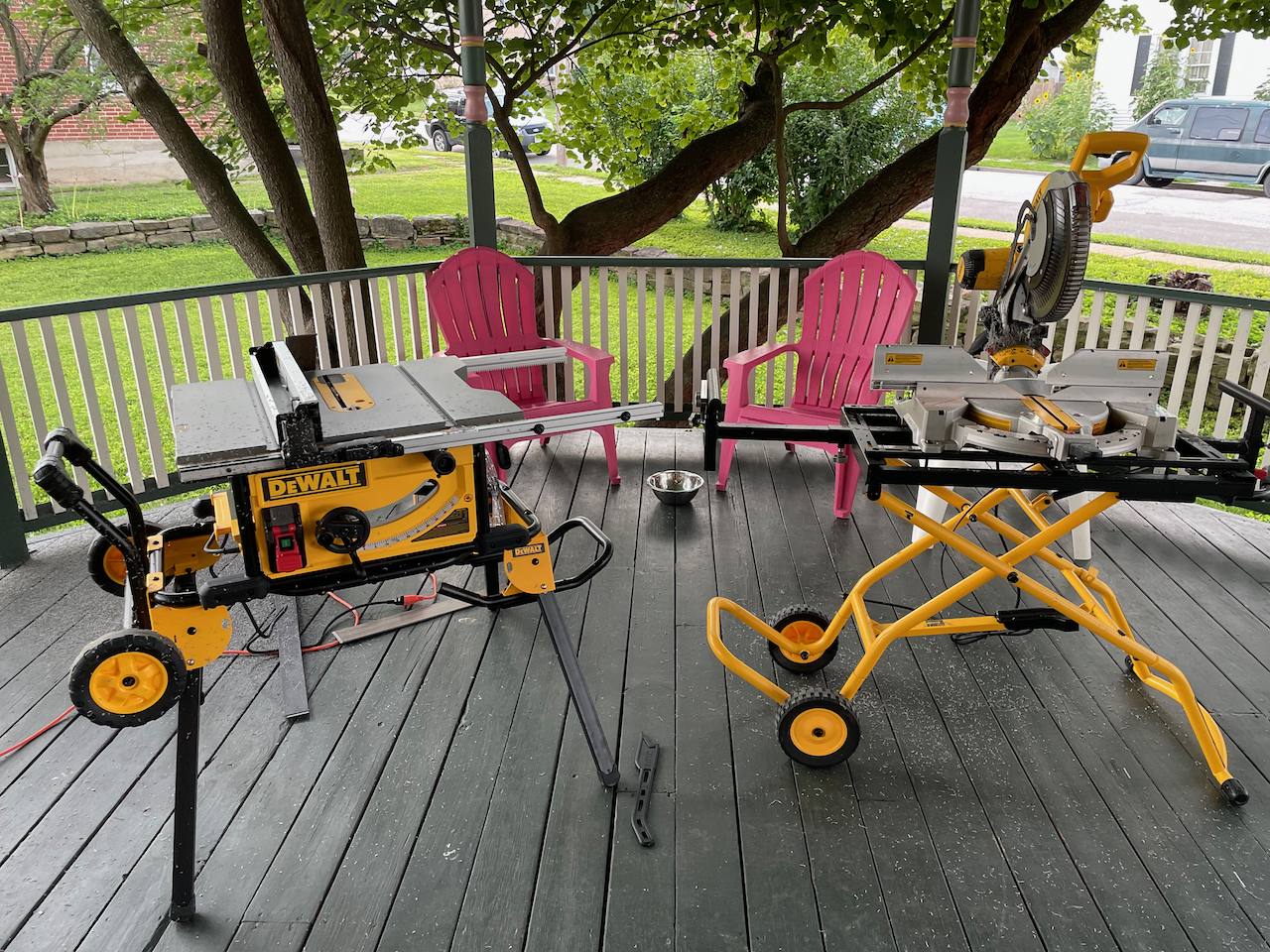
The elevated entry floor and very worn carpet.After removing the entry floor, we discovered there was originally parquet flooring.Baseboards are up and numbered; next is removing the carpet.The mastic from the 1980s carpet was a project itself.Entry floor and carpet removed, next is prepping the subfloor.The Varathane ezV made short order of the mastic.Sanding the perimeterTwo coats on the plinth blocks, base and trim.The floor was mostly level.Prep is done and ready to put down the new floor.Halfway doneDueling sawsThe raised entry required shimming the plinths and base.
Lighting
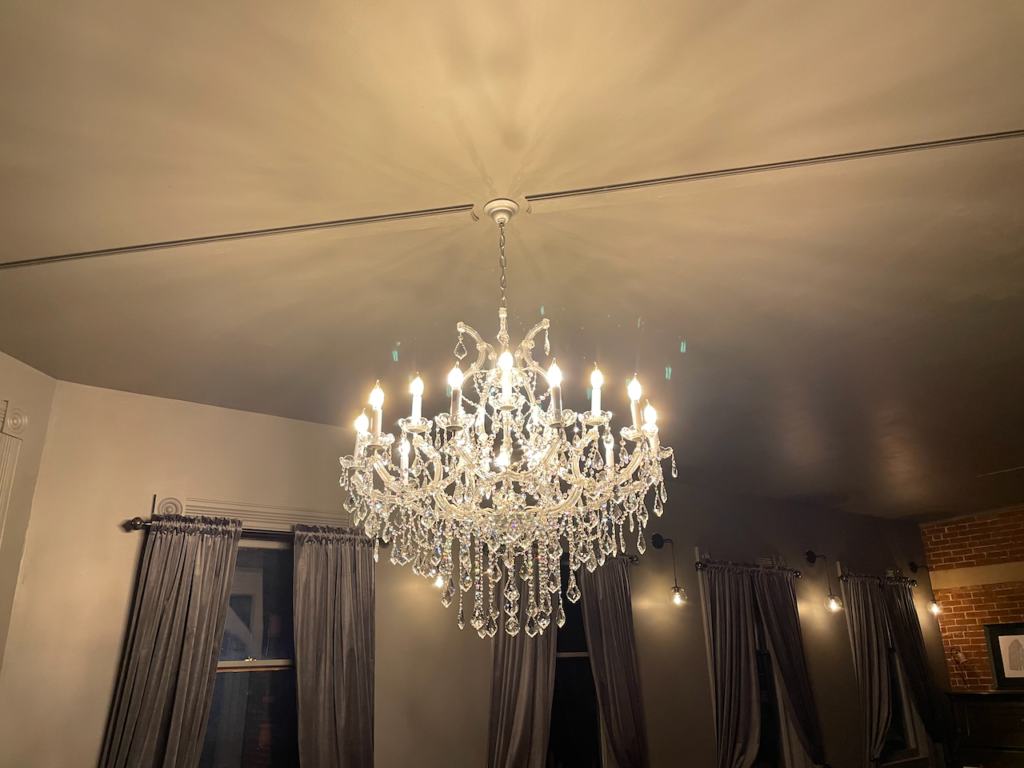
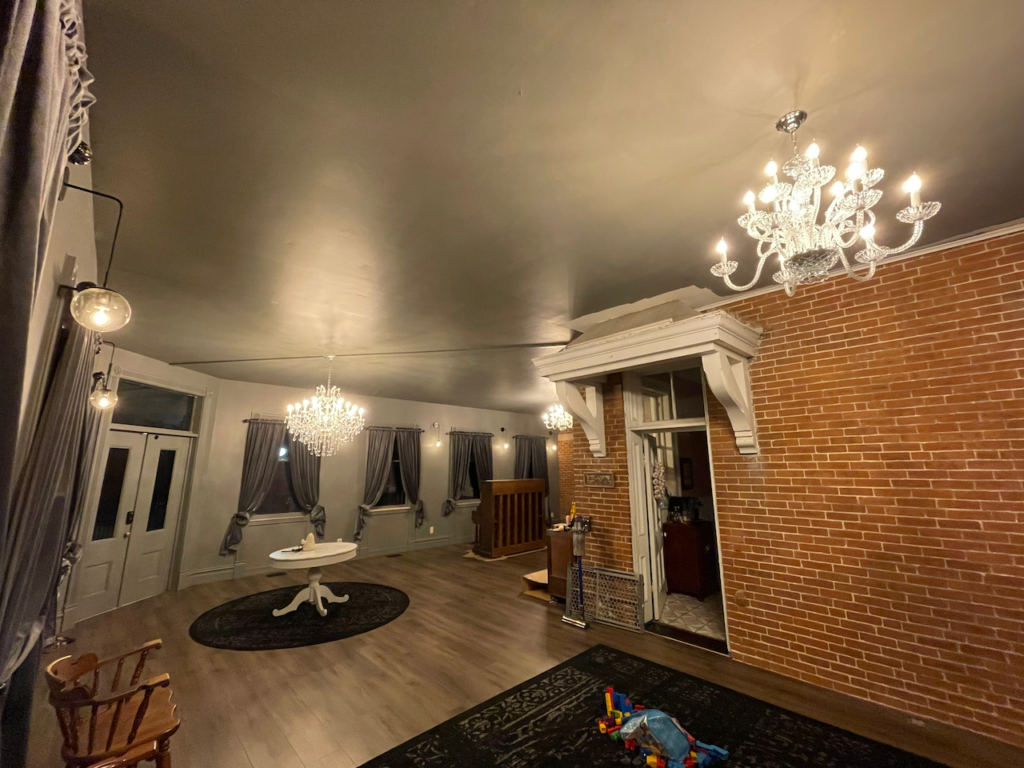
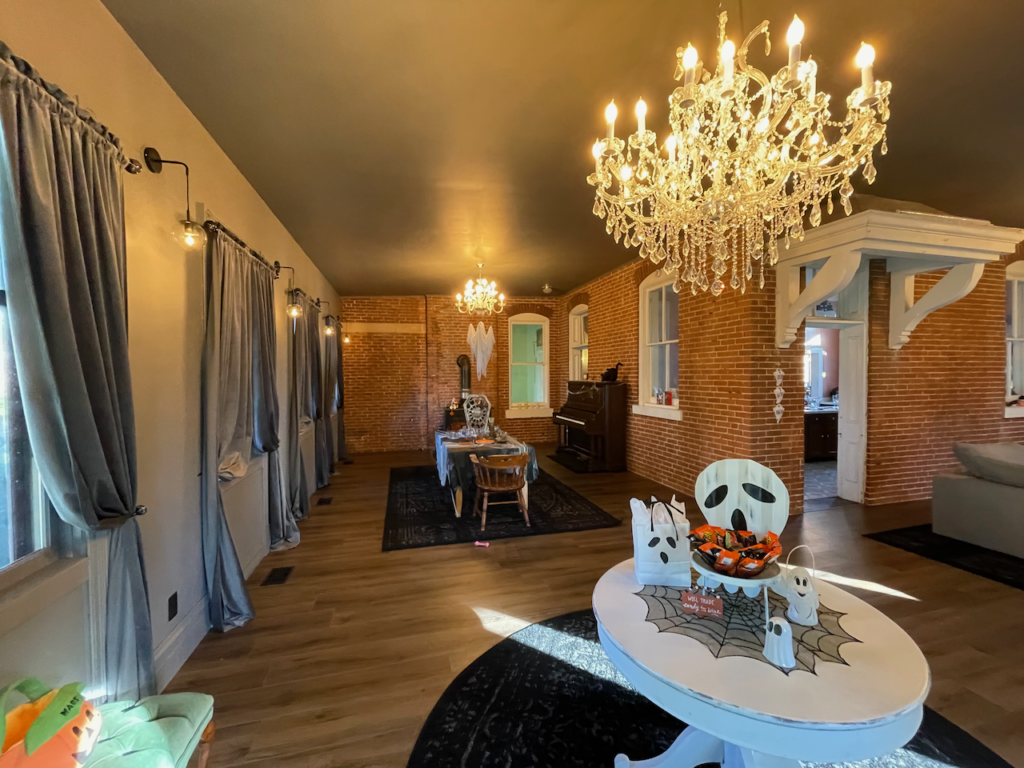
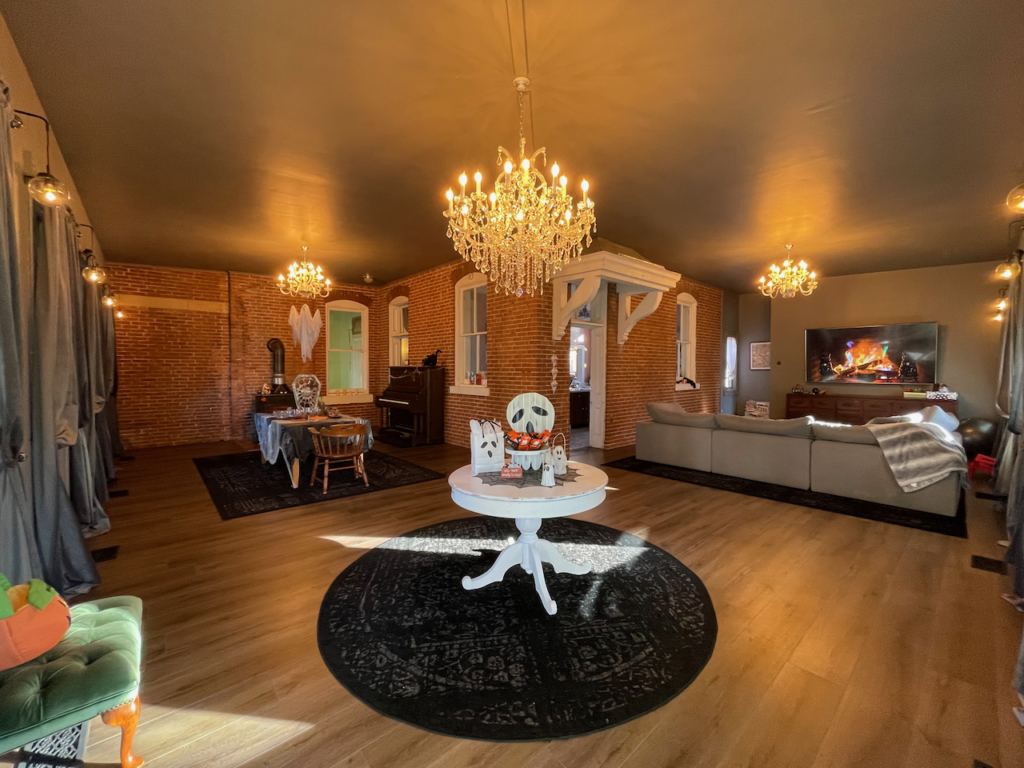
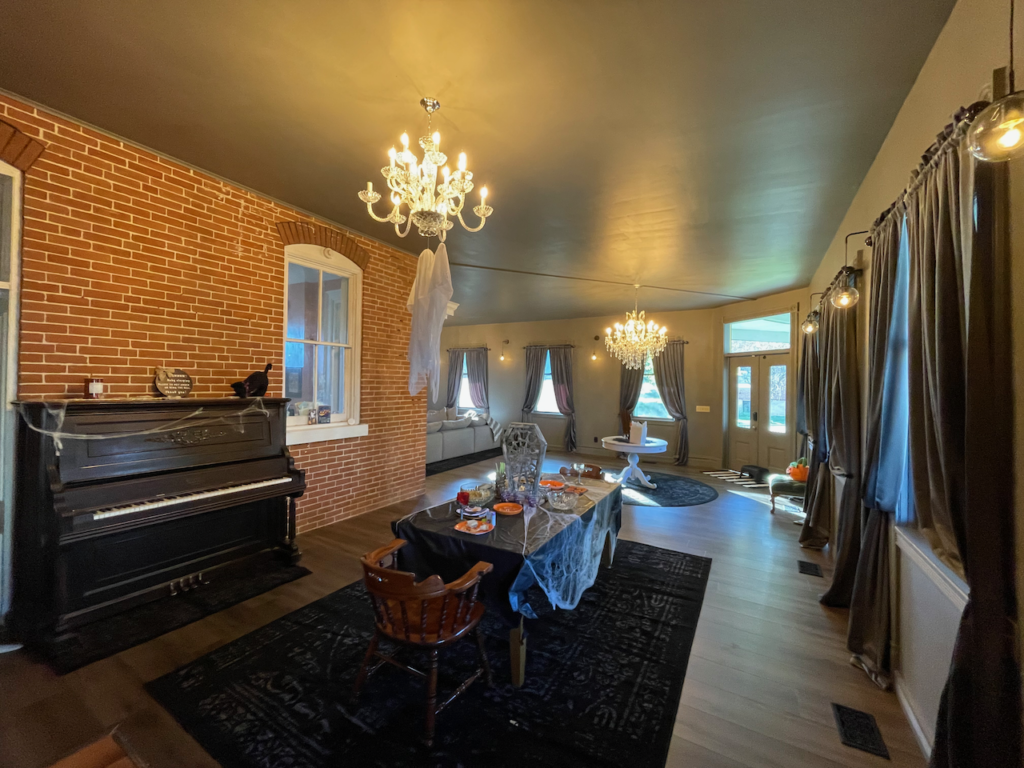
There were three ceiling fans, likely original from the 1980s. We started with the main entry, replacing the fan with a 16-light chandelier.
There were eight outlets near the ceiling that we changed out for sconces. We replaced the other two fans with 12-light chandeliers.
Before moving in furniture, our little guy loved the extra space.
Before & After
Conclusion
Renovating the family room is a project of projects, and we are happy it’s nearly done. Just in time, too, the twins are due in December!